Your Best Interior Design Project Is Not Enough If Nobody Finds You
Imagine this.
You have completed a stunning 3BHK home.
The lighting is perfect.
The furniture is carefully selected.
The kitchen is functional and beautiful.
The photographs look like they belong in a design magazine.
You post the project on Instagram.
You receive likes.
A few people comment:
“Beautiful work!”
But nobody serious calls.
This is one of the biggest problems facing interior designers today.
Great design does not automatically create great business.
A potential client may spend weeks researching interior designers before booking a consultation. They may search Google, browse Instagram, compare portfolios, watch Reels, read reviews and check whether a designer understands their budget and location.
That means the real question is no longer:
“How good is your portfolio?”
It is:
“Can the right client discover, trust and contact you online?”
That is where digital marketing for interior designers becomes a growth strategy—not simply another promotional activity.
Introduction
Interior design is an inherently visual and trust-driven business.
Clients are not purchasing a simple product. They are investing significant money into a space where they will live, work, relax or welcome customers.
Before making that decision, they want answers:
- Can this designer understand my taste?
- Have they completed projects similar to mine?
- Do they work in my city?
- Can they handle my budget?
- What is their process?
- Can I trust them with my home?
- What do previous clients say?
- How quickly can I speak with them?
Digital marketing can help answer these questions before the first phone call.
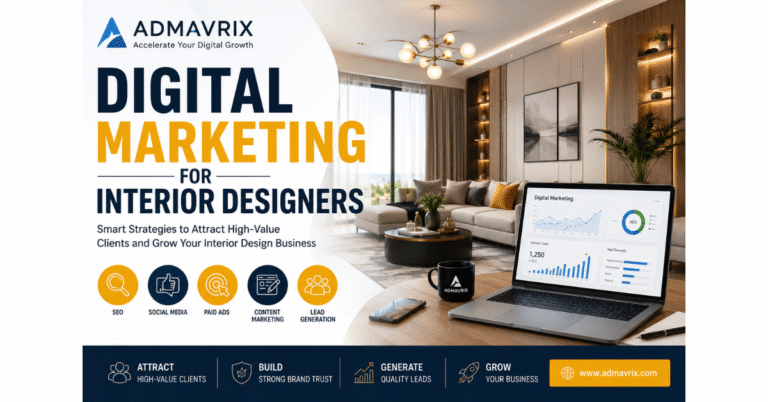
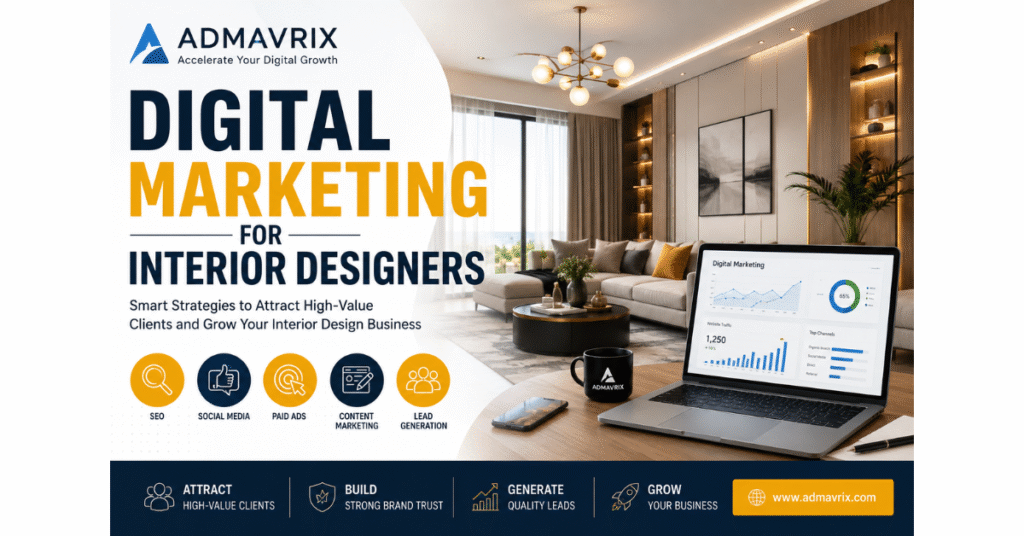
A strong strategy combines SEO, local search, social media, content marketing, paid advertising, portfolio marketing, reviews, landing pages and lead nurturing.
The objective should not simply be to generate more likes or website visitors.
The objective is to build a system that turns:
Visibility → Trust → Enquiry → Consultation → Qualified Opportunity → Client
Current industry guidance increasingly treats interior-design marketing as a complete funnel rather than simply posting on Instagram.
What Is Digital Marketing for Interior Designers?
Digital marketing for interior designers is the strategic use of online channels to attract, educate, convince and convert people who are looking for interior design services.
These channels can include:
- Search engine optimization (SEO)
- Google Search
- Google Business Profile
- YouTube
- Content marketing
- Google Ads
- Meta Ads
- Email marketing
- WhatsApp follow-ups
- Online reviews
- Portfolio websites
- Landing pages
- Remarketing
- Analytics and conversion tracking
But there is an important distinction.
Digital marketing is not simply being active online.
Posting three Instagram images every week is activity.
Building a system that consistently attracts homeowners searching for an interior designer, demonstrates your expertise, qualifies them and turns them into consultations is marketing strategy.
Key Points of Digital Marketing for Interior Designers
A successful interior design marketing strategy should focus on seven core areas:
1. Build a High-Converting Portfolio Website
Your website should do more than display beautiful images.
It should answer:
- Who are you?
- What type of projects do you specialize in?
- Where do you operate?
- What services do you offer?
- What types of properties do you design?
- What makes your studio different?
- How can someone request a consultation?
Every important project should ideally have its own portfolio page.
Instead of:
“Our Projects”
create pages such as:
- Modern 3BHK Interior Design in Bangalore
- Luxury Apartment Interior Design
- Modular Kitchen Design
- Minimalist Living Room Design
- Office Interior Design
- Villa Interior Design
This creates more opportunities to match specific search intent.
2. Use SEO to Capture High-Intent Searches
SEO can help your interior design business appear when potential clients are actively researching services.
Examples include:
- interior designers in Bangalore
- best interior designers in Mumbai
- 3BHK interior designer near me
- luxury interior designer in Hyderabad
- modular kitchen designer in Delhi
- home interior design company in Pune
- office interior designers near me
The strategy should combine service keywords + location + project type + client intent.
Local SEO is particularly important because interior design is usually location-dependent. Industry SEO guides for interior designers also emphasize local search, project-specific pages and content that captures high-intent searches.
3. Turn Instagram Into a Trust-Building Channel
Instagram is naturally suited to interior design because the service is highly visual.
But posting only finished rooms can become repetitive.
Create different content pillars:
Portfolio
- Before and after
- Completed projects
- Room transformations
Education
- Interior design mistakes
- Budget planning
- Material selection
- Lighting tips
- Space optimization
Authority
- Designer opinions
- Design principles
- Material comparisons
- Behind-the-scenes decisions
Trust
- Client testimonials
- Site visits
- Team introductions
- Project progress
Engagement
- “Which living room do you prefer?”
- “Wooden or marble flooring?”
- “Warm or cool lighting?”
The goal is to make potential clients think:
“This designer understands what I want.”
Visual Introduction: What Your Digital Presence Should Communicate
A potential client should be able to understand your positioning within seconds.
Your digital presence should visually communicate:
STYLE + EXPERTISE + TRUST + LOCATION + SERVICE + ACTION
For example:
Luxury Interior Studio | Bangalore
Specializing in Premium 2BHK, 3BHK & Villa Interiors
View Projects → Book Consultation
This is much stronger than simply displaying:
“Welcome to XYZ Interiors.”
Your website and social profiles should make the next step obvious.
Features of an Effective Interior Design Digital Marketing Strategy
Search Engine Optimization
Optimize service pages, project pages, location pages and useful educational content around relevant search intent.
Local SEO
Maintain an accurate Google Business Profile and build genuine reviews from clients.
Social Media Marketing
Use Instagram, Facebook, Pinterest and other relevant visual platforms to showcase expertise and build familiarity.
Paid Advertising
Use Google Ads to capture active searches and Meta Ads to create demand and retarget interested users.
Content Marketing
Publish useful articles answering questions potential clients ask before hiring a designer.
Lead Generation
Use landing pages, enquiry forms, consultation offers and WhatsApp to turn traffic into conversations.
Remarketing
Reconnect with people who visited your website, interacted with your content or previously showed interest.
Analytics
Track enquiries, qualified leads, consultation bookings and actual projects—not only clicks and impressions.
Benefits of Digital Marketing for Interior Designers
1. Reach Clients Beyond Your Referral Network
Referrals are valuable, but they are difficult to predict.
Digital marketing gives your studio another acquisition channel.
2. Build Trust Before the First Meeting
A strong portfolio, reviews, case studies and educational content can reduce uncertainty before a prospect contacts you.
3. Generate More Targeted Leads
Instead of attracting everyone, campaigns can target specific:
- Locations
- Property types
- Services
- Budgets
- Customer segments
4. Build Long-Term Brand Authority
Useful content can continue attracting visitors months after publication.
5. Showcase Your Design Philosophy
Your marketing should communicate not only what you create, but how you think.
6. Measure What Works
Digital channels allow you to track the journey from impression to enquiry and eventually to revenue.
Quick Insights Table
| Digital Channel | Primary Purpose | Best Use |
|---|---|---|
| SEO | Long-term visibility | High-intent searches |
| Google Ads | Immediate search traffic | Ready-to-hire clients |
| Brand + trust | Portfolio and visual storytelling | |
| Reach + retargeting | Local audiences | |
| Inspiration discovery | Design ideas and portfolio | |
| YouTube | Authority | Tours, explanations and case studies |
| Google Business Profile | Local visibility | Local enquiries and reviews |
| Content Marketing | Education | Building expertise |
| Lead nurturing | Faster conversations | |
| Follow-up | Long consideration cycles | |
| Remarketing | Conversion | Re-engaging interested visitors |
Small Case Study: From “Beautiful Work” to a Lead Generation System
Consider a hypothetical interior design studio in Bangalore.
The studio has:
- 30+ completed projects
- Strong photography
- Good client satisfaction
- Instagram followers
- Almost all new clients coming through referrals
The problem?
The studio has no predictable online acquisition system.
Step 1: Positioning
Instead of marketing itself as simply an “interior design company,” it positions itself around:
Premium residential interiors for 2BHK, 3BHK and villas in Bangalore.
Step 2: Website
The studio creates dedicated pages for:
- 2BHK interiors
- 3BHK interiors
- Villa interiors
- Modular kitchens
- Living rooms
- Bangalore locations
Step 3: SEO
It creates useful content around questions such as:
- How much does a 3BHK interior cost?
- How to choose an interior designer?
- Modular kitchen design ideas
- Interior design mistakes homeowners should avoid
Step 4: Instagram
The studio changes from random project posting to structured content:
40% portfolio 30% educational 20% trust/social proof 10% promotional
Step 5: Lead Generation
Google Search Ads target high-intent searches while Meta Ads promote selected project transformations.
Step 6: Follow-Up
Website enquiries are directed to a structured consultation process.
The important lesson is not a particular number of leads.
The lesson is that marketing becomes more powerful when every channel has a defined role in the customer journey.
Deep Explanation: How the Interior Design Marketing Funnel Works
A useful interior design marketing funnel can be divided into five stages.
Stage 1: Discovery
The potential client first discovers your business.
Channels:
- YouTube
- Recommendations
Your objective:
Get noticed.
Stage 2: Consideration
Now the person wants to know whether you are worth considering.
They may:
- Visit your website
- View your portfolio
- Read reviews
- Watch your videos
- Check Instagram
- Compare competitors
Your objective:
Build trust.
Stage 3: Qualification
Not every enquiry is a good lead.
Ask relevant questions:
- Location
- Property type
- Project size
- Design requirements
- Expected timeline
- Approximate budget
Your objective:
Identify genuine opportunities.
Stage 4: Consultation
The prospect speaks with the design team.
Now the quality of your marketing becomes important because expectations have already been established.
Your objective:
Convert interest into a serious project discussion.
Stage 5: Conversion
The prospect receives the proposal and makes a decision.
Your marketing may support this stage through:
- Testimonials
- Case studies
- Portfolio examples
- Process explanations
- FAQs
- Clear communication
This is why generating leads alone is not enough.
A recent analysis of professional-service marketing highlights the same broader principle: increasing lead volume does not automatically increase revenue if the intake and follow-up process is weak.
Real Example: How a Google Search Can Become a Client
Imagine a homeowner searches:
“Best interior designer for 3BHK in Bangalore.”
They find your website.
The landing page immediately shows:
3BHK Interior Design in Bangalore
Then:
- 5 completed 3BHK projects
- Client testimonials
- Project locations
- Design styles
- Process
- FAQs
- Consultation CTA
The visitor does not need to search again to understand what you offer.
They click:
“Book a Design Consultation.”
That is what good digital marketing should accomplish.
It does not force someone to become a customer.
It removes uncertainty from the decision.
SEO Strategy for Interior Designers
Your SEO strategy should have three layers.
Layer 1: Commercial Keywords
These are searches closest to purchasing.
Examples:
- interior designers in Bangalore
- interior design company in Bangalore
- luxury interior designers
- home interior designers near me
- office interior designers
- modular kitchen designers
Layer 2: Project-Based Keywords
Examples:
- 2BHK interior design
- 3BHK interior design
- villa interior design
- apartment interior design
- small home interior design
- office interior design
Layer 3: Informational Keywords
Examples:
- interior design cost
- how to choose an interior designer
- interior design mistakes
- best materials for modular kitchen
- modern living room ideas
- home interior design checklist
This creates a content ecosystem that can attract people at different stages of the buying journey.
Google’s own SEO guidance recommends using language that searchers are likely to use while also creating useful, well-organized and unique content.
Social Media Strategy for Interior Designers
A strong Instagram strategy should not look like a catalogue.
Instead of:
“Beautiful living room design.”
Try:
“This 3BHK living room looked smaller than it actually was. Here are 3 design decisions we used to make it feel more spacious.”
Now the post provides:
Visual + Story + Expertise + Education.
That combination is more powerful than a beautiful image alone.
Content Ideas
- Before vs after transformation
- Designer reacts to common design mistakes
- 3 things to consider before renovating
- Cost breakdown of a room
- Site visit vlog
- Material comparison
- Lighting mistakes
- Small-space solutions
- Client walkthrough
- “Why we designed it this way”
- Designer’s choice vs client’s first choice
- Project timeline
- Behind-the-scenes installation
Google Ads for Interior Designers
Google Ads can be particularly useful because it captures people already searching for services.
For example:
“interior designers near me”
has different intent from:
“living room colour ideas.”
The first search is closer to a commercial decision.
A practical Google Ads structure could separate campaigns by:
- Location
- Service
- Project type
- High-intent keywords
Landing pages should match the search.
If someone searches for “3BHK interior designer in Bangalore,” sending them to a generic homepage creates unnecessary friction.
A dedicated 3BHK landing page is usually a stronger experience.
Meta Ads for Interior Designers
Instagram and Facebook advertising can be useful for creating awareness and retargeting.
Strong creatives can include:
Creative 1: Before & After
“From empty apartment to finished home.”
Creative 2: Problem/Solution
“Your living room feels small? These 3 design decisions can change it.”
Creative 3: Portfolio
“A modern 3BHK designed for a growing family.”
Creative 4: Lead Generation
“Planning your home interiors? Book a consultation.”
The creative should sell the outcome, not simply the service.
Trends in Digital Marketing for Interior Designers in 2026
1. Portfolio Content Is Becoming More Story-Driven
A single finished-room photograph is useful.
A story explaining the client’s problem, design decision and final result is more persuasive.
2. Short-Form Video Is Becoming a Core Discovery Format
Reels and short videos can demonstrate transformations, processes and expertise quickly.
3. Local Search Remains Critical
Interior design is usually geographically constrained, making local visibility especially valuable.
4. Case Studies Are Becoming More Important
Instead of saying:
“We create beautiful interiors.”
show:
Client → Challenge → Strategy → Design → Result
5. AI Is Supporting Marketing Workflows
AI can assist with:
- Content ideation
- Research
- First drafts
- Ad variations
- Customer segmentation
- Reporting
- Creative concepts
But AI should support expertise rather than replace genuine project experience.
6. Conversion Matters More Than Vanity Metrics
10,000 views are not automatically better than 500 views.
If those 500 views generate qualified consultation requests, they may be commercially more valuable.
Common Digital Marketing Mistakes Interior Designers Make
Mistake 1: Posting Only Finished Projects
Beautiful portfolios matter, but they don’t answer every client question.
Mistake 2: Chasing Followers Instead of Leads
Follower growth can be useful, but business growth depends on qualified opportunities and conversions.
Mistake 3: Ignoring Local SEO
If your business serves Bangalore, your digital strategy should clearly communicate Bangalore.
Mistake 4: Using One Generic Website Page
Different services and project types deserve relevant landing pages.
Mistake 5: Sending Every Ad to the Homepage
Match the landing page to the user’s search or ad.
Mistake 6: Not Showing Reviews
Interior design is trust-heavy. Social proof matters.
Mistake 7: Responding Slowly to Enquiries
A marketing campaign can generate the enquiry, but poor follow-up can lose it.
Mistake 8: Using Stock Images Instead of Real Work
Your actual projects are your strongest marketing assets.
Mistake 9: Keyword Stuffing
Repeating “digital marketing for interior designers” unnaturally can make content worse.
Mistake 10: No Measurement
If you don’t track enquiries and conversions, you cannot confidently identify your best marketing channel.
Pro Tips for Interior Design Marketing
Tip 1: Sell the Transformation
Don’t only show:
“Beautiful kitchen.”
Show:
“How we transformed an awkward kitchen into a functional family space.”
Tip 2: Create Location Pages Carefully
If you genuinely serve multiple locations, create useful location-specific pages rather than duplicate pages with city names swapped.
Tip 3: Build a Project Library
Every major project can become:
- Portfolio page
- Instagram Reel
- Carousel
- Case study
- YouTube video
- Pinterest content
- Blog article
One project can fuel an entire content ecosystem.
Tip 4: Use Client Questions as Content Ideas
Every question your sales team receives can potentially become content.
Tip 5: Track Revenue, Not Just Traffic
The most important question isn’t:
“How many people visited the website?”
It is:
“How many qualified opportunities did our marketing create?”
Step-by-Step Guide: Build Your Interior Design Digital Marketing Strategy
Step 1: Define Your Ideal Client
Decide:
- Residential or commercial?
- Budget range?
- Property type?
- Location?
- Design style?
- New construction or renovation?
Step 2: Define Your Positioning
Answer:
Why should someone choose your studio instead of another designer?
Step 3: Build Your Website
Create:
- Homepage
- About
- Services
- Portfolio
- Individual project pages
- Locations
- Testimonials
- Blog
- Contact page
Step 4: Set Up Local SEO
Optimize your Google Business Profile and maintain consistent business information across relevant platforms.
Step 5: Build Your Keyword Map
Group keywords by:
Service + Location + Project Type + Intent
Step 6: Create Content
Publish:
- Project case studies
- Design guides
- Cost-related articles
- Mistake guides
- Material comparisons
- Location-specific content
Step 7: Build Your Social Media Engine
Create recurring content pillars:
Portfolio + Education + Authority + Trust + Engagement
Step 8: Launch Paid Campaigns
Test:
- Google Search Ads
- Meta Ads
- Remarketing
Step 9: Create a Lead Qualification Process
Collect information such as:
- Name
- Phone
- Location
- Property type
- Project requirements
- Timeline
- Approximate budget
Step 10: Track the Funnel
Monitor:
Traffic → Leads → Qualified Leads → Consultations → Proposals → Projects
That is the real marketing dashboard.
Expert Quote
Google Search Central’s guidance is clear:
“The content is helpful, reliable, and people-first.”
For interior designers, that principle is especially important.
Your content should not exist merely because you want another keyword-ranked page.
It should help a potential client make a better decision.
FAQ: Digital Marketing for Interior Designers
1. Why is digital marketing important for interior designers?
Digital marketing helps interior designers become discoverable online, showcase their portfolio, establish trust and generate qualified enquiries through channels such as SEO, social media, Google Ads and content marketing.
2. What is the best digital marketing strategy for interior designers?
There is no single channel that works for every studio. A strong strategy generally combines local SEO, a conversion-focused website, visual content, social media, search advertising, reviews and structured lead follow-up.
3. Is SEO useful for interior designers?
Yes. SEO can help interior designers attract people actively searching for services, locations and project-specific solutions. Local SEO is particularly relevant because most interior design services are location-based.
4. How can interior designers get leads from Instagram?
Interior designers can use portfolio content, Reels, educational posts, testimonials, before-and-after transformations and targeted advertising to attract potential clients. Every promotional post should include a clear next step.
5. Should interior designers use Google Ads?
Google Ads can be useful when targeting high-intent searches such as people looking for interior designers in a specific city or for a particular project type.
6. How often should an interior designer post on Instagram?
Consistency matters more than an arbitrary posting number. A studio should establish a sustainable schedule that allows it to maintain quality while covering portfolio, educational, authority and trust content.
7. What keywords should interior designers target?
Keywords should reflect the actual services and markets served. Examples include “interior designers in Bangalore,” “3BHK interior design,” “luxury interior designers,” “modular kitchen designers” and other relevant service-location combinations.
8. How long does SEO take for an interior design business?
SEO is a long-term strategy. Results vary based on competition, website quality, authority, location, content quality and the strength of the existing domain. Businesses should evaluate progress through visibility, qualified traffic and conversions rather than expecting an instant result.
9. Should interior designers use paid ads and SEO together?
Yes. SEO can build long-term organic visibility while paid advertising can provide faster access to high-intent audiences. Using both can create a more balanced acquisition strategy.
10. What should an interior design website include?
At minimum, it should clearly communicate services, portfolio, locations served, testimonials, project examples, contact information and an obvious consultation or enquiry CTA.
Future Outlook: Where Interior Design Marketing Is Heading
The future of interior design marketing will not be about simply producing more content.
It will be about producing better evidence of expertise.
Potential clients will increasingly expect to see:
- Real project stories
- Transparent processes
- Strong visual portfolios
- Genuine client experiences
- Location expertise
- Clear service positioning
- Educational content
- Fast communication
- Consistent digital experiences
Search is also becoming more sophisticated.
That makes shallow, repetitive content less useful and increases the importance of content that demonstrates experience, expertise and original insight. Google’s current guidance specifically encourages original analysis, comprehensive coverage and content created primarily to help people.
For interior designers, this creates an opportunity.
Your completed projects are not just portfolio pieces.
They are marketing assets.
One successful project can become a case study, Reel, carousel, blog, video, testimonial, Pinterest post and website portfolio page.
The designers who build systems around their expertise will have a stronger advantage than those who simply post occasionally.
Conclusion
Interior design is a visual business.
But digital marketing for interior designers is not only about making that business look beautiful online.
It is about making the business:
Discoverable. Credible. Memorable. Accessible. And easy to choose.
A beautiful portfolio can attract attention.
A strong digital marketing strategy can turn that attention into business.
The winning approach is not to chase every platform or trend.
Instead, build a connected system:
SEO brings discovery.
Social media builds familiarity.
Content demonstrates expertise.
Reviews build trust.
Paid advertising accelerates reach.
Landing pages convert interest.
Lead qualification improves quality.
Follow-up turns enquiries into opportunities.
And measurement tells you what is actually producing results.
For an interior design studio that wants predictable growth, that is the real value of digital marketing.
Ready to Turn Your Interior Design Expertise Into a Lead-Generating Brand?
Your next client could already be searching for an interior designer online.
The question is:
Will they find you—or your competitor?
At Admavrix, we help businesses build digital marketing strategies designed around visibility, credibility, lead generation and measurable growth.
From SEO and content marketing to social media, paid advertising and conversion-focused websites, the goal is simple:
Put your business in front of the right audience and turn attention into opportunities.
Ready to grow your interior design business online? Connect with Admavrix and build a digital strategy around your business goals.