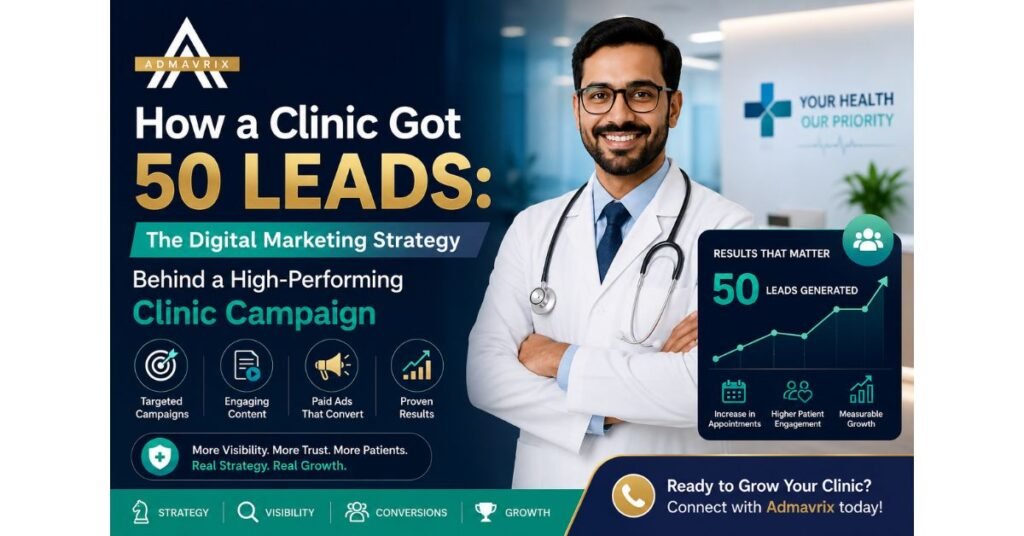
50 Leads Didn’t Come From Posting More. They Came From Fixing the Funnel.
A clinic can have excellent doctors, modern facilities and satisfied patients—and still struggle to generate new enquiries.
Why?
Because being good at healthcare and being easy to find online are two different things.
Imagine a potential patient searching Google for a clinic.
They don’t know your brand.
They don’t know your doctors.
They don’t know how good your service is.
They simply have a need and are looking for someone they can trust.
They may search Google, check the clinic’s location, look at reviews, visit Instagram, compare websites and finally decide whether to call or submit an enquiry.
Now imagine a clinic that previously received only occasional enquiries.
Instead of simply increasing its advertising budget, the marketing team rebuilt the entire journey:
Search → Landing Page → Trust → Enquiry → Follow-Up
The result in this illustrative campaign scenario?
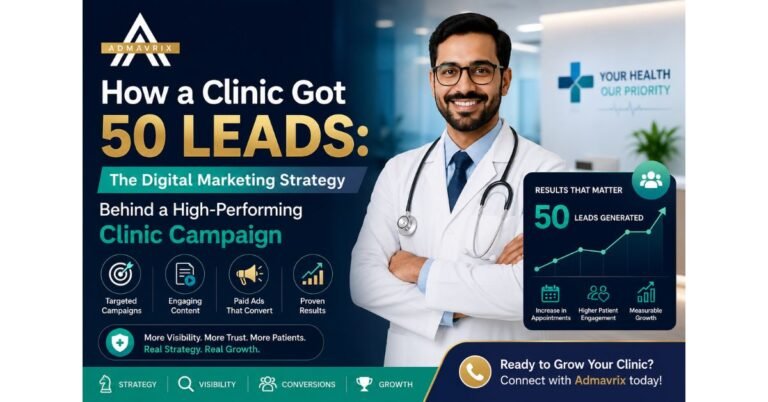
50 leads.
The important lesson isn’t the number 50.
The lesson is how the marketing system was designed to make those enquiries possible.
Introduction
Healthcare marketing is different from marketing many other businesses.
A person choosing a clinic is making a decision that can involve trust, location, expertise, convenience, reputation and cost.
That means a clinic’s digital presence needs to answer important questions quickly:
- What services does the clinic provide?
- Where is it located?
- Who are the doctors?
- What makes the clinic different?
- How can a patient contact the clinic?
- Is the clinic easy to reach?
- What do existing patients say?
- What happens after I enquire?
This is why effective digital marketing for clinics should not be treated as simply posting on social media or running advertisements.
It should be treated as a patient acquisition system.
The objective is to connect the right audience with the right service, provide useful information, establish trust and make the next action simple.
What Does “50 Leads” Actually Mean?
Before celebrating 50 leads, a clinic needs to define what a lead means.
A lead could be:
- A phone enquiry
- Website form submission
- WhatsApp enquiry
- Consultation request
- Appointment request
- Callback request
- Booking enquiry
But not every lead has equal value.
For example:
50 enquiries ≠ 50 appointments
and:
50 appointments ≠ 50 new patients
This distinction is critical.
A strong clinic marketing campaign should track the entire funnel:
Impressions → Clicks → Leads → Qualified Leads → Appointments → Patients
That gives the clinic a much clearer understanding of marketing performance.
Key Points Behind a 50-Lead Clinic Campaign
A high-performing clinic lead generation campaign usually depends on several connected elements.
1. Clear Service Positioning
The campaign needs to communicate exactly what the clinic offers.
2. Local Search Visibility
Patients often search for healthcare services based on location.
3. Strong Landing Pages
Advertising traffic needs somewhere relevant to go.
4. Trust Signals
Doctor profiles, credentials, reviews, facilities and transparent information can reduce uncertainty.
5. Targeted Advertising
Campaigns should reach relevant audiences without relying on vague targeting.
6. Strong Call-to-Action
The patient should immediately understand what to do next.
7. Fast Follow-Up
A lead is valuable only if someone actually responds to it.
8. Measurement
The clinic needs to know which channels are producing genuine opportunities.
Visual Introduction: The 50-Lead Funnel
Think of the campaign as a simple funnel:
1000s of people see the clinic
↓
Hundreds discover the website or social profile
↓
Dozens show genuine interest
↓
50 submit enquiries
↓
Qualified leads are identified
↓
Appointments are scheduled
↓
Patients visit the clinic
The marketing team’s job is not simply to increase the number at the top.
It is to improve the movement between each stage.
Features of a Strong Clinic Digital Marketing Strategy
Local SEO
Local SEO helps a clinic become more visible when people search for healthcare services in a specific area.
Important elements include:
- Google Business Profile
- Accurate clinic information
- Location-specific website content
- Service pages
- Patient reviews
- Consistent business information
- Local content
Search Advertising
Search advertising can help clinics reach people actively looking for a relevant service.
For example:
“dental clinic near me”
has very different intent from:
“how to maintain healthy teeth.”
The first search can indicate stronger commercial intent.
Social Media Marketing
Social media can help clinics demonstrate expertise, introduce doctors, answer general questions and build familiarity.
Content Marketing
Useful articles and educational content can help answer questions patients commonly have before contacting a clinic.
Landing Pages
Each campaign should ideally direct users to a relevant page rather than automatically sending everyone to the homepage.
Lead Management
Every enquiry should enter a clear process so the clinic knows:
- Where it came from
- What service it relates to
- Whether it is qualified
- Whether contact was successful
- Whether an appointment was booked
Benefits of a Structured Clinic Lead Generation Strategy
More Relevant Enquiries
Better targeting and messaging can reduce irrelevant traffic.
Better Patient Experience
A clear digital journey makes it easier for people to find information and contact the clinic.
Stronger Brand Trust
Consistent information, professional presentation and genuine reviews can support credibility.
Better Marketing Decisions
Tracking allows the clinic to understand which campaigns are producing results.
More Predictable Growth
A structured acquisition system can reduce complete dependence on referrals.
Better Return on Marketing Investment
When campaigns are measured against qualified leads and appointments, budgets can be optimized more intelligently.
Quick Insights Table
| Marketing Element | Main Purpose | What to Measure |
|---|---|---|
| Local SEO | Local visibility | Calls, searches, website actions |
| Google Ads | Capture high-intent demand | Leads, cost per lead |
| Social Media | Awareness and trust | Reach, engagement, enquiries |
| Website | Educate and convert | Conversion rate |
| Landing Page | Campaign conversion | Form submissions |
| Reviews | Build credibility | Review volume and quality |
| Content Marketing | Answer patient questions | Organic traffic |
| Lead communication | Response and appointment rate | |
| CRM/Lead Sheet | Track prospects | Qualified leads |
| Analytics | Measure performance | Funnel conversion |
Small Case Study: How the Clinic Reached 50 Leads
Note: The following is an illustrative case-study model designed to explain how a clinic could achieve 50 leads. Replace the figures with verified campaign data if you are publishing this as a real Admavrix client case study.
Consider a multi-specialty clinic operating in a competitive urban market.
The clinic had a good reputation offline but inconsistent online enquiries.
Its marketing problem wasn’t necessarily a lack of demand.
The bigger problem was that the existing digital journey was fragmented.
The clinic had:
- A basic website
- Social media accounts
- Some organic visibility
- Existing patient reviews
- Occasional paid advertising
But there was no connected lead-generation strategy.
The objective
The marketing team established a clear goal:
Generate 50 relevant enquiries while improving the quality of incoming leads.
Instead of running one generic campaign, they created a multi-stage strategy.
Deep Explanation: The Strategy Behind the 50 Leads
Step 1: Identify the Highest-Value Service
The clinic began by identifying which service it wanted to grow.
This is important.
Marketing:
“We provide healthcare services.”
is too broad.
A stronger approach is:
“We help people looking for [specific service] in [specific location].”
This creates clearer messaging.
Step 2: Understand Patient Search Intent
The marketing team mapped different types of searches.
High-Intent Searches
Examples:
- clinic near me
- specialist clinic in [location]
- [service] clinic near me
- best [service] clinic
- book consultation [service]
Informational Searches
Examples:
- what is [condition]
- symptoms of [condition]
- when should I see a specialist
- how does [procedure] work
The campaign prioritized commercial intent for lead generation while using educational content to build long-term visibility.
Step 3: Improve the Clinic’s Website
The website became the central conversion point.
The service page included:
- Clear headline
- Service explanation
- Doctor information
- Clinic location
- Operating hours
- FAQs
- Trust elements
- Contact options
- Appointment CTA
The purpose wasn’t to make the page complicated.
It was to remove uncertainty.
Step 4: Build a Dedicated Landing Page
Instead of sending every advertisement to the homepage, the campaign created a dedicated landing page.
For example:
Looking for [Service] in [City]?
Then immediately:
- Explain the service
- Introduce the clinic
- Show relevant credentials
- Explain the next step
- Provide contact options
The page ends with a clear CTA:
Request a Consultation
or:
Book an Appointment
The landing page should not overwhelm the visitor with unnecessary information.
Step 5: Launch Search Campaigns
Search advertising was used to capture people already looking for relevant services.
The strategy separated keywords into tightly related groups.
For example:
Campaign: Dental Services
- dental clinic near me
- dentist in [location]
- dental consultation
- dental clinic [location]
Campaign: Specific Service
- [service] specialist
- [service] clinic
- [service] consultation
This structure makes it easier to align:
Keyword → Advertisement → Landing Page
Step 6: Build Social Media Trust
The clinic didn’t use social media only for promotional offers.
Content included:
- Doctor introductions
- Clinic walkthroughs
- General health education
- FAQs
- Patient experience stories where appropriately consented
- Facility information
- Behind-the-scenes content
- Myth vs fact posts
- General wellness information
The objective was simple:
Make the clinic feel credible before the patient makes contact.
Step 7: Strengthen Local SEO
The clinic’s Google Business Profile became an important part of the strategy.
The team focused on:
- Accurate information
- Correct categories
- Services
- Location
- Working hours
- Photos
- Genuine reviews
- Regular updates
For a local clinic, being discoverable when someone searches nearby can be extremely valuable.
Step 8: Create a Lead Follow-Up Process
This is where many campaigns fail.
Suppose the campaign generates 50 enquiries.
If the clinic responds slowly, the marketing campaign can still underperform.
A basic process could be:
Lead received
↓
Contact within a defined response window
↓
Understand requirement
↓
Confirm suitable service
↓
Offer available appointment
↓
Record outcome
↓
Follow up where appropriate
Marketing creates the opportunity.
Operations convert the opportunity.
Step 9: Measure the Real Numbers
The campaign dashboard should not stop at leads.
For example:
| Funnel Stage | Example Result |
|---|---|
| Ad impressions | 25,000 |
| Website visits | 1,200 |
| Enquiries | 50 |
| Qualified leads | 38 |
| Appointments booked | 24 |
| Completed appointments | 19 |
These numbers are illustrative.
The important point is that lead volume is only one part of performance.
A campaign generating 50 poor-quality leads can be less valuable than a campaign generating 30 highly qualified leads.
Real Example / Case Study Framework for Admavrix
If Admavrix has an actual clinic client with verified data, use this format instead of fictional numbers:
Client
[Clinic Name] — [City]
Challenge
The clinic was receiving inconsistent online enquiries and relied heavily on referrals.
Objective
Generate qualified leads for [specific service].
Strategy
- Local SEO
- Google Ads
- Meta Ads
- Landing page optimization
- Content marketing
- Lead tracking
- Follow-up system
Campaign Period
[X weeks/months]
Results
- 50 leads
- X qualified leads
- X appointments
- ₹X cost per lead
- X% landing-page conversion rate
Key Learning
The strongest result came from connecting advertising, landing pages and follow-up instead of treating each channel independently.
This format gives the case study much more credibility because every number can be verified.
Trends in Clinic Digital Marketing
1. Search Is Becoming More Conversational
People increasingly search using longer and more specific questions.
Instead of:
“dentist”
a user may search:
“best dental clinic for a consultation near me.”
This makes useful, specific content increasingly important.
Google’s guidance for AI search experiences continues to emphasize unique, valuable content that satisfies users rather than content created simply to attract search traffic.
2. Local Visibility Remains Important
For clinics, location can be one of the strongest elements of search intent.
A person usually wants healthcare that is accessible to them.
Therefore:
Service + Location
can be a powerful SEO combination.
3. Video Builds Familiarity
Short videos can help introduce:
- Doctors
- Facilities
- Services
- General educational topics
- Clinic culture
The objective should be education and trust—not exaggerated medical promises.
4. First-Party Lead Data Is Becoming More Valuable
Clinics should maintain organized records of enquiries, appointment outcomes and campaign sources while respecting applicable privacy and healthcare requirements.
5. Compliance Is Part of Marketing Strategy
Healthcare advertising requires additional care.
Google classifies health-related content as a sensitive interest category and restricts certain forms of personalized advertising.
For example, advertisers should not build campaigns around sensitive personal health information in ways prohibited by platform policies.
Google also maintains specific healthcare and medicines advertising requirements, including country-specific rules.
Therefore, clinic marketing should always balance:
Performance + Patient Trust + Privacy + Advertising Compliance
Common Mistakes Clinics Make With Digital Marketing
Mistake 1: Running Ads Without a Landing Page Strategy
Sending every visitor to the homepage can reduce relevance.
Mistake 2: Focusing Only on Lead Quantity
50 leads sound impressive.
But what if only 5 are relevant?
Always track lead quality.
Mistake 3: Using Aggressive Medical Claims
Healthcare marketing should avoid misleading promises or guaranteed outcomes.
Mistake 4: Ignoring Local SEO
A clinic can spend money on advertising while missing valuable local visibility.
Mistake 5: No Follow-Up System
A lead without follow-up is a missed opportunity.
Mistake 6: Posting Only Promotional Content
Patients also need education and reassurance.
Mistake 7: Hiding Important Information
Make location, contact details, services and appointment information easy to find.
Mistake 8: No Conversion Tracking
Without tracking, it becomes difficult to determine which campaigns actually generate business outcomes.
Mistake 9: Buying Fake Reviews
Fake reviews can damage trust and create serious reputational problems.
Mistake 10: Copying Competitor Content
Google’s current guidance emphasizes original, useful and people-first content rather than content created primarily for rankings.
Pro Tips for Generating More Clinic Leads
1. Start With One Strong Service
Don’t advertise everything simultaneously.
Find the service with the strongest commercial opportunity and build a focused campaign.
2. Create Location-Specific Pages
If the clinic genuinely serves multiple locations, create genuinely useful pages rather than duplicating the same content and changing only the city name.
3. Use Real Expertise
Doctor interviews, professional explanations and original clinic insights can create stronger content than generic AI-written articles.
4. Make the CTA Simple
Use actions such as:
Book Appointment
Request a Consultation
Call the Clinic
Send an Enquiry
5. Track Every Lead Source
Know whether the enquiry came from:
- Organic search
- Referral
- Website
- Other channels
6. Improve Response Time
A high-quality lead can lose interest if nobody responds.
7. Optimize Based on Quality
Don’t automatically move the budget toward the campaign with the cheapest leads.
Move budget toward the campaign producing the best qualified outcomes.
Expert Quote
Google Search Central’s current guidance says:
“Google’s automated ranking systems are designed to prioritize helpful, reliable information that’s created to benefit people.”
For healthcare marketing, this principle is especially important.
A clinic should not create content simply because a keyword has search volume.
It should create content because a real patient may find the answer useful.
Step-by-Step Guide: How to Build a 50-Lead Clinic Campaign
Step 1: Choose the Target Service
Select one specific service or patient segment.
Step 2: Define the Location
Identify the geographic area the clinic can realistically serve.
Step 3: Research Search Intent
Find out what potential patients search before contacting the clinic.
Step 4: Build the Landing Page
Create a page that matches the service and campaign.
Step 5: Add Trust Signals
Include legitimate:
- Doctor credentials
- Clinic information
- Reviews
- Facilities
- Certifications where applicable
- Clear contact details
Step 6: Launch Search Campaigns
Target relevant commercial-intent searches while following applicable healthcare advertising policies.
Step 7: Build Supporting Social Content
Create educational and trust-building content.
Step 8: Strengthen Local SEO
Optimize the Google Business Profile and local website presence.
Step 9: Track Leads
Record:
Source → Service → Lead → Qualification → Appointment → Outcome
Step 10: Improve the Funnel
After collecting enough data, identify where prospects are dropping off.
For example:
If traffic is high but leads are low:
Improve the landing page.
If leads are high but appointments are low:
Improve qualification and follow-up.
If appointments are high but attendance is low:
Improve reminders and patient communication.
This is how a lead-generation campaign becomes a growth system.
FAQ Section
1. How can a clinic generate 50 leads?
A clinic can work toward 50 leads by combining local SEO, targeted search advertising, social media, strong landing pages, relevant content and a structured lead follow-up process. The exact number of leads will depend on the clinic, service, location, competition, budget and conversion rate.
2. What is the best marketing strategy for a clinic?
There is no single strategy that works for every clinic. A strong starting point is usually a combination of local SEO, a conversion-focused website, relevant content, search advertising and consistent lead management.
3. How much does it cost to generate clinic leads?
There is no universal cost per lead. It depends on the healthcare service, location, competition, advertising platform, landing-page conversion rate and lead quality.
4. Are Google Ads effective for clinics?
Google Ads can be effective for capturing relevant search demand, but healthcare advertisers must comply with Google’s healthcare and personalized advertising policies.
5. Is SEO important for healthcare clinics?
Yes. SEO can help clinics build organic visibility for relevant services and location-based searches. However, healthcare content should prioritize accuracy, trust and usefulness.
6. Should a clinic use Instagram for marketing?
Instagram can support awareness, education and trust, particularly when clinics use professional video, doctor introductions, general educational content and facility information.
7. What is a qualified clinic lead?
A qualified lead is an enquiry that matches the clinic’s target service and practical criteria such as location, requirement and potential appointment intent.
8. Why are clinic leads not converting into appointments?
Possible reasons include slow follow-up, poor lead quality, unclear service positioning, weak communication, inconvenient appointment options or a landing page that creates uncertainty.
9. Should clinics focus on leads or appointments?
Clinics should monitor both. Leads measure marketing response, while appointments provide a stronger indication of whether those leads are moving toward actual business outcomes.
10. How long does clinic SEO take?
SEO is a long-term process. Results vary based on competition, website quality, authority, location, content quality and technical performance. There is no guaranteed timeline.
Future Outlook: The Next Stage of Healthcare Marketing
The future of clinic marketing will not simply be about spending more money on advertising.
It will be about creating a better digital patient journey.
Patients will increasingly expect clinics to provide:
- Easy-to-find information
- Professional websites
- Clear service explanations
- Convenient contact options
- Strong local visibility
- Useful educational content
- Trustworthy reviews
- Fast communication
- Consistent information across platforms
At the same time, healthcare marketers will need to pay greater attention to privacy, advertising restrictions and responsible communication.
Google’s current advertising policies already treat health-related information as a sensitive category for personalized advertising, making responsible targeting an important part of healthcare campaign planning.
AI search is also changing how people discover information.
That makes generic content less valuable and increases the importance of original expertise, useful explanations and satisfying answers. Google has specifically advised site owners to focus on unique, valuable content as search evolves toward AI experiences.
The clinics that win will not necessarily be the ones that post the most.
They will be the ones that build the strongest connection between:
Search → Information → Trust → Enquiry → Appointment → Patient Experience
Conclusion
Getting 50 leads is not about finding a magic advertisement.
It is about building a system.
A clinic needs to be visible when people search.
It needs to communicate its services clearly.
It needs to establish trust.
It needs to provide a relevant landing page.
It needs to make contacting the clinic easy.
And most importantly, it needs to follow up when the enquiry arrives.
That is the difference between:
“We ran a marketing campaign.”
and:
“We built a patient acquisition system.”
The illustrative 50-lead campaign demonstrates an important principle:
Better marketing isn’t always about reaching more people. It’s about making the right people take the right next step.
For clinics looking to grow sustainably, the goal should not simply be more leads.
The goal should be:
More relevant leads → More appointments → Better patient experience → Sustainable growth.
Want Your Clinic to Generate More Qualified Leads?
Your next patient may already be searching for the service you provide.
The question is:
Can they find your clinic when they’re ready to take action?
At Admavrix, we help businesses build digital growth strategies around:
- SEO
- Local SEO
- Google Ads
- Social Media Marketing
- Content Marketing
- Landing Page Optimization
- Lead Generation
- Analytics & Conversion Tracking
We don’t believe in chasing clicks just to make a report look good.
We focus on building a measurable journey from:
Visibility → Enquiries → Qualified Leads → Business Growth
Ready to build a stronger digital presence for your clinic?
Connect with Admavrix and create a healthcare marketing strategy built around your clinic’s goals.