A small business can have excellent products, quality services, and a professional website—but still struggle to attract consistent customers.
Why?
Because having a website is not the same as being visible online.
Potential customers are constantly searching for solutions:
- How to get more customers online
- Which service is right for their business
- How much a product or service costs
- Which company they should trust
- How to solve a specific problem
If your website does not provide useful answers, another business will.
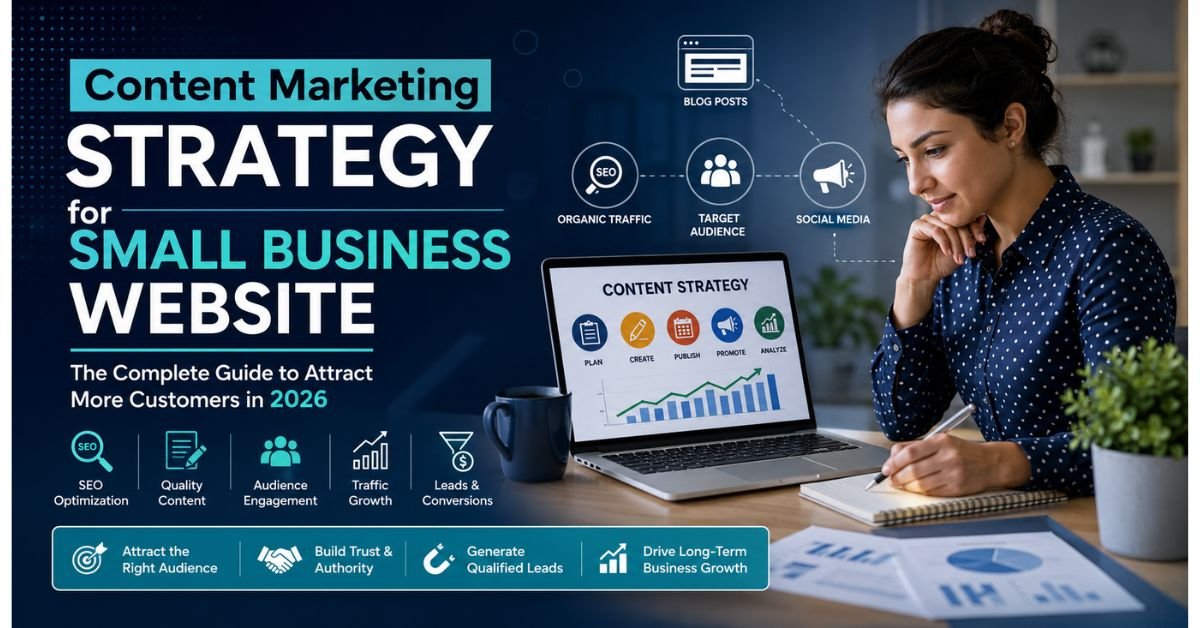
This is why a content marketing strategy for a small business website is no longer optional for businesses that want to build sustainable online visibility.
The right strategy can help your business:
- Attract organic website traffic
- Build authority in your industry
- Answer customer questions
- Generate qualified leads
- Support sales conversations
- Reduce dependence on paid advertising
But effective content marketing is not about publishing random blog posts every week.
It is about creating the right content for the right audience at the right stage of the customer journey.
Introduction
Small businesses often face a difficult marketing challenge.
They need more customers, but they may have:
- Limited marketing budgets
- Small teams
- Strong competition
- Limited brand awareness
- Difficulty ranking on Google
- Dependence on referrals or paid advertising
Content marketing provides a practical way to build long-term digital visibility.
A well-planned small business content strategy can transform a website from a simple online brochure into a valuable business growth asset.
For example, a potential customer may discover your business through a blog post. They may then read a related guide, visit your service page, review your case studies, and eventually contact your business.
This entire journey can begin with one useful piece of content.
In this guide, we explain how to build a practical content marketing strategy for a small business website, including keyword research, content planning, topic clusters, SEO, distribution, measurement, common mistakes, and future trends.
What Is a Content Marketing Strategy for a Small Business Website?
A content marketing strategy for a small business website is a structured plan for creating, publishing, optimizing, distributing, and measuring content that attracts a specific target audience and supports business objectives.
It answers important questions such as:
- Who is your target audience?
- What problems do they have?
- What do they search for online?
- What content should you create?
- Which keywords should you target?
- How should content be distributed?
- How will you measure success?
A simple definition is:
A content marketing strategy for a small business website is a planned approach to creating and distributing useful content that attracts potential customers, improves search visibility, builds trust, and supports business growth.
The key difference between content marketing and random blogging is strategy.
A blog post may attract traffic.
A service page may generate leads.
A case study may build trust.
A comparison article may help a customer make a decision.
Together, these different content formats create a complete marketing system.
Key Points of a Successful Small Business Content Strategy
A strong content marketing strategy should include the following elements:
1. Clear Business Objectives
Your content should support a specific goal.
Examples:
- Increase organic traffic
- Generate more leads
- Build brand authority
- Promote a service
- Improve product visibility
- Increase email subscribers
2. Defined Target Audience
You need to understand who you are creating content for.
3. Keyword Research
Identify the terms and questions your audience searches for.
4. Search Intent
Understand what the user expects to find when searching.
5. Content Pillars
Organize your content around important business topics.
6. Content Calendar
Create a consistent publishing plan.
7. SEO Optimization
Optimize content for search engines while keeping it useful for people.
8. Content Distribution
Promote your content across relevant channels.
9. Performance Tracking
Measure traffic, rankings, leads, and conversions.
Visual Introduction: How Content Marketing Supports Business Growth
Customer Problem
        ↓
Google Search
        ↓
Helpful Blog Content
        ↓
Website Visit
        ↓
Related Content
        ↓
Service Page
        ↓
Trust & Consideration
        ↓
Lead or Customer
A successful content strategy connects every stage of this journey.
The purpose is not simply to attract visitors.
The purpose is to attract relevant visitors who may eventually become customers.
Features of an Effective Website Content Strategy
Audience-Focused Content
Your content should be created around your audience’s problems and questions.
Instead of asking:
What do we want to write about?
Ask:
What does our potential customer need help with?
This simple change can significantly improve content quality.
Search-Optimized Content
SEO helps search engines understand your content and helps potential customers discover it.
Important SEO elements include:
- Keyword targeting
- Search intent
- Clear headings
- Internal linking
- Descriptive URLs
- Meta titles
- Meta descriptions
- Image optimization
Topic Clusters
Instead of publishing unrelated articles, organize content around connected topics.
For example:
Main Topic: Content Marketing Strategy for Small Business Website
Supporting topics:
- Content Plan for Small Business
- Content Calendar for Small Business
- Content Marketing Examples
- Content Marketing ROI
- Small Business SEO Strategy
This creates a stronger website structure.
Multiple Content Formats
Content marketing is not limited to blogs.
A single article can be converted into:
- Social media posts
- Videos
- Carousels
- Infographics
- Email newsletters
- Guides
- Checklists
This allows businesses to reach audiences across different channels.
Benefits of Content Marketing for Small Businesses
1. Increases Organic Traffic
People search online before making many purchasing decisions.
A useful article can help your business appear when potential customers are searching for relevant information.
2. Builds Brand Authority
Regularly publishing useful content can demonstrate expertise and knowledge.
3. Generates Qualified Leads
Content can attract people who are actively looking for solutions related to your products or services.
4. Supports Customer Decisions
Comparison articles, guides, case studies, and FAQs can help customers feel more confident.
5. Creates Long-Term Marketing Assets
A useful article can continue attracting visitors long after publication.
6. Supports Other Marketing Channels
Content can be repurposed for:
- Email marketing
- YouTube
- Online communities
7. Reduces Dependence on Paid Traffic
Paid advertising can deliver immediate visibility, while content can contribute to long-term organic growth.
The most effective strategy often combines both.
Quick Insights Table
| Content Marketing Element | Purpose | Business Benefit |
|---|---|---|
| Keyword Research | Find customer searches | Better topic selection |
| Blog Content | Answer questions | Organic traffic |
| Service Pages | Explain offers | Lead generation |
| Case Studies | Show results | Build trust |
| Internal Links | Connect content | Better navigation |
| Content Calendar | Plan publishing | Consistency |
| Social Promotion | Distribute content | More reach |
| Analytics | Measure results | Better decisions |
Small Case Study: Turning One Topic Into a Content Cluster
Imagine a small digital marketing agency wants to attract more small business clients.
Instead of publishing unrelated articles, it creates one main topic:
Pillar Page:
Content Marketing Strategy for Small Business Website
Then it creates supporting content:
- How to Create a Content Plan for a Small Business
- Content Calendar for Small Business
- SEO for Small Business Websites
- Content Marketing Examples
- How to Measure Content Marketing ROI
Each supporting article links to the main pillar page.
The result is a connected content system.
This approach allows the business to:
- Cover related customer questions
- Build topical relevance
- Improve internal linking
- Create multiple traffic opportunities
- Guide visitors toward relevant services
The lesson is simple:
A connected content system is more powerful than a collection of unrelated blog posts.
Deep Explanation: How to Build a Content Marketing Strategy
Step 1: Define Your Business Goal
Start with the outcome you want.
For example:
Increase qualified leads from organic search.
This goal influences the type of content you create.
If your goal is brand awareness, you may focus on educational content.
If your goal is lead generation, you need more commercial content and strong conversion paths.
Step 2: Define Your Ideal Customer
Create a clear picture of your target customer.
Consider:
- Industry
- Location
- Business size
- Budget
- Problems
- Goals
- Buying behaviour
For example:
Target Customer: Small Business Owner
- Wants more customers
- Has a limited marketing budget
- Does not understand SEO
- Wants measurable results
- Searches Google for marketing solutions
Your content should address these specific needs.
Step 3: Research Customer Problems
The best content topics usually come from real customer questions.
Examples:
- Why is my website not getting traffic?
- How much does digital marketing cost?
- Should I use SEO or Google Ads?
- How can I get more leads online?
- How often should I publish blog posts?
Each question can become a valuable content opportunity.
Step 4: Research Keywords
Keyword research helps identify how people search for information.
For this topic, relevant keywords include:
Primary Keyword
content marketing strategy for small business website
Secondary Keywords
- content marketing for small business
- small business content strategy
- website content strategy
- content plan for small business
- content calendar for small business
- content marketing examples
Long-Tail Keywords
- how to create a content marketing strategy for a small business
- how often should a small business publish blog posts
- how to increase website traffic with content marketing
- best content marketing strategy for small businesses
Commercial Keywords
- content marketing services for small business
- small business content marketing agency
- content marketing consultant for small business
The strongest content strategy uses a combination of informational and commercial keywords.
Step 5: Organize Content Into Pillars
Choose the main topics your business wants to be known for.
For a digital marketing business, these may include:
- SEO
- Content Marketing
- Google Ads
- Social Media Marketing
- Website Marketing
- Lead Generation
Then create supporting content around each pillar.
Step 6: Create a Content Calendar
Plan your content in advance.
A simple monthly plan could include:
| Week | Content |
|---|---|
| Week 1 | Educational Blog |
| Week 2 | Case Study |
| Week 3 | Comparison Article |
| Week 4 | Practical Checklist |
Consistency is more important than publishing a large amount of content at once.
Step 7: Optimize Content for SEO
Before publishing, optimize:
- SEO title
- URL
- Meta description
- H1
- H2 and H3 headings
- Image alt text
- Internal links
- Related keywords
However, avoid forcing the same keyword into every sentence.
The content should sound natural.
Step 8: Promote Your Content
Publishing is only one part of content marketing.
Promote your article through:
- Industry communities
- Relevant partnerships
One article can become multiple pieces of content.
Step 9: Measure Performance
Track:
- Organic clicks
- Impressions
- CTR
- Keyword rankings
- Organic traffic
- Leads
- Conversions
A high-traffic article is not always a successful article.
The most valuable content attracts the right audience and contributes to business growth.
Real Example: One Blog Can Become 10 Marketing Assets
Imagine you publish:
How to Create a Content Marketing Strategy for a Small Business Website
You can turn it into:
- LinkedIn post
- Instagram carousel
- Facebook post
- Short video
- X thread
- Email newsletter
- Infographic
- Checklist
- Quora answer
- Sales conversation resource
This approach increases the value of every article you create.
Content Marketing Trends in 2026
AI-Assisted Content Workflows
AI can support:
- Topic research
- Content outlines
- Content repurposing
- Data analysis
- Content updates
However, businesses still need human expertise, original insights, fact-checking, and editorial judgment.
Search Beyond Traditional Keywords
Users increasingly search through:
- Voice assistants
- AI tools
- Social platforms
- Video platforms
Businesses should create content that answers real questions clearly.
First-Hand Experience
Generic content is easy to create.
Original examples, data, opinions, case studies, and practical experience can make content more valuable.
Content Refreshing
Updating existing content will become increasingly important.
Businesses should regularly review:
- Outdated information
- Old statistics
- Broken links
- Declining rankings
- New customer questions
Short-Form Content Distribution
Long-form content can be repurposed into short videos, social posts, and visual content.
This creates multiple opportunities to reach potential customers.
Common Content Marketing Mistakes
Publishing Random Topics
A website should have a clear content structure.
Focusing Only on Search Volume
High search volume does not always mean high business value.
Ignoring Search Intent
The content must answer what the searcher actually wants.
Keyword Stuffing
Repeating a keyword excessively can make content unnatural.
Ignoring Existing Content
Old content may have untapped ranking potential.
Publishing Without Promotion
Even high-quality content needs distribution.
No Internal Linking
Unconnected articles create a poor content structure.
No Conversion Path
A visitor should have a relevant next step.
Pro Tips for a Better Small Business Content Strategy
Tip 1: Start With Customer Questions
Your best content ideas may already be coming from your customers.
Tip 2: Focus on Specific Problems
Specific topics often attract more relevant audiences.
Tip 3: Build Topic Clusters
Connect related content together.
Tip 4: Update Existing Articles
Improving old content can be faster than starting from zero.
Tip 5: Create Original Examples
Practical examples make content more useful.
Tip 6: Add Clear Calls to Action
Tell the visitor what to do next.
Tip 7: Track Business Results
Traffic is useful, but leads and revenue matter more.
Step-by-Step Guide: Create Your Content Strategy in 7 Days
Day 1: Define Your Audience
Write down your ideal customer and their biggest problems.
Day 2: Identify Business Goals
Choose whether you want traffic, leads, awareness, or sales.
Day 3: Research Keywords
Find relevant keywords based on customer questions and search intent.
Day 4: Create Content Pillars
Organize your topics into 3–6 main categories.
Day 5: Build a Content Calendar
Plan the next 30–90 days of content.
Day 6: Create and Optimize Content
Write useful content and optimize it for users and search engines.
Day 7: Create a Promotion Plan
Decide where and how you will distribute the content.
Frequently Asked Questions
What is a content marketing strategy for a small business website?
A content marketing strategy for a small business website is a structured plan for creating, optimizing, publishing, and promoting content that attracts potential customers, improves online visibility, builds trust, and supports business growth.
Why is content marketing important for small businesses?
Content marketing helps small businesses attract organic traffic, build authority, answer customer questions, generate leads, and create long-term digital assets.
How often should a small business publish blog posts?
Many small businesses can begin with two to four high-quality blog posts per month. However, quality, relevance, and consistency are more important than publishing as frequently as possible.
Does content marketing work for local businesses?
Yes. Content marketing for local businesses can help improve search visibility, answer customer questions, build trust, and attract people searching for relevant products and services.
How long does content marketing take to generate results?
Results depend on competition, website authority, content quality, keyword targeting, and promotion. Some content may gain visibility quickly, while meaningful organic growth usually requires consistent effort over time.
What should a small business content plan include?
A content plan should include business objectives, target audience, keywords, content pillars, content formats, publishing dates, distribution channels, and performance metrics.
How can content marketing increase website traffic?
Content marketing can increase website traffic by creating useful pages that target relevant search queries and by distributing those pages across other marketing channels.

Future Outlook: The Future of Small Business Content Marketing
The future of content marketing will be increasingly focused on:
- Real expertise
- Original insights
- First-hand experience
- Helpful content
- Multi-channel distribution
- AI-assisted workflows
- Personalization
- Search visibility across multiple platforms
Small businesses will not necessarily need to publish the most content.
They will need to publish the most useful content for their specific audience.
The businesses that understand their customers, create genuinely helpful content, and consistently improve their digital presence will have a stronger opportunity to build long-term visibility.
Conclusion
A successful content marketing strategy for a small business website is not about publishing hundreds of random blog posts.
It is about building a strategic content system.
The most effective approach combines:
- Audience research
- Keyword research
- Search intent
- Topic clusters
- Helpful content
- SEO optimization
- Internal linking
- Content promotion
- Performance measurement
Your website should not simply exist online.
It should answer customer questions, demonstrate your expertise, attract relevant visitors, and guide potential customers toward taking action.
Start with your audience.
Understand their problems.
Create content that solves those problems.
Then optimize, promote, measure, and improve.
That is how content marketing can become a long-term growth channel for a small business.
Ready to turn your website content into a growth engine?
At Admavrix, we help businesses build strategic digital marketing systems that combine content, SEO, paid advertising, social media, and data-driven marketing to improve online visibility and generate meaningful business opportunities.
Whether you are launching a new website or trying to increase traffic to an existing one, a strategic content marketing approach can help you attract the right audience and move closer to your business goals.
Build smarter. Market better. Grow with Admavrix.
Expert Quotes
“Content is the atomic particle of all digital marketing.” — Rebecca Lieb
“Marketing is no longer about the stuff that you make, but about the stories you tell.” — Seth Godin
“Content marketing is the gap between what brands produce and what consumers actually want.” — Michael Brenner