Artificial Intelligence is no longer just a productivity tool—it has become a competitive advantage for marketers. From creating SEO-optimized blog posts to running marketing campaigns, AI assistants are transforming how businesses attract, engage, and convert customers.
But one question remains:
Which AI assistant should marketers choose in 2026—ChatGPT, Gemini, or Claude?
Each platform offers unique strengths, but choosing the wrong one could slow your workflow and reduce your marketing efficiency. This guide compares all three AI models to help you make the right decision.
Introduction
The rapid growth of artificial intelligence has completely reshaped digital marketing. Content creation, keyword research, campaign planning, email marketing, customer support, and data analysis can now be completed in minutes instead of hours.
Among today’s leading AI assistants, ChatGPT, Gemini, and Claude stand out as the most popular choices for marketers. While they share similar capabilities, each excels in different areas.
This comparison explains their features, strengths, weaknesses, and ideal use cases so you can select the AI platform that best fits your marketing goals.
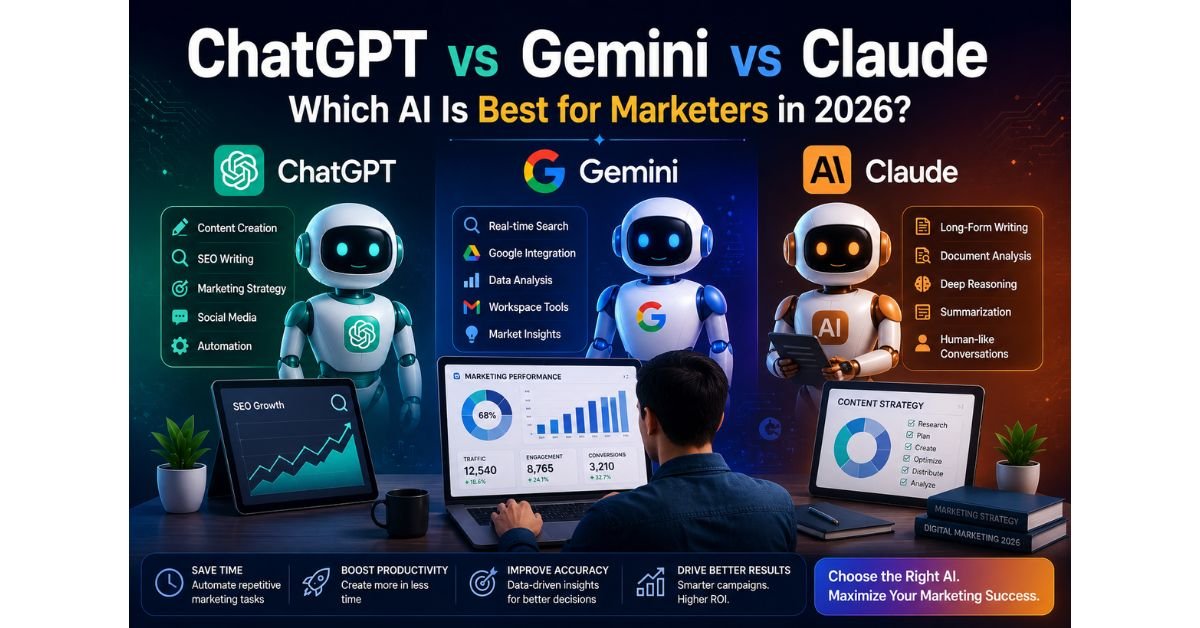
What Is ChatGPT vs Gemini vs Claude?
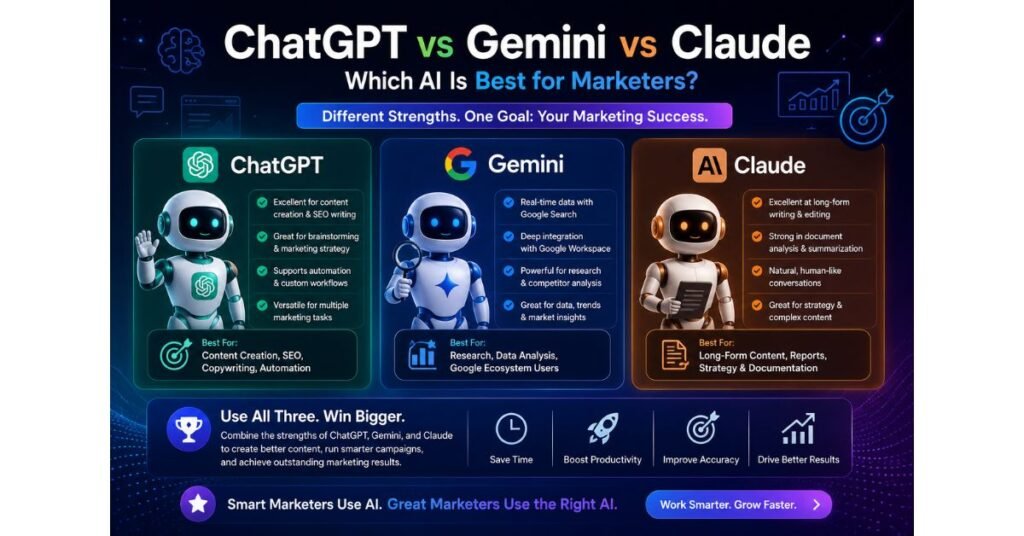
ChatGPT is OpenAI’s conversational AI, widely used for content writing, coding, brainstorming, SEO, and business automation.
Gemini, developed by Google, integrates deeply with Google Search, Workspace, Gmail, Docs, and other Google products, making it especially useful for research and productivity.
Claude, created by Anthropic, focuses on natural writing, long-form content, reasoning, and document analysis, making it a preferred option for handling extensive reports and strategic planning.
Although all three use advanced language models, their strengths differ depending on the marketing task.
Key Points
- ChatGPT is excellent for content creation and SEO.
- Gemini integrates seamlessly with Google’s ecosystem.
- Claude excels at analyzing long documents and producing natural writing.
- All three support marketing automation and productivity.
- Choosing the right AI depends on your business objectives.
Visual Introduction
| AI Tool | Best For | Ideal Users |
|---|---|---|
| ChatGPT | SEO, Content Creation, Automation | Content Marketers, Agencies |
| Gemini | Google Workspace & Research | SEO Specialists, Google Users |
| Claude | Long Documents & Strategy | Business Consultants, Copywriters |
Features Comparison
1. ChatGPT
Key Features
- High-quality content generation
- SEO article writing
- Marketing strategy creation
- Coding assistance
- Campaign planning
- Image generation support
- Workflow automation
- Custom GPTs for specialized tasks
Best For
- Blog writing
- Landing pages
- Email campaigns
- Social media content
- Keyword clustering
- Marketing automation
2. Google Gemini
Key Features
- Real-time Google Search integration
- Google Docs and Gmail support
- Strong data research
- Google Maps integration
- YouTube insights
- Spreadsheet assistance
- Google Workspace productivity
Best For
- Market research
- Competitor analysis
- Data collection
- Research-heavy SEO projects
3. Claude
Key Features
- Exceptional long-form writing
- Large document analysis
- Strategic planning
- Research summarization
- Human-like responses
- Context retention
Best For
- Whitepapers
- Business reports
- Content editing
- Brand messaging
- Documentation
Benefits for Digital Marketers
ChatGPT
✔ Produces SEO-friendly content quickly
✔ Generates social media captions
✔ Creates marketing funnels
✔ Saves content production time
✔ Supports brainstorming and ideation
Gemini
✔ Accesses up-to-date information through Google services
✔ Simplifies research tasks
✔ Improves productivity within Google Workspace
✔ Helps verify facts during content creation
Claude
✔ Creates polished long-form content
✔ Summarizes complex documents
✔ Maintains consistent writing quality
✔ Handles extensive context effectively
Quick Insights Table
| Feature | ChatGPT | Gemini | Claude |
|---|---|---|---|
| SEO Writing | Excellent | Very Good | Very Good |
| Content Creation | Excellent | Good | Excellent |
| Keyword Research | Very Good | Excellent | Good |
| Market Research | Good | Excellent | Very Good |
| Long-Form Writing | Excellent | Good | Excellent |
| Document Analysis | Very Good | Good | Excellent |
| Coding Assistance | Excellent | Very Good | Good |
| Google Workspace Integration | Limited | Excellent | Limited |
| Creative Brainstorming | Excellent | Very Good | Excellent |
| Marketing Strategy | Excellent | Very Good | Excellent |
| Email Copywriting | Excellent | Good | Excellent |
| Ease of Use | Excellent | Very Good | Excellent |
| Best For | Content Marketing & SEO | Research & Google Ecosystem | Long-Form Content & Business Documentation |
Deep Explanation: Which AI Performs Better for Marketing?
For most digital marketers, no single AI tool is perfect for every task.
ChatGPT shines in creating engaging blog posts, SEO content, ad copy, email campaigns, and social media content. Its versatility makes it an all-in-one assistant for agencies and businesses managing multiple marketing channels.
Gemini stands out when research and Google ecosystem integration are essential. If your workflow depends on Google Docs, Gmail, Sheets, or Search, Gemini can streamline your daily operations and improve collaboration.
Claude is particularly effective for handling large documents, refining content, and producing polished, professional writing. Its ability to maintain context over lengthy conversations makes it valuable for strategic planning and comprehensive documentation.
In practice, many successful marketing teams combine these tools rather than relying on a single platform. ChatGPT can generate ideas, Gemini can validate research, and Claude can refine the final output for publication.
Real Marketing Example
Imagine a digital marketing agency launching a new product campaign.
- ChatGPT creates SEO blog posts, compelling ad copy, engaging social media captions, and personalized email campaigns.
- Gemini researches competitors, identifies trending keywords, gathers Google Search insights, and organizes campaign data in Google Sheets.
- Claude reviews the final content, improves readability, refines the brand voice, and summarizes lengthy marketing reports for stakeholders.
Instead of choosing one AI over another, the agency leverages each tool where it performs best. This approach increases productivity, improves content quality, and saves valuable time.
Small Case Study
How a Marketing Agency Increased Productivity by 45%
A mid-sized digital marketing agency struggled to produce content consistently while managing SEO, paid advertising, and social media campaigns.
They adopted the following workflow:
- ChatGPT for content creation and campaign ideation
- Gemini for keyword research and competitor analysis
- Claude for editing, proofreading, and long-form content refinement
Within three months, the agency experienced:
- 45% faster content production
- 30% reduction in editing time
- Higher client satisfaction due to improved content quality
- More efficient collaboration across teams
The biggest lesson was that combining AI tools based on their strengths delivered better results than relying on a single platform.
AI Marketing Trends in 2026
The future of AI-powered marketing is evolving rapidly. Here are the trends every marketer should watch:
- AI-generated videos and images becoming standard in campaigns.
- Personalized customer experiences powered by AI.
- AI-assisted SEO and Answer Engine Optimization (AEO).
- Automated marketing workflows with AI agents.
- Voice search and conversational AI optimization.
- Predictive analytics for smarter campaign decisions.
- AI-powered customer support and chatbots.
- Multimodal AI that understands text, images, audio, and video together.
Marketers who adopt these trends early will gain a significant competitive advantage.
Common Mistakes Marketers Make
Avoid these mistakes when using AI tools:
- Relying entirely on AI without human review.
- Publishing AI-generated content without fact-checking.
- Ignoring brand voice and consistency.
- Using outdated or overly generic prompts.
- Forgetting SEO fundamentals while creating AI content.
- Choosing an AI tool based on popularity instead of business needs.
- Neglecting data privacy and confidential information when using AI platforms.
AI should enhance human creativity—not replace strategic thinking.
Pro Tips
- Use ChatGPT for SEO blogs, landing pages, and marketing strategies.
- Use Gemini when working with Google Workspace or conducting research.
- Use Claude for editing long-form articles, reports, and documentation.
- Create detailed prompts for higher-quality AI outputs.
- Always review AI-generated content before publishing.
- Combine multiple AI tools for the best marketing results.
Expert Quote
“Artificial intelligence won’t replace marketers. Marketers who effectively use AI will replace those who don’t.”
This reflects the growing reality of digital marketing, where AI boosts productivity while human creativity, strategy, and critical thinking remain essential.
Step-by-Step Guide: Choosing the Right AI Tool
Step 1: Define Your Marketing Goals
Identify whether your priority is content creation, research, campaign planning, or document analysis.
Step 2: Evaluate Features
Compare each AI platform based on integrations, writing quality, research capabilities, and ease of use.
Step 3: Test Free Versions
Experiment with ChatGPT, Gemini, and Claude using real marketing tasks before committing to a paid plan.
Step 4: Measure Productivity
Track improvements in content quality, time savings, and campaign performance.
Step 5: Build an AI Workflow
Assign specific tasks to each AI tool based on its strengths to maximize efficiency.
Future Outlook
As AI technology continues to evolve, marketers will increasingly rely on intelligent assistants for content creation, campaign optimization, customer engagement, and data analysis. Future AI models will become more personalized, context-aware, and capable of handling complex workflows across multiple platforms.
Businesses that embrace AI while maintaining human oversight will be better positioned to adapt to changing market demands and deliver exceptional customer experiences.
Conclusion
The comparison between ChatGPT vs Gemini vs Claude shows that each AI assistant offers unique strengths for marketers.
- Choose ChatGPT if your focus is SEO, content marketing, copywriting, and automation.
- Choose Gemini if your workflow revolves around Google Search and Google Workspace.
- Choose Claude if you need exceptional long-form writing, document analysis, and strategic content refinement.
Rather than searching for a single winner, consider how these tools can complement one another. By integrating AI into your marketing strategy thoughtfully, you can improve productivity, create higher-quality content, and stay ahead in the competitive digital landscape.
At Admavrix, we help businesses stay ahead with expert insights on SEO, AI, digital marketing, Google updates, content strategy, and emerging technologies. Explore our latest articles to discover practical strategies that drive measurable growth and keep your marketing future-ready.
Frequently Asked Questions (FAQ)
1. Which AI is best for SEO content?
ChatGPT is widely regarded as one of the strongest options for creating SEO-optimized content with the right prompts and human editing.
2. Is Gemini better than ChatGPT?
Gemini excels in Google ecosystem integration and research, while ChatGPT is generally stronger for content creation and marketing strategy.
3. Is Claude good for marketers?
Yes. Claude is an excellent choice for long-form writing, document analysis, and refining professional content.
4. Can I use all three AI tools together?
Absolutely. Many marketing teams combine ChatGPT, Gemini, and Claude to leverage the strengths of each platform.
5. Which AI is best for social media content?
ChatGPT is particularly effective for creating engaging social media captions, ad copy, and campaign ideas.
6. Which AI integrates best with Google Workspace?
Gemini offers the deepest integration with Google Docs, Gmail, Sheets, and other Google services.
7. Does AI replace digital marketers?
No. AI enhances productivity, but strategic planning, creativity, and decision-making still require human expertise.
8. Are AI-generated articles good for SEO?
Yes, provided they are accurate, original, optimized for search intent, and reviewed by a human editor before publication.