Imagine completing an entire day’s work before lunch. Emails are answered automatically, social media posts are scheduled, customer questions are handled instantly, and marketing content is ready to publish. This is no longer a future concept—it’s the reality of AI for small businesses.
Artificial Intelligence is helping startups and small businesses save time, reduce costs, and compete with much larger companies. The best part? You don’t need a huge budget or a team of data scientists to benefit from AI.
Introduction
Running a small business often means wearing multiple hats. Business owners manage marketing, customer support, finance, operations, and sales simultaneously. As workloads increase, productivity often decreases.
Artificial Intelligence (AI) is changing this by automating repetitive tasks, improving decision-making, and allowing business owners to focus on growth instead of routine work.
Today, AI tools are accessible, affordable, and easy to use. From content creation and customer support to email marketing and analytics, AI has become a powerful business partner that helps companies work smarter—not harder.
What is AI for Small Businesses?
AI for small businesses refers to using Artificial Intelligence tools to automate daily business operations, improve efficiency, analyze data, and support better decision-making.
Instead of replacing employees, AI works alongside teams by handling repetitive and time-consuming tasks. This allows employees to focus on creative thinking, customer relationships, and strategic growth.
Key Points
- Automates repetitive work
- Saves time and operational costs
- Improves customer support
- Enhances marketing performance
- Generates business insights
- Supports faster decision-making
- Increases team productivity
Why AI Matters for Small Businesses
Small businesses often operate with limited budgets and smaller teams. AI helps bridge this gap by providing enterprise-level capabilities without requiring significant investment.
With AI, businesses can respond faster to customers, create content in minutes, automate administrative tasks, and make data-driven decisions that improve overall performance.
Key Features
Smart Content Creation
Generate blogs, emails, product descriptions, and social media posts in minutes.
AI Chatbots
Provide instant customer support 24/7 without increasing staffing costs.
Marketing Automation
Schedule campaigns, personalize emails, and analyze performance automatically.
Data Analytics
Transform business data into actionable insights for better decision-making.
Workflow Automation
Reduce manual work by automating repetitive business processes.
Benefits of AI
- Increased productivity
- Lower operational costs
- Faster customer response times
- Better marketing ROI
- Improved decision-making
- Enhanced customer experience
- Greater business scalability
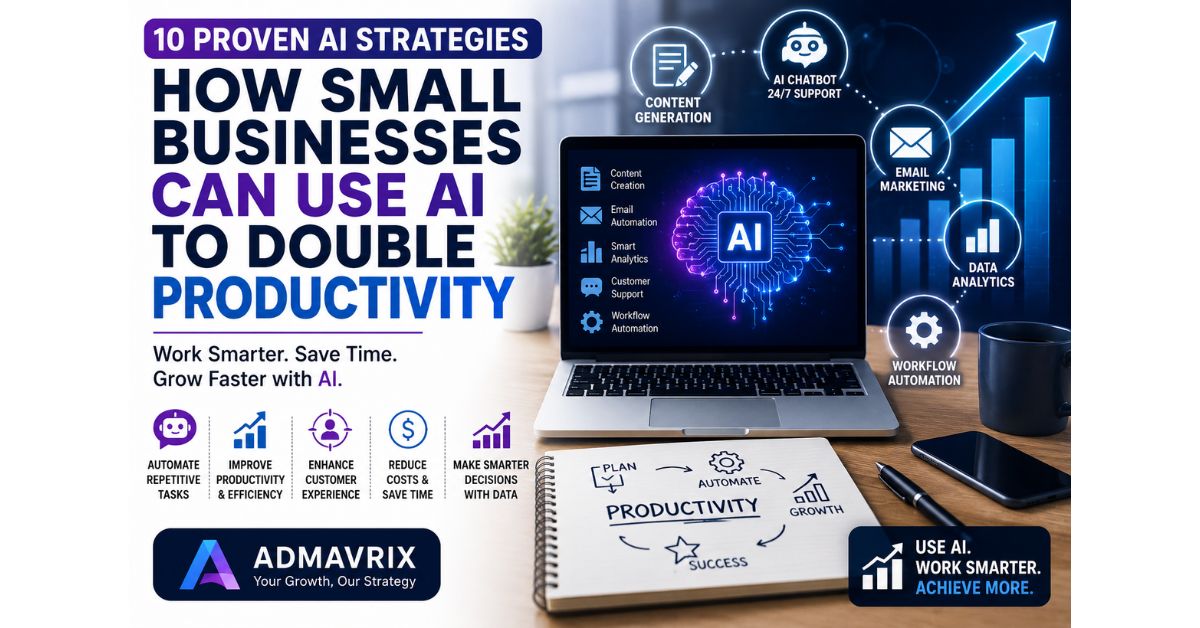
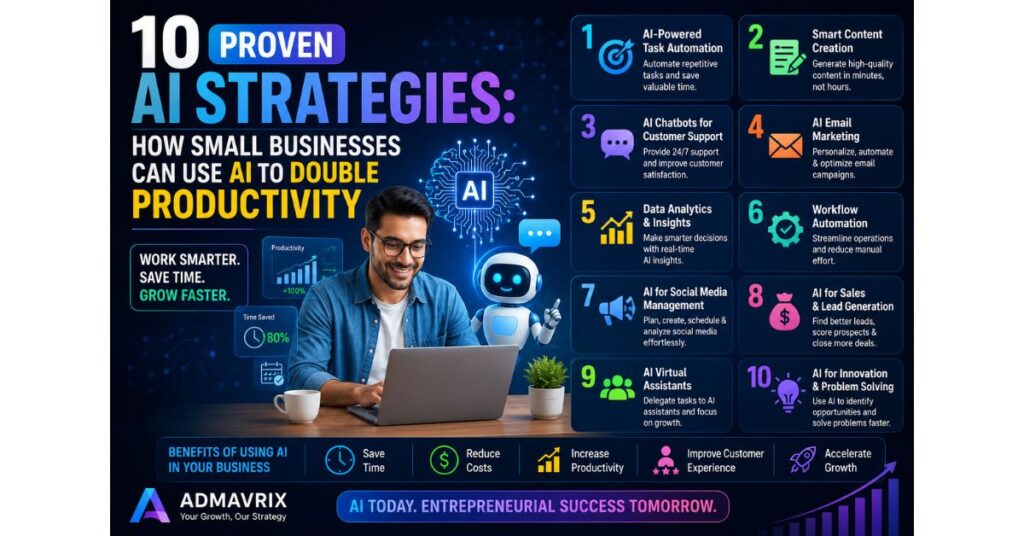
10 Proven AI Strategies: How Small Businesses Can Use AI to Double Productivity
1. Automate Repetitive Tasks
AI can handle repetitive tasks such as data entry, appointment scheduling, invoice generation, document management, and workflow automation. By reducing manual work, employees can focus on strategic activities that drive business growth and improve overall efficiency.
2. Create High-Quality Content Faster
AI-powered writing tools help businesses generate blog posts, social media captions, email campaigns, product descriptions, and marketing copy within minutes. This significantly reduces content creation time while maintaining consistency and quality.
3. Deliver 24/7 Customer Support with AI Chatbots
AI chatbots can answer frequently asked questions, provide product recommendations, resolve common customer issues, and collect lead information around the clock. This improves customer satisfaction while reducing support costs.
4. Automate Email Marketing Campaigns
AI enables businesses to create personalized email campaigns by analyzing customer behavior, purchase history, and engagement patterns. Automated email sequences help improve open rates, click-through rates, and customer retention with minimal manual effort.
5. Make Smarter Decisions with AI Analytics
AI tools analyze large volumes of business data and generate actionable insights in real time. From identifying sales trends to predicting customer behavior, AI helps business owners make faster and more informed decisions.
6. Improve Workflow Efficiency
AI integrates multiple business applications to automate approvals, notifications, task assignments, and project tracking. This streamlines internal operations, reduces bottlenecks, and increases overall team productivity.
7. Simplify Social Media Management
AI-powered marketing platforms assist with content planning, caption generation, hashtag suggestions, post scheduling, and performance analysis. Businesses can maintain a consistent online presence while spending far less time managing social media.
8. Increase Sales and Lead Generation
AI helps businesses identify high-quality leads, score prospects based on buying intent, personalize sales outreach, and recommend products based on customer preferences. This allows sales teams to focus on opportunities that are more likely to convert.
9. Use AI Virtual Assistants for Daily Operations
AI virtual assistants can schedule meetings, organize calendars, set reminders, summarize documents, transcribe meetings, and manage daily administrative tasks. This saves valuable time and improves operational efficiency.
10. Drive Innovation and Business Growth
Beyond automation, AI enables businesses to discover new market opportunities, improve products and services, predict future trends, and develop more effective business strategies. Companies that strategically adopt AI gain a competitive advantage and position themselves for long-term sustainable growth.
Quick Insights
| AI Application | Business Benefit |
|---|---|
| Content Creation | Saves hours of writing |
| Chatbots | 24/7 customer support |
| Email Marketing | Higher engagement |
| Analytics | Better decisions |
| Automation | Reduced manual work |
Small Case Study
A local digital marketing agency with five employees struggled to manage client content, emails, and reporting. By implementing AI-powered writing assistants, automated scheduling tools, and reporting software, the agency reduced manual work by nearly 40%. Employees spent more time on strategy and client relationships, resulting in higher customer satisfaction and increased monthly revenue.
Real Example
Many small businesses now use AI-powered platforms like ChatGPT for content creation, Canva AI for design assistance, and automation tools to schedule social media posts and email campaigns. These solutions help them compete effectively with larger organizations while keeping operational costs under control.
Current Trends
- AI-powered customer support
- Predictive marketing analytics
- Personalized email campaigns
- AI-generated videos
- Voice AI assistants
- Workflow automation
- AI search optimization
Common Mistakes
- Using AI without human review
- Ignoring data privacy
- Automating every task unnecessarily
- Choosing too many AI tools at once
- Failing to train employees
Pro Tips
- Start with one AI tool and expand gradually.
- Combine AI with human creativity.
- Monitor performance regularly.
- Train your team to use AI effectively.
- Focus on solving real business problems rather than adopting AI for trends.
Expert Quote
“Artificial Intelligence doesn’t replace successful businesses—it empowers them to operate more efficiently and make better decisions.”
Step-by-Step Guide
- Identify repetitive tasks.
- Choose AI tools that match your business goals.
- Automate one workflow at a time.
- Measure time savings and productivity improvements.
- Optimize processes based on results.
- Continue expanding AI across different departments.
Future Outlook
AI adoption among small businesses will continue to grow rapidly. Businesses that embrace automation, predictive analytics, and AI-assisted marketing today will be better positioned to improve efficiency, reduce costs, and deliver exceptional customer experiences in the years ahead.
Conclusion
Artificial Intelligence has become one of the most valuable investments for small businesses seeking sustainable growth. By automating routine tasks, improving customer engagement, and enabling smarter decision-making, AI allows entrepreneurs to focus on innovation and long-term success.
Rather than replacing human expertise, AI enhances productivity and empowers businesses to achieve more with fewer resources. Companies that adopt AI strategically today will gain a competitive advantage in tomorrow’s digital economy.
At Admavrix, we help businesses leverage AI, SEO, content marketing, and digital strategies to achieve measurable growth. Whether you’re looking to automate marketing, improve search rankings, or build a stronger online presence, our team can help you transform your business with practical, results-driven solutions.
Frequently Asked Questions
Q1. Is AI affordable for small businesses?
Yes. Many AI tools offer free plans or affordable subscriptions designed for startups and small businesses.
Q2. Can AI replace employees?
No. AI supports employees by automating repetitive tasks, allowing them to focus on higher-value work.
Q3. Which business functions benefit most from AI?
Marketing, customer support, sales, content creation, analytics, and administrative workflows are among the areas that benefit most.
Q4. How can a business start using AI?
Begin by identifying repetitive tasks, selecting one suitable AI tool, and gradually expanding its use as your team becomes more comfortable.