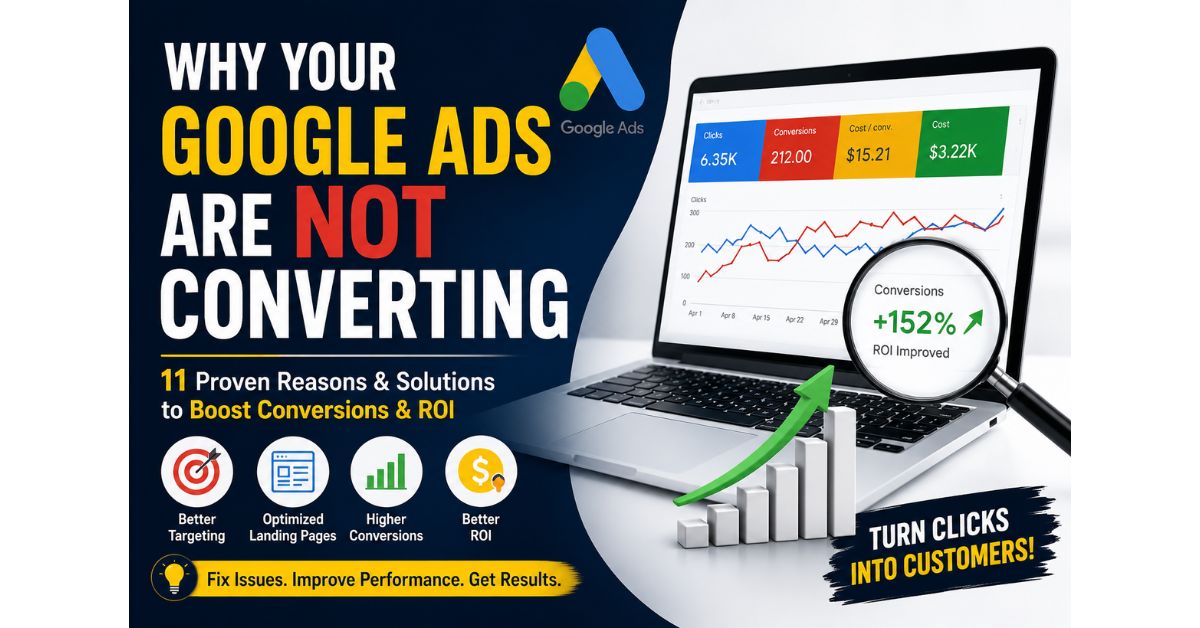
Getting hundreds of clicks but zero leads? Spending money on Google Ads without seeing conversions can be frustrating. The good news is that most Google Ads problems are fixable. Understanding why your Google Ads are not converting is the first step toward turning wasted ad spend into profitable campaigns.
Introduction
Google Ads remains one of the most effective digital advertising platforms. However, many businesses experience high impressions and clicks without getting inquiries, sales, or leads.
If you’re wondering why your Google Ads are not converting, the issue usually lies in targeting, landing pages, keyword intent, or tracking problems. This guide explains the most common causes and proven solutions to improve your campaign performance.
If you’re wondering why your Google Ads are not converting, you’re not alone. Understanding why your Google Ads are not converting is the first step toward improving campaign performance and maximizing ROI.
Why Your Google Ads Are Not Converting: Common Reasons
1. Wrong Keyword Targeting
Using broad or irrelevant keywords attracts unqualified traffic, resulting in clicks but no conversions. Focus on high-intent and long-tail keywords to improve Google Ads performance.
2. Weak Ad Copy
Poor headlines and unclear calls-to-action reduce click quality. Compelling ad copy can significantly increase conversion rates and ROI.
3. Poor Landing Page Experience
Slow-loading pages, confusing layouts, or mismatched content often cause visitors to leave without taking action.
4. Incorrect Audience Targeting
Targeting the wrong demographics, locations, or interests can lead to wasted ad spend and low-quality leads.
5. Missing Negative Keywords
Without negative keywords, your ads may appear for irrelevant searches, increasing costs and reducing campaign effectiveness.
6. Broken Conversion Tracking
Improper Google Ads or GA4 tracking makes it difficult to measure performance and optimize campaigns accurately.
7. Low Quality Score
A poor Quality Score can increase CPC and reduce ad visibility, affecting overall Google Ads conversion rates.
8. Mobile Optimization Issues
If your website isn’t mobile-friendly, users may abandon the page before completing a purchase or inquiry.
9. Ineffective Bidding Strategy
Using the wrong bidding strategy can limit visibility and prevent your ads from reaching high-converting audiences.
10. Lack of A/B Testing
Not testing headlines, CTAs, and landing pages means missed opportunities to improve PPC campaign performance.
11. High Competition and Rising CPC
Competitive industries often require continuous optimization to maintain strong Google Ads ROI and conversions.
What Does “Google Ads Not Converting” Mean?
Google Ads not converting means users click on your ads but fail to perform desired actions such as:
- Purchasing products
- Filling forms
- Calling your business
- Downloading resources
- Booking appointments
Key Points
Wrong keyword targeting
Poor landing page experience
Weak ad copy
Broken conversion tracking
Irrelevant audience targeting
Low Quality Score
Lack of negative keywords
Mobile optimization issues
Slow website speed
Weak call-to-action
Incorrect bidding strategy
Benefits of Fixing Conversion Issues
- Higher ROI
- Reduced ad spend wastage
- Better Quality Score
- Lower CPC
- Increased leads and sales
- Improved customer experience
- Higher conversion rates
Quick Insights Table
| Problem | Impact | Solution |
|---|---|---|
| Broad Keywords | Low-quality traffic | Use long-tail keywords |
| Poor Landing Page | High bounce rate | Optimize page speed |
| Weak CTA | Fewer leads | Add a strong CTA |
| Tracking Errors | Wrong data | Set up GA4 properly |
| Wrong Audience | Low conversions | Refine targeting |
| Mobile Issues | User exits | Mobile optimization |
Small Case Study
A SaaS company spent $2,000 monthly on Google Ads but generated only three leads.
After:
- Improving landing pages
- Adding negative keywords
- Fixing GA4 conversion tracking
Their conversion rate increased from 1.2% to 4.7%, reducing CPA by 42%.
Deep Explanation
1. Targeting the Wrong Keywords
Many advertisers use broad keywords that attract unqualified traffic.
Bad Keyword:
Digital marketing
Better Keyword:
Digital marketing agency for small businesses
Long-tail keywords bring higher intent traffic.
2. Weak Landing Pages
Sending users to your homepage often causes drop-offs.
Optimize:
- Clear headline
- Fast loading speed
- Testimonials
- Strong CTA
- Mobile responsiveness
3. Poor Conversion Tracking
Without proper tracking, Google cannot optimize campaigns effectively.
Use:
- GA4
- Google Tag Manager
- Enhanced Conversions
Tracking issues are among the biggest causes of poor performance.
4. No Negative Keywords
Negative keywords prevent irrelevant clicks.
Examples:
- Free
- Jobs
- Training
- Course
- Tutorial
5. Weak Ad Copy
Your ads should contain:
- Benefits
- Emotional triggers
- Numbers
- CTA
Example:
❌ Best SEO Services
✅ Get 3X More Leads With Proven SEO Strategies
6. Slow Website Speed
Visitors abandon websites that load slowly.
Optimize:
- Images
- Hosting
- Caching
- Core Web Vitals
7. Wrong Audience Targeting
Focus on:
- Location
- Interests
- Device
- Demographics
- Remarketing audiences
8. Poor Quality Score
Quality Score affects:
- CPC
- Rankings
- Visibility
Improve:
- Relevance
- CTR
- Landing page experience
9. Weak CTA
Examples:
❌ Learn More
✅ Get Your Free Consultation Today
10. Wrong Bid Strategy
Use:
- Maximize Conversions
- Target CPA
- Target ROAS
11. Ignoring Mobile Users
Over 60% of ad traffic comes from smartphones.
Ensure:
- Fast pages
- Responsive design
- Simple forms
Real Example
An e-commerce store received 500 clicks monthly with zero sales.
Problems:
- Homepage destination
- Generic keywords
- No negative keywords
Solutions:
- Dedicated landing pages
- Long-tail keywords
- Audience refinement
Results:
- 230% increase in conversions
- 38% lower CPA
2026 Trends
AI-Powered Campaigns
Google AI is becoming smarter.
Focus on:
- Performance Max
- First-party data
- Enhanced conversions
- Automation
- Smart bidding
Common Mistakes
Broad keywords
Sending traffic to the homepage
Ignoring mobile users
No conversion tracking
Weak CTAs
No A/B testing
Pro Tips
Use phrase-match keywords.
⭐ Install GA4 and GTM.
⭐ Create dedicated landing pages.
⭐ Add trust signals.
⭐ Test multiple ad copies.
⭐ Monitor Quality Score weekly.
Expert Quotes
“You can’t optimize what you can’t measure.”
— Google Ads Experts
“Search intent is more important than traffic volume.”
— PPC Specialists
Step-by-Step Guide
Step 1
Audit keyword targeting.
Step 2
Fix conversion tracking.
Step 3
Optimize landing pages.
Step 4
Add negative keywords.
Step 5
Improve CTAs.
Step 6
Test and scale campaigns.
Future Outlook
AI and automation will dominate Google Ads in 2026. Businesses that focus on user intent, first-party data, and conversion optimization will achieve higher ROI and sustainable growth.
Conclusion
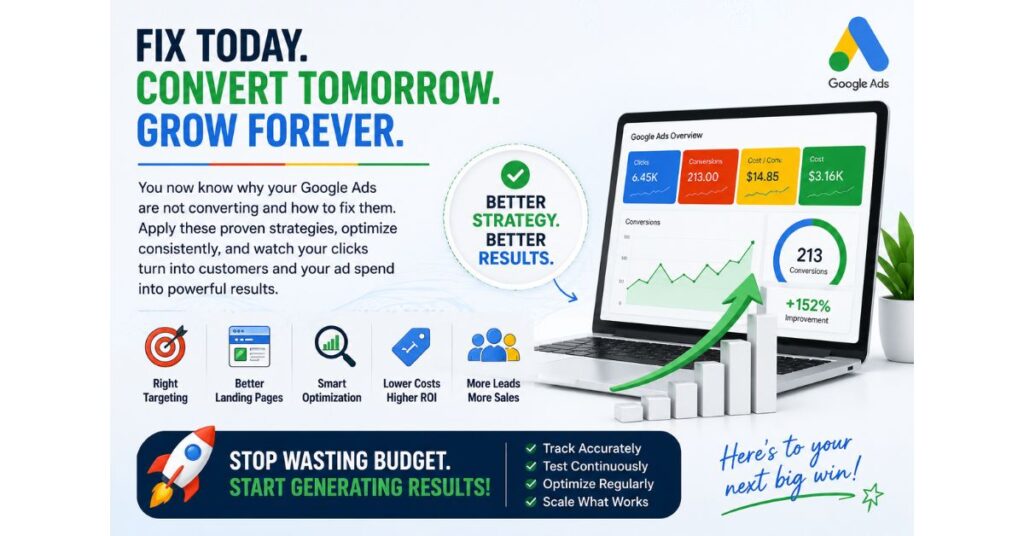
Understanding why your Google Ads are not converting is crucial for maximizing ROI. Most conversion issues stem from keyword targeting, poor landing pages, broken tracking, and weak ad copy. By fixing these areas, businesses can significantly improve performance and generate more leads without increasing ad spend.
Knowing why your Google Ads are not converting can help you identify hidden issues and implement proven strategies to increase conversions and reduce wasted ad spend.
Why Choose Admavrix?
At Admavrix, we help businesses maximize their advertising budget through:
- Google Ads Management
- SEO Services
- Landing Page Optimization
- Conversion Rate Optimization
- Analytics & Tracking Setup
- Performance Marketing
Ready to boost your conversions?
Contact Admavrix today and transform clicks into customers!
FAQ
Why are my Google Ads getting clicks but no conversions?
Poor landing pages, wrong keywords, or tracking issues are the most common reasons.
How can I improve Google Ads conversion rates?
Use long-tail keywords, optimize landing pages, and improve targeting.
What is a good Google Ads conversion rate?
Most industries see conversion rates between 2% and 5%.
Do negative keywords improve conversions?
Yes. They prevent irrelevant traffic and reduce wasted ad spend.
Should I use Performance Max campaigns?
Performance Max campaigns are effective when combined with accurate conversion tracking and quality assets.