Digital marketing is changing faster than ever. For years, marketers focused on ranking websites on traditional search engines. But in 2026, AI-powered search experiences are reshaping how people discover information, products, and brands.
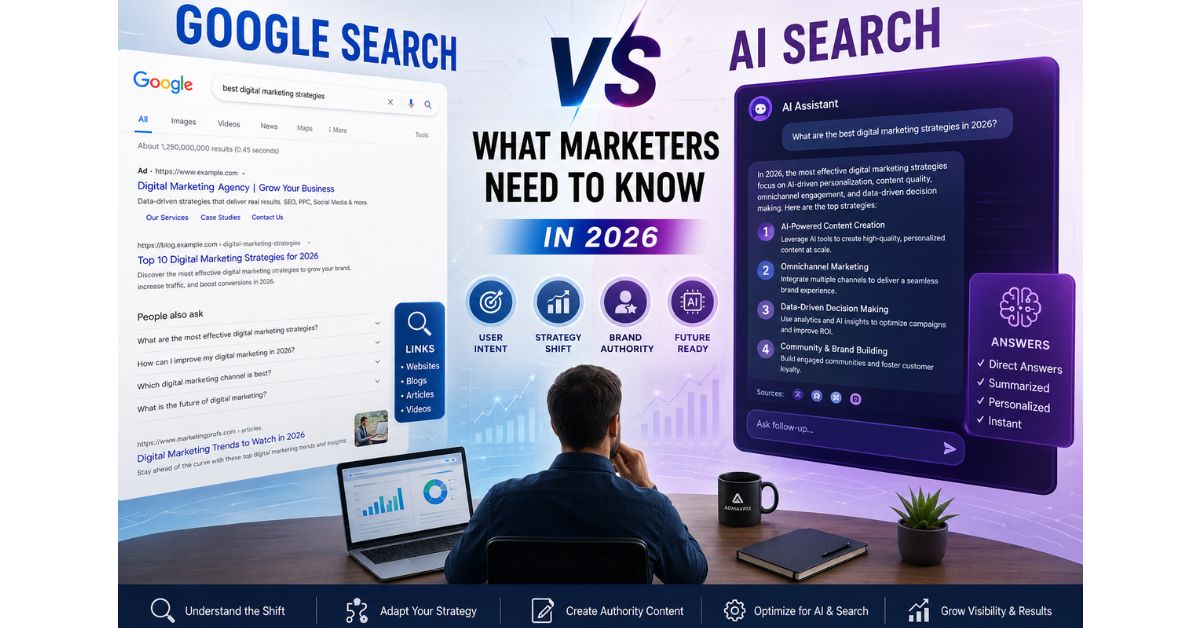
With AI assistants providing direct answers instead of just a list of links, businesses must adapt their SEO and content strategies to stay visible. Understanding the difference between Google Search and AI Search is now essential for marketers who want to remain competitive.
What Is Traditional Google Search?
Traditional search engines like Google Search work by crawling, indexing, and ranking web pages based on relevance, authority, and user intent.
When users search for a query, they receive:
- Search Engine Results Pages (SERPs)
- Organic listings
- Paid advertisements
- Featured snippets
- Videos and images
- Local business results
Users typically click on multiple links to find the information they need.
Key Characteristics of Google Search
- Keyword-based ranking
- Website traffic-focused
- Link-building importance
- Technical SEO requirements
- User clicks drive engagement
For marketers, success has traditionally meant securing higher rankings and increasing website traffic.
What Is AI Search?
AI Search uses artificial intelligence and large language models to generate direct, conversational answers for users.
Instead of displaying only links, AI systems analyze information from multiple sources and provide summarized responses.
Popular AI-powered search experiences include:
Users can ask complex questions in natural language and receive immediate answers without visiting multiple websites.
Key Characteristics of AI Search
- Conversational interactions
- Direct answers
- Context-aware responses
- Multi-source information synthesis
- Reduced reliance on keyword matching
Google Search vs AI Search: Major Differences
Feature | Google Search | AI Search |
Results | List of links | Direct answers |
User Journey | Multiple clicks | Instant response |
SEO Focus | Keywords & backlinks | Authority & content quality |
Search Style | Short queries | Conversational questions |
Traffic Generation | High website visits | Lower click-through rates |
User Experience | Search and browse | Ask and receive answers |
Benefits of Google Search
Massive Reach
Billions of daily searches.
Website Traffic
Strong source of organic visitors.
Established SEO Framework
Clear optimization techniques.
Local Visibility
Excellent for location-based businesses.
Benefits of AI Search
Faster User Experience
Instant answers.
Better Personalization
Context-aware responses.
Improved Query Understanding
Handles complex questions effectively.
Higher Intent Users
Visitors often arrive with stronger purchase intent.
Small Case Study
SaaS Company SEO Transformation
A SaaS startup relied solely on traditional SEO strategies.
Results:
- Strong rankings
- Moderate conversions
- Limited brand recognition
After shifting to AI-friendly content:
- Added expert insights
- Created comprehensive guides
- Published original research
- Structured content for AI readability
Within six months:
- Increased branded searches
- Improved conversion rates
- Gained visibility in AI-generated responses
The lesson?
Authority now matters as much as rankings.
Why AI Search Is Changing Everything
Traditional search engines act like librarians.
You ask a question.
They show you books.
AI Search acts like an expert consultant.
You ask a question.
It gives you a complete answer.
This changes user behavior significantly.
Users spend less time:
- Comparing websites
- Reading multiple articles
- Researching manually
Instead, they rely on AI-generated summaries.
This means marketers must focus on becoming trusted sources of information.
Real-World Example
Traditional Search Journey
User searches:
“Best CRM software”
Google displays:
- Blog A
- Blog B
- Review Site
- Vendor Website
User visits multiple pages.
AI Search Journey
User asks:
“Recommend the best CRM software for a growing e-commerce business.”
AI immediately provides:
- Top recommendations
- Features
- Pricing summaries
- Pros and cons
The decision-making process becomes much faster.
Latest Trends in Search Marketing (2026)
1. AI Overview Optimization
Marketers are now optimizing content specifically to appear in AI-generated answers.
2. Entity-Based SEO
Search engines increasingly focus on topics and entities rather than exact keywords.
3. Brand Signal Growth
Mentions, reviews, and authority signals influence visibility.
4. Conversational Search
Long-tail natural language queries continue growing rapidly.
5. Search Everywhere Strategy
Visibility now includes:
- Search Engines
- AI Assistants
- Social Media
- Voice Search
- Video Platforms
Common Mistakes Marketers Make
Focusing only on rankings
Ignoring AI search platforms
Publishing thin content
Keyword stuffing
Neglecting E-E-A-T principles
Not updating old content
Ignoring brand authority
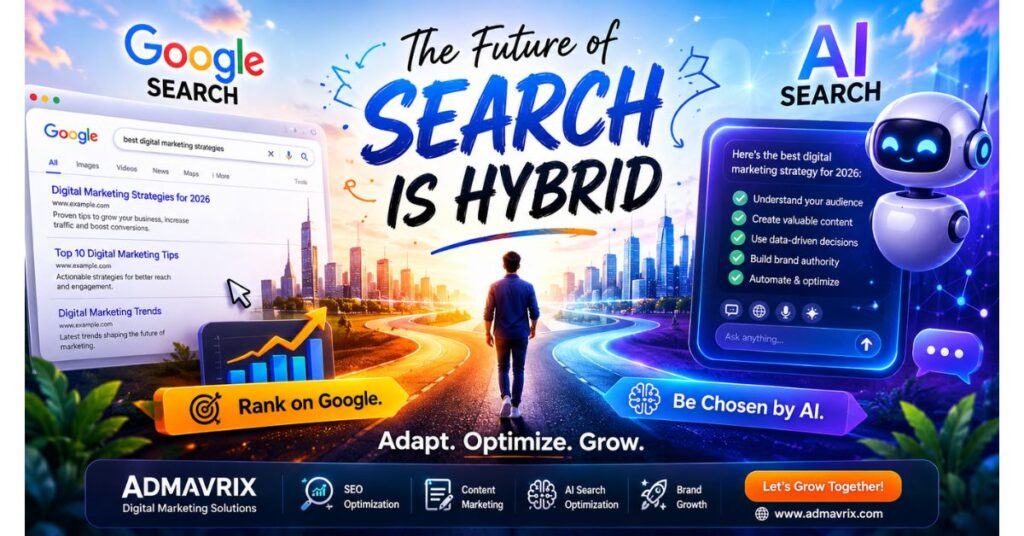
Future Outlook
The next few years will bring even deeper integration between search engines and AI assistants.
Successful marketers will not choose between Google Search and AI Search.
They will optimize for both.
The brands that create trustworthy, helpful, and comprehensive content today will become the most visible brands tomorrow.
AI is not replacing SEO.
It is redefining it.
Conclusion
Google Search vs AI Search is no longer a debate about which platform will win. Both are shaping the future of digital discovery.
Traditional search engines continue driving valuable traffic, while AI search platforms are transforming how users consume information. Marketers who adapt by focusing on authority, expertise, user intent, and high-quality content will gain a significant competitive advantage in 2026 and beyond.
The future belongs to brands that can be discovered, trusted, and recommended across every search experience.
Ready to Future-Proof Your SEO Strategy?
At Admavrix, we help businesses dominate both traditional search results and emerging AI-powered search platforms.
Our Services:
SEO Strategy & Optimization
AI Search Optimization
Content Marketing
Social Media Marketing
Performance Marketing
Technical SEO Audits
Brand Visibility Growth
Website: https://admavrix.com
Contact Admavrix today and start building a future-ready digital presence.
FAQ Section
1. What is the difference between Google Search and AI Search?
Google Search primarily provides links to websites, while AI Search generates direct answers using information from multiple sources.
2. Will AI Search replace SEO?
No. SEO remains essential, but optimization strategies are evolving to include AI visibility and authority signals.
3. What is AI Search Optimization?
AI Search Optimization involves creating authoritative, structured, and comprehensive content that AI systems can understand and reference.
4. How can businesses prepare for AI Search?
Businesses should focus on content quality, E-E-A-T principles, topical authority, brand building, and user-focused experiences.
5. Why is brand authority becoming more important?
AI systems often prioritize trusted and credible sources when generating answers, making brand reputation a key ranking factor.