Artificial Intelligence is transforming digital marketing faster than ever. From automated content creation to predictive analytics, AI helps brands save time, reduce costs, and scale campaigns quickly. But there’s a hidden problem — many businesses are using AI the wrong way.
One careless AI-generated post, inaccurate ad copy, or robotic customer interaction can damage trust, reduce engagement, and even hurt your brand reputation permanently.
So, how can brands use AI wisely without making costly mistakes?
Let’s explore.
AI in digital marketing refers to using machine learning, predictive analytics, and automation tools to optimize campaigns, personalize customer journeys, and scale content. However, misuse or over‑reliance on AI can backfire.
Introduction
Artificial Intelligence has become a major force in modern marketing. Brands now use AI tools for:
- Content creation
- Email automation
- Social media scheduling
- Customer support chatbots
- SEO optimization
- Data analysis
- Personalized advertising
While AI offers incredible advantages, overdependence and poor implementation can create serious marketing issues.
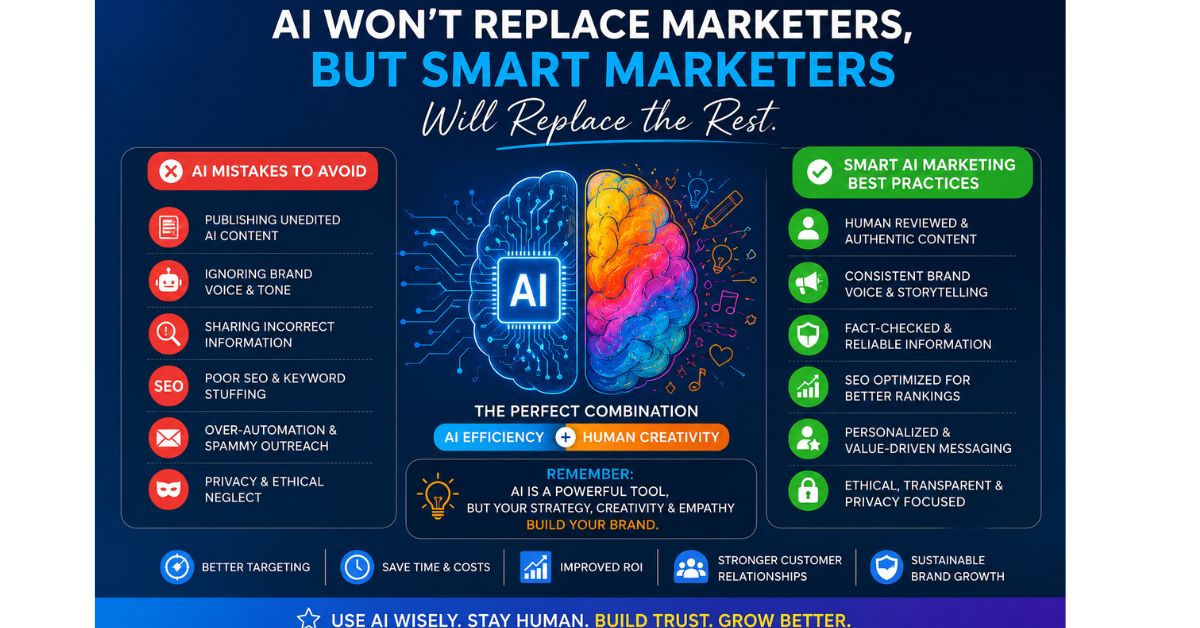
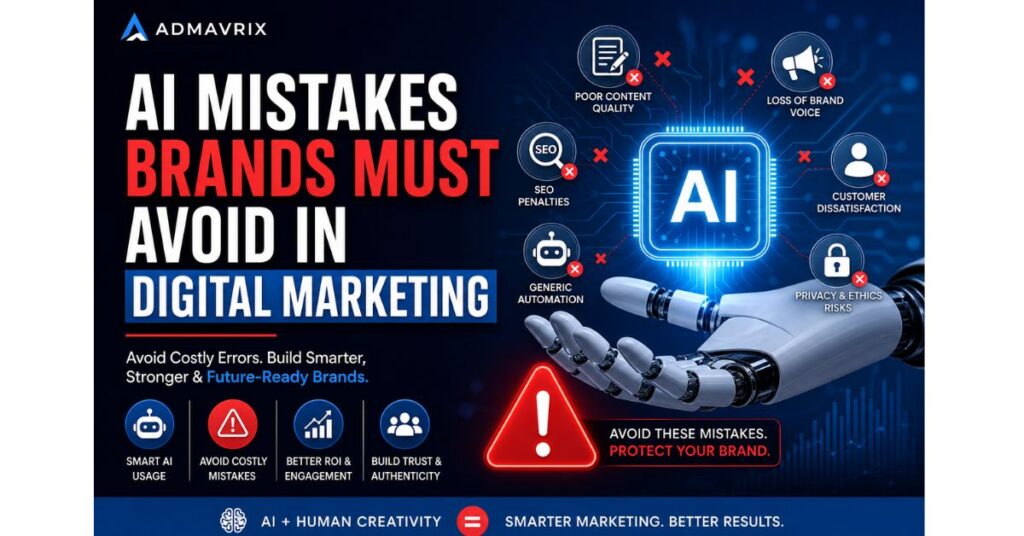
Brands that blindly trust AI without human oversight often face:
- Low-quality content
- Generic messaging
- SEO penalties
- Loss of authenticity
- Customer dissatisfaction
Understanding these mistakes early can help businesses create smarter, safer, and more effective digital marketing strategies.
Meaning of AI in Digital Marketing
AI in digital marketing refers to the use of machine learning, automation, and intelligent software to improve marketing performance, customer targeting, content generation, and campaign optimization.
AI-powered marketing tools can:
- Analyze customer behavior
- Generate content ideas
- Predict trends
- Automate repetitive tasks
- Improve personalization
- Optimize advertising campaigns
However, AI should support marketers — not completely replace human creativity and strategy.
Key Points
- AI improves marketing efficiency but requires human supervision
- Poor AI usage can damage brand credibility
- Authenticity matters more than automation
- SEO-friendly AI content needs editing and optimization
- Ethical AI usage builds long-term trust
- Smart brands combine AI with human creativity
Visual Introduction
Traditional Marketing | AI-Powered Marketing |
Manual content writing | Automated content generation |
Generic audience targeting | Personalized targeting |
Slow campaign analysis | Real-time analytics |
Manual customer support | AI chatbots |
Human-only decisions | Data-driven recommendations |
Features of AI in Digital Marketing
1. Content Automation
AI tools can generate blogs, captions, emails, and ad copies quickly.
2. Customer Personalization
AI analyzes user behavior to deliver personalized experiences.
3. Predictive Analytics
Brands can predict customer trends and buying patterns.
4. Chatbots & Customer Service
AI-powered bots provide instant responses to customers.
5. Smart Advertising
AI optimizes ad targeting and bidding strategies automatically.
Benefits of AI Marketing
Benefit | Impact |
Faster Content Creation | Saves time |
Better Targeting | Higher conversions |
Automation | Reduces workload |
Data Insights | Smarter decisions |
Personalization | Better customer experience |
Campaign Optimization | Improved ROI |
Small Case Study
Example: AI-Generated Social Media Disaster
A retail brand used AI to auto-generate social media captions without review. One caption included inaccurate product information and insensitive wording during a global event.
Result:
- Massive backlash on social media
- Negative customer comments
- Brand apology campaign
- Loss of engagement and trust
Lesson:
AI should assist content creation — not publish automatically without human review.
AI Mistakes Brands Must Avoid
1. Over-Reliance on AI Content
Many brands publish AI-generated blogs without editing. This creates:
- Repetitive writing
- Lack of originality
- Generic tone
- Weak storytelling
Solution:
Always add:
- Human editing
- Brand personality
- Real examples
- Unique insights
2. Ignoring Brand Voice
AI tools may create content that sounds robotic or inconsistent.
Risk:
Customers may feel disconnected from your brand identity.
Solution:
Train your AI prompts carefully and maintain:
- Consistent tone
- Emotional connection
- Brand values
3. Publishing Incorrect Information
AI sometimes generates inaccurate or outdated data.
Risk:
False claims can damage credibility and trust.
Solution:
Fact-check:
- Statistics
- Product information
- Industry trends
- Legal claims
4. Poor SEO Optimization
Many AI-generated blogs:
- Overuse keywords
- Lack structure
- Ignore search intent
Result:
Poor rankings and low engagement.
Solution:
Use proper:
- Headings
- Internal linking
- Keyword placement
- Readability optimization
5. Using AI Without Human Creativity
AI cannot fully replace:
- Emotional storytelling
- Creative campaigns
- Human psychology
- Cultural understanding
Best Practice:
Use AI as an assistant, not a replacement.
6. Spammy Automation
Over-automated emails and messages can frustrate users.
Examples:
- Too many AI-generated emails
- Repetitive chatbot replies
- Automated irrelevant recommendations
Solution:
Focus on personalization and user experience.
7. Ethical & Privacy Issues
Using AI without transparency may create trust issues.
Brands Must:
- Protect customer data
- Follow privacy regulations
- Avoid misleading AI-generated content
Real Example / Case Study
AI Chatbot Failure in Customer Support
A company launched an AI chatbot without proper testing. The bot misunderstood customer queries and provided irrelevant answers repeatedly.
Result:
- Increased customer frustration
- Negative online reviews
- Higher support complaints
What They Changed:
- Added human escalation support
- Improved AI training
- Monitored responses regularly
Final Outcome:
Customer satisfaction improved significantly. AI Chatbot Failure in Customer Support
A company launched an AI chatbot without proper testing. The bot misunderstood customer queries and provided irrelevant answers repeatedly.
Result:
- Increased customer frustration
- Negative online reviews
- Higher support complaints
What They Changed:
- Added human escalation support
- Improved AI training
- Monitored responses regularly
Final Outcome:
Customer satisfaction improved significantly.
Explanation
1. Over‑Automation
Brands often automate everything—from emails to social posts—losing authenticity. AI should assist, not replace, human creativity.
2. Data Quality Neglect
AI is only as good as the data it consumes. Inaccurate or outdated data leads to poor targeting and wasted ad spend.
3. Personalization Pitfalls
Sending “Dear Customer” emails or irrelevant product recommendations erodes trust. AI must be trained for micro‑segmentation.
4. Compliance Risks
Ignoring privacy laws while using AI for data collection can result in fines and reputational damage.
5. Blind Trust in Tools
AI tools are powerful but not infallible. Human oversight ensures campaigns remain ethical and effective.
Latest Trends in AI Marketing
1. AI Video Creation
Brands are using AI for short-form video generation.
2. Predictive Customer Analytics
AI helps forecast buying behavior.
3. AI-Powered SEO Tools
Advanced optimization recommendations improve rankings.
4. Hyper-Personalization
AI delivers personalized experiences in real time.
5. Conversational AI
Smarter chatbots improve customer interactions.
Common Mistakes
- Publishing unedited AI content
- Ignoring customer emotions
- Using excessive automation
- Copying competitors with AI
- Creating low-value SEO content
- Depending fully on AI tools
- Neglecting originality
Pro Tips
Use AI for research and efficiency
Add human creativity to every campaign
Optimize AI content for SEO manually
Maintain authentic storytelling
Monitor AI-generated analytics carefully
Test chatbot experiences regularly
Keep customer trust as the priority
Conclusion
Artificial Intelligence is revolutionizing digital marketing, but success depends on how brands use it. Businesses that blindly automate everything risk losing authenticity, customer trust, and brand credibility.
The future belongs to brands that combine:
- AI efficiency
- Human creativity
- Ethical practices
- Personalized experiences
AI should empower marketers — not replace meaningful human connection.
Brands that maintain this balance will build stronger relationships, better engagement, and long-term digital success.
At Admavrix, we help brands combine AI-powered strategies with human creativity to build high-performing digital campaigns that drive real results.
Our Services:
- SEO Optimization
- Social Media Marketing
- AI-Assisted Content Strategy
- Paid Advertising
- Brand Growth Solutions
- Website Optimization
Grow smarter with Admavrix today!
Contact Admavrix Today at www.admavrix.com to build AI‑driven marketing strategies that avoid pitfalls and maximize ROI.