Your customer sees your Instagram ad.
They click.
They visit your website.
They browse a product.
They add it to the cart.
And then… they disappear.
For many D2C brands, this is where the customer journey ends.
But what if the conversation could continue directly inside a platform your customers already use every day?
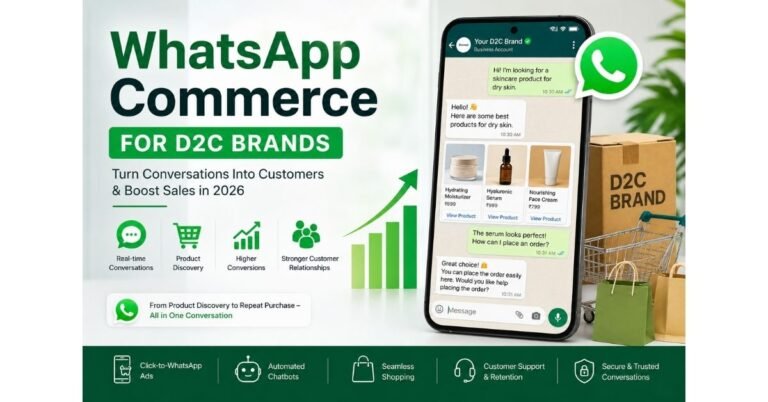
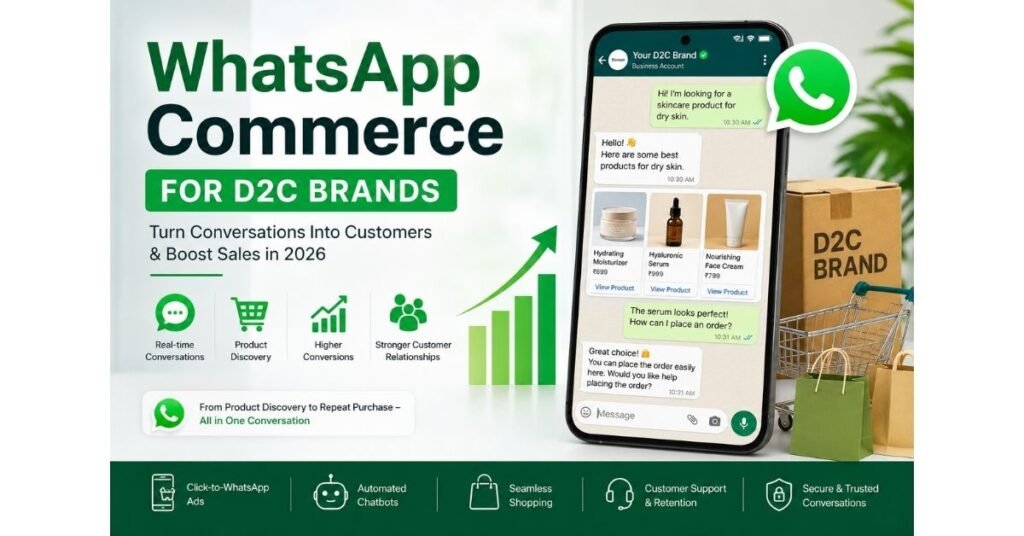
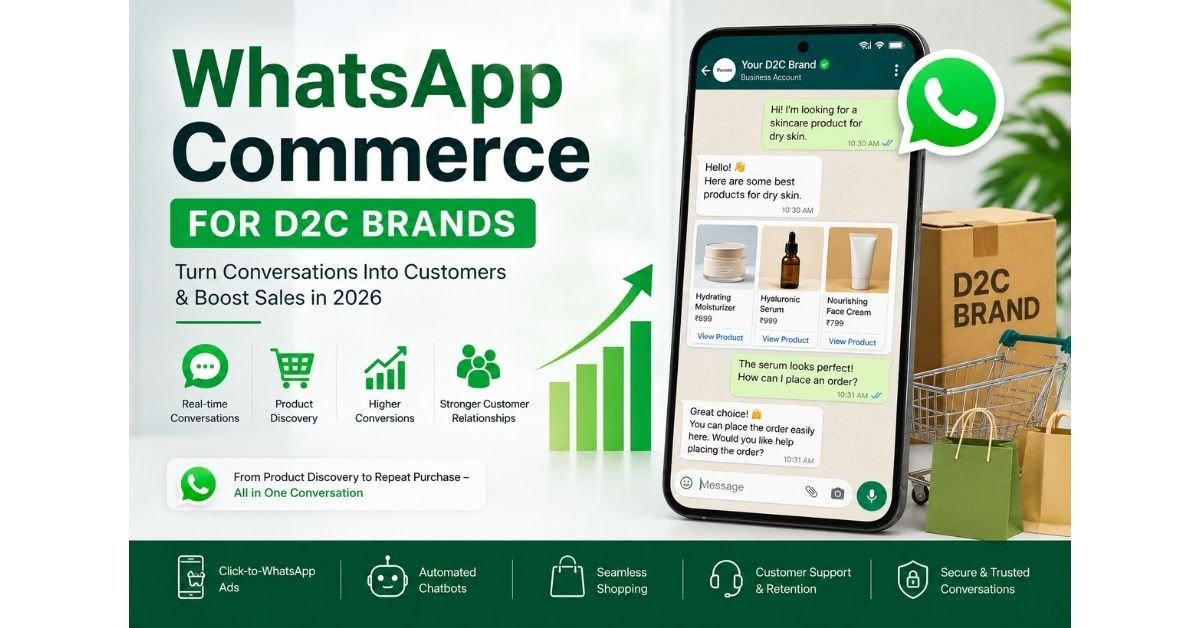
That is where WhatsApp Commerce for D2C brands becomes powerful.
Instead of forcing customers through multiple pages, forms, and checkout steps, brands can use WhatsApp to answer questions, recommend products, share catalogs, recover abandoned carts, confirm orders, and build long-term customer relationships.
In 2026, WhatsApp is no longer just a messaging channel.
For D2C businesses, it can become a sales, marketing, support, and retention channel in one place.
Introduction
D2C brands have changed the way consumers discover and purchase products.
Customers now expect:
- Fast responses
- Personalized recommendations
- Easy product discovery
- Convenient communication
- Quick order updates
- Simple purchasing experiences
- Helpful customer support
Traditional eCommerce funnels can sometimes create friction.
A customer may discover a product on Instagram, move to a website, search for information, compare products, add an item to the cart, and eventually leave without purchasing.
WhatsApp Commerce offers another approach: bring the conversation closer to the purchase.
With WhatsApp, D2C brands can combine conversational marketing, product discovery, customer support, automation, and sales into a single customer journey.
What Is WhatsApp Commerce for D2C Brands?
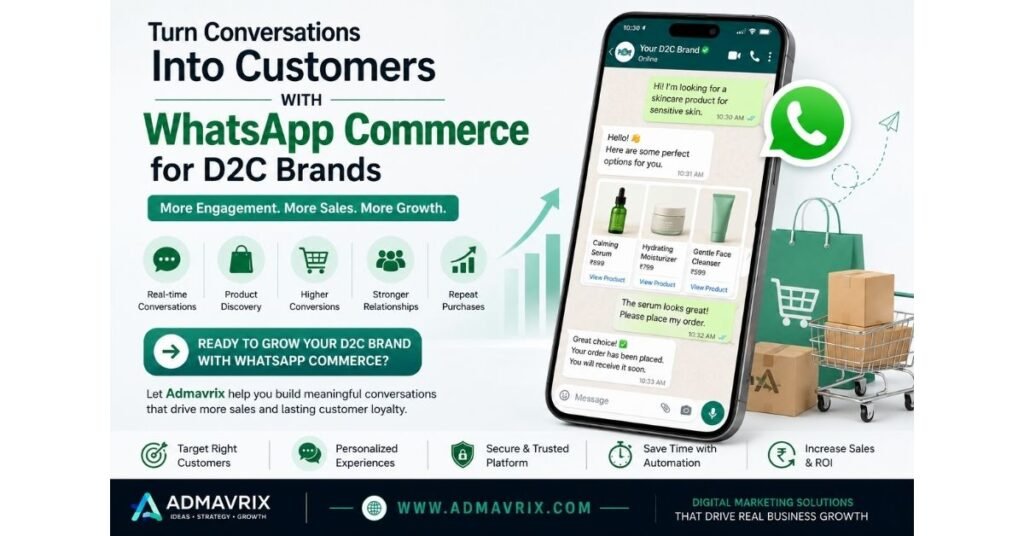
WhatsApp Commerce for D2C brands is the use of WhatsApp as a digital commerce channel where businesses can interact with customers, showcase products, provide recommendations, answer questions, generate leads, assist with purchases, send transactional updates, and encourage repeat sales.
It combines:
Messaging + Marketing + Product Discovery + Sales + Customer Support + Retention
A simplified WhatsApp Commerce journey looks like this:
Ad / Social Media → WhatsApp Conversation → Product Discovery → Recommendation → Purchase → Order Updates → Repeat Purchase
Instead of treating WhatsApp only as a customer-support channel, D2C brands can use it throughout the customer lifecycle.
Visual Introduction: How WhatsApp Commerce Works
Think of the customer journey like this:
1. DISCOVER
Customer sees an Instagram, Facebook, Google, or influencer campaign.
↓
2. START CONVERSATION
Customer clicks a WhatsApp CTA.
↓
3. ENGAGE
The brand answers questions or uses automation to provide information.
↓
4. DISCOVER PRODUCTS
Customer browses products through a catalog or receives personalized recommendations.
↓
5. CONVERT
Customer completes the purchase.
↓
6. RETAIN
The brand sends useful updates, offers, recommendations, and replenishment reminders.
↓
7. REPEAT
Customer returns for another purchase.
This is the core idea behind conversational commerce.
Key Points at a Glance
If you are a D2C brand, remember these seven principles:
- WhatsApp should support the complete customer journey.
- Personalization is more powerful than generic promotions.
- Automation should reduce response time, not remove the human touch.
- Product catalogs make discovery easier.
- Abandoned-cart conversations can recover lost opportunities.
- Customer data should be used responsibly and with appropriate consent.
- Every WhatsApp campaign should have a measurable business objective.
Key Features of WhatsApp Commerce
1. WhatsApp Business Profile
A professional WhatsApp Business presence gives customers important information such as:
- Business name
- Description
- Website
- Business category
- Operating hours
- Contact information
This creates a more professional customer experience.
2. Product Catalog
D2C brands can showcase products through a digital catalog.
Depending on the setup and available features, customers may be able to view:
- Product images
- Product names
- Descriptions
- Prices
- Product information
A well-organized catalog reduces the number of messages needed to explain basic product information.
3. Conversational Selling
Instead of simply sending customers to a website, brands can start a conversation.
For example:
Customer: “Which face serum is best for oily skin?”
Brand: “If you have oily skin, our Vitamin C + Niacinamide Serum may be a better option. Would you like to see the ingredients and customer reviews?”
This feels more like assistance than advertising.
4. Automated Responses
Automation can help answer common questions about:
- Product availability
- Shipping
- Delivery timelines
- Return policies
- Order status
- Product recommendations
- Frequently asked questions
This allows teams to focus on more complex customer conversations.
5. WhatsApp Chatbots
A chatbot can guide customers through predefined journeys.
For example:
Welcome
“Hi! 👋 What are you looking for today?”
Options:
- Shop Products
- Track My Order
- Get a Recommendation
- Talk to Support
This creates a structured customer experience.
6. Click-to-WhatsApp Advertising
D2C brands can connect paid campaigns with WhatsApp conversations.
For example:
Instagram Ad → Click WhatsApp → Product Conversation → Purchase
This can be especially useful for products where customers have questions before purchasing.
7. Order & Delivery Updates
WhatsApp can also be used for customer communication related to:
- Order confirmation
- Shipping updates
- Delivery notifications
- Support requests
Transactional communication can improve transparency and customer confidence.
Benefits of WhatsApp Commerce for D2C Brands
1. Faster Customer Communication
Customers do not always want to fill out a form or wait for an email response.
WhatsApp allows brands to communicate through a familiar messaging environment.
2. Higher Engagement Potential
A personalized conversation can be more engaging than a generic promotional message.
Instead of:
“Buy our new product today!”
A better approach could be:
“Looking for a moisturizer for dry skin? We can help you choose.”
The second message begins with the customer’s problem.
3. Personalized Product Recommendations
D2C brands can use customer preferences and conversation context to recommend relevant products.
For example:
Customer: “I need a shampoo for damaged hair.”
The brand can recommend products based on the customer’s stated requirement.
4. Abandoned Cart Recovery
A customer may add a product to their cart but fail to complete the purchase.
A properly designed WhatsApp recovery journey can remind the customer about the product and help resolve purchase objections.
For example:
“You left something behind. Need help completing your order?”
The goal is not to spam the customer.
The goal is to remove friction.
5. Better Customer Support
Customers can ask questions before and after purchasing.
This makes WhatsApp useful across the entire customer lifecycle.
6. Improved Customer Retention
D2C success is not only about acquiring customers.
It is also about getting customers to purchase again.
WhatsApp can support:
- Reorder reminders
- New product announcements
- Product education
- Customer support
- Loyalty communication
- Personalized recommendations
Quick Insights Table
| WhatsApp Commerce Element | D2C Brand Benefit |
|---|---|
| Product Catalog | Easier product discovery |
| WhatsApp Chat | Direct customer communication |
| Automation | Faster responses |
| Chatbots | Scalable customer journeys |
| Click-to-WhatsApp Ads | Connect advertising with conversations |
| Cart Recovery | Re-engage potential buyers |
| Order Updates | Better customer experience |
| Personalization | More relevant recommendations |
| Customer Support | Faster issue resolution |
| Retention Campaigns | Encourage repeat purchases |
Small Case Study: A Hypothetical D2C Skincare Brand
Consider a fictional D2C skincare company called GlowPure.
Before implementing WhatsApp Commerce, its customer journey looked like this:
Instagram Ad → Website → Product Page → Checkout
The company noticed that many customers were asking questions about:
- Skin type
- Ingredients
- Product combinations
- Shipping
- Returns
Instead of sending every customer to a generic product page, GlowPure introduced a WhatsApp-based buying journey.
New Journey
Instagram Ad
↓
Click to WhatsApp
↓
“What are you looking for?”
↓
Dry Skin / Acne-Prone Skin / Brightening / Anti-Ageing
↓
Personalized product recommendation
↓
Product information
↓
Purchase
↓
Order confirmation
↓
Post-purchase support
The important change was not simply adding WhatsApp.
The brand redesigned the customer journey around conversation and intent.
Deep Explanation: Why WhatsApp Commerce Works for D2C
The biggest advantage of WhatsApp Commerce is not the messaging app itself.
It is the reduction of purchase friction.
Traditional eCommerce journeys often rely on customers finding answers themselves.
A customer might ask:
- Is this suitable for me?
- Which product should I choose?
- How long will delivery take?
- Can I return it?
- Which size should I buy?
- How do I use it?
If these questions remain unanswered, the customer may leave.
WhatsApp allows the brand to bring assistance directly into the decision-making process.
The new model becomes:
Customer Intent → Conversation → Assistance → Confidence → Conversion
That is why WhatsApp Commerce can be particularly useful for products that require explanation or personalization.
Real Example: How a D2C Fashion Brand Can Use WhatsApp
Imagine a customer sees a Meta ad for a clothing brand.
The ad says:
“New Festive Collection — Find Your Look.”
The customer clicks WhatsApp.
The automated conversation begins:
Bot:
“Hi! 👋 What are you shopping for?”
Customer:
“Women’s ethnic wear.”
Bot:
“Great! What type?”
- Kurta Sets
- Sarees
- Dresses
- Festive Wear
The customer selects Kurta Sets.
The brand then presents relevant products.
The customer asks:
“Do you have this in XL?”
The brand responds with availability.
The customer is now closer to purchasing because the biggest objection—availability—has been resolved.
This is conversational commerce in action.
WhatsApp Commerce Funnel for D2C Brands
A strong WhatsApp sales funnel can be divided into six stages.
Stage 1: Awareness
Use:
- Instagram Ads
- Facebook Ads
- Influencer Marketing
- Google Ads
- Organic Social Media
- QR Codes
Stage 2: Conversation
Give customers a reason to start a WhatsApp conversation.
Examples:
- Get Product Recommendations
- Find Your Perfect Product
- Ask an Expert
- Get a Special Offer
- Check Availability
Stage 3: Qualification
Understand the customer’s intent.
Stage 4: Recommendation
Suggest relevant products.
Stage 5: Conversion
Make the purchasing process as simple as possible.
Stage 6: Retention
Continue providing value after the sale.
WhatsApp Commerce Trends for D2C Brands in 2026
1. Conversational AI
AI-powered assistants are becoming increasingly useful for handling repetitive customer questions and guiding product discovery.
However, brands should maintain human escalation for complex situations.
2. Hyper-Personalization
Generic messages are becoming less effective.
Customers increasingly expect recommendations based on their interests, previous interactions, and purchase context.
3. Click-to-WhatsApp Advertising
Paid social campaigns can increasingly be designed around conversation rather than simply website traffic.
4. Automated Customer Journeys
Brands are moving beyond one-time messages and creating automated journeys for:
Discovery → Purchase → Support → Retention
5. Conversational Customer Support
WhatsApp is increasingly becoming part of the customer-service infrastructure for digital-first brands.
6. First-Party Customer Relationships
As digital advertising becomes more competitive, D2C brands are placing greater importance on building direct relationships with customers.
WhatsApp can become one part of that broader retention strategy.
Common WhatsApp Commerce Mistakes
1: Sending Too Many Promotional Messages
Nobody wants constant sales messages.
Better approach: Balance promotions with useful information, support, recommendations, and education.
2: Treating WhatsApp Like Email
WhatsApp is conversational.
Long promotional paragraphs can feel unnatural.
Better approach: Keep messages concise and action-oriented.
3: No Human Support
Automation is useful, but customers should have a clear way to reach a human when necessary.
4: Poor Product Information
If customers have to ask basic questions repeatedly, the buying journey becomes slower.
Make product information clear and easy to access.
5: No Measurement
Do not judge WhatsApp Commerce only by the number of messages.
Track business outcomes.
Important metrics include:
- Conversations started
- Qualified conversations
- Product inquiries
- Conversion rate
- Cost per conversation
- Cost per acquisition
- Revenue generated
- Cart recovery rate
- Repeat purchase rate
- Customer response rate
Pro Tips for D2C Brands
1: Start With One Use Case
Do not automate everything immediately.
Start with one high-value problem such as:
Abandoned Cart Recovery
or
Product Recommendations
Then expand.
2: Build Conversation Around Customer Intent
Instead of asking:
“Would you like to buy something?”
Ask:
“What are you looking for today?”
The second question is easier to answer.
3: Use Short Messages
Break complex information into smaller conversational messages.
4: Create Clear CTAs
Examples:
- Shop Now
- Find My Product
- Track Order
- Talk to Support
- View Collection
- Get Recommendation
5: Segment Customers
Different customers need different communication.
Possible segments include:
- New visitors
- First-time buyers
- Repeat customers
- High-value customers
- Cart abandoners
- Product-specific customers
6: Respect Consent and Messaging Rules
WhatsApp Commerce should be built around appropriate customer consent, platform policies, and applicable privacy requirements.
Do not turn WhatsApp into a spam channel.
Step-by-Step Guide: How to Implement WhatsApp Commerce for Your D2C Brand
1: Define Your Goal
Choose one primary objective.
For example:
Increase conversions from social media traffic.
2: Set Up Your Business Presence
Create and optimize your WhatsApp Business presence with accurate business information.
3: Create Your Product Catalog
Add your key products with:
- High-quality images
- Clear names
- Useful descriptions
- Accurate pricing
- Relevant product information
4: Design Your Customer Journey
Map the conversation.
Example:
Hello → Customer Need → Product Recommendation → Product Details → Purchase → Confirmation
5: Identify Automation Opportunities
Automate repetitive questions such as:
- Where is my order?
- What are your delivery timelines?
- What is your return policy?
- Which products do you offer?
6: Connect Marketing Campaigns
Test campaigns that move users from:
Meta Ad → WhatsApp → Conversation → Purchase
7: Add Human Escalation
Give customers an easy way to connect with a real person.
8: Create Retention Campaigns
After purchase, consider useful communications such as:
- Product usage tips
- Reorder reminders
- Relevant new products
- Customer support
- Loyalty benefits
9: Track Performance
Create a simple dashboard containing:
Spend → Conversations → Qualified Leads → Purchases → Revenue → ROAS
10: Optimize
Test:
- Different ad creatives
- Different opening messages
- Different CTAs
- Different product recommendations
- Different conversation flows
Then invest more in what generates profitable customers.
Expert Quote
“The future of D2C commerce is not only about getting customers to a website. It is about making the buying journey easier, faster, and more personal.”
— Admavrix Digital Marketing Perspective
Frequently Asked Questions
What is WhatsApp Commerce for D2C brands?
WhatsApp Commerce for D2C brands is the use of WhatsApp to support product discovery, customer conversations, sales, customer service, order communication, and retention.
Is WhatsApp good for D2C marketing?
Yes. WhatsApp can be particularly useful for D2C brands that need direct customer communication, product recommendations, customer support, and retention campaigns.
How can D2C brands increase sales using WhatsApp?
Brands can use WhatsApp for product recommendations, Click-to-WhatsApp advertising, customer support, abandoned-cart recovery, product catalogs, personalized conversations, and repeat-purchase campaigns.
What is conversational commerce?
Conversational commerce is the process of using messaging and conversational interfaces to help customers discover, evaluate, purchase, and receive support for products or services.
Can WhatsApp help recover abandoned carts?
Yes. D2C brands can design appropriate WhatsApp journeys to remind customers about abandoned purchases and help resolve questions or objections that prevented checkout.
What is the difference between WhatsApp marketing and WhatsApp Commerce?
WhatsApp marketing focuses primarily on communication and promotion.
WhatsApp Commerce goes further by connecting conversations with product discovery, recommendations, sales, customer support, and retention.
Should a D2C brand use WhatsApp chatbots?
Chatbots can be useful when a brand receives many repetitive questions or needs to guide customers through structured journeys. However, human support should remain available for complex requests.
What should D2C brands measure on WhatsApp?
Important metrics include conversations, qualified conversations, conversion rate, customer acquisition cost, revenue, cart recovery, repeat purchases, and return on advertising spend.
Future Outlook: The Future of WhatsApp Commerce
The next stage of D2C growth will not simply be about driving more traffic.
It will be about creating better customer journeys.
As AI, automation, personalization, and conversational interfaces continue to develop, WhatsApp can become an important layer connecting:
Advertising → Conversation → Commerce → Support → Retention
The brands that succeed will not be the ones that send the most messages.
They will be the brands that understand when to message, what to say, and how to make the customer experience easier.
For D2C brands, WhatsApp Commerce should therefore be viewed not as another promotional channel, but as part of a broader customer experience and revenue strategy.
Conclusion
WhatsApp Commerce for D2C brands is changing the way businesses think about online selling.
Instead of relying entirely on traditional website funnels, brands can use conversations to help customers discover products, answer questions, overcome objections, complete purchases, and return for future purchases.
The winning formula is simple:
Right Customer + Right Conversation + Right Product + Right Timing = Better Commerce Experience
Start small.
Choose one use case.
Build a simple customer journey.
Measure the results.
Then scale what works.
For ambitious D2C brands, WhatsApp can become much more than a messaging platform.
It can become a powerful bridge between marketing, sales, and customer relationships.
Ready to Build a High-Converting D2C Marketing Strategy?
At Admavrix, we help businesses build smarter digital marketing strategies using SEO, social media marketing, paid advertising, content marketing, conversion optimization, and performance marketing.
Want to turn more online visitors into customers?
Explore digital marketing solutions with Admavrix and build your next growth strategy.