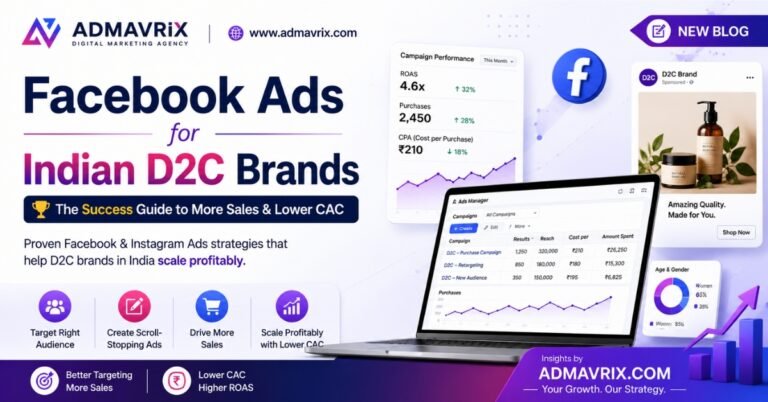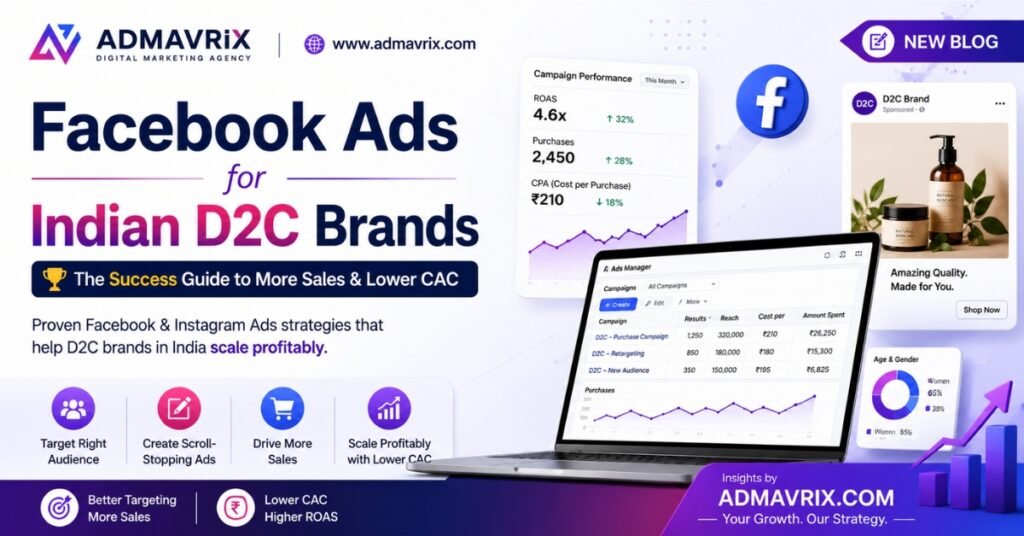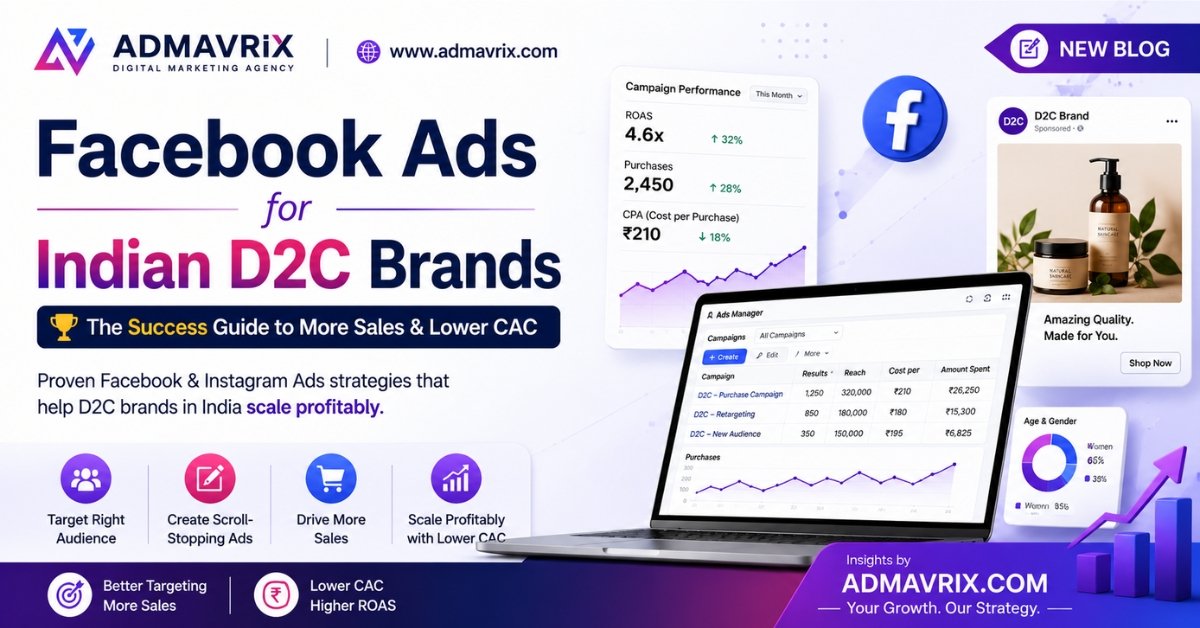
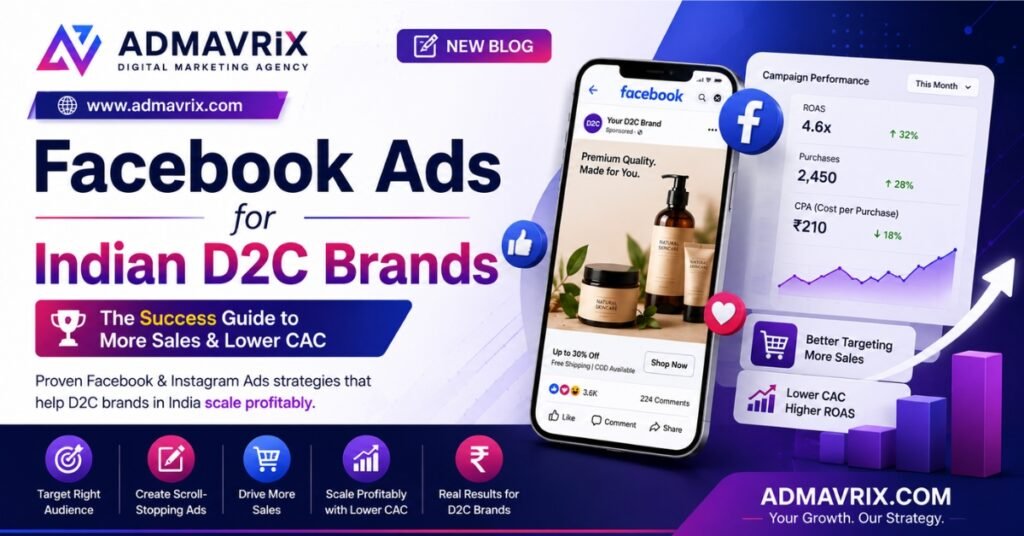
Your customer is already scrolling Facebook and Instagram. The real question is: are they seeing your D2C brand—or your competitor’s?
For Indian D2C brands, Facebook Ads can become one of the most powerful customer-acquisition channels when creative, targeting, tracking, landing pages and offers work together.
But simply boosting a post and waiting for sales is not a growth strategy.
A successful Facebook Ads strategy for an Indian D2C brand starts with understanding who buys, why they buy, what stops them from buying and which creative makes them take action.
Introduction
D2C competition is becoming more intense.
A new skincare brand can compete with established companies. A small fashion brand can reach customers across India. A homegrown food brand can sell beyond its local city.
But reaching customers is only the beginning.
The bigger challenge is acquiring those customers profitably.
That’s where Facebook Ads for Indian D2C Brands can make a significant difference.
With the right strategy, Facebook and Instagram advertising can help brands:
- Discover new customers
- Retarget interested shoppers
- Test products and offers
- Build brand awareness
- Generate website purchases
- Scale winning campaigns
- Improve customer acquisition efficiency
This guide explains how Indian D2C brands can build a Facebook Ads strategy designed for sustainable growth and measurable success.
Meaning: What Are Facebook Ads for Indian D2C Brands?
Facebook Ads for Indian D2C Brands refers to paid advertising campaigns run through Meta’s advertising ecosystem to promote products directly to consumers.
D2C brands typically sell through their own:
- Ecommerce website
- Mobile website
- Social media channels
- Marketplace ecosystem
- Dedicated landing pages
Facebook Ads can introduce these products to potential customers and move them through different stages of the buying journey.
A simple D2C advertising funnel looks like this:
Attention → Interest → Consideration → Purchase → Retargeting → Repeat Purchase
For example:
A person watches a skincare Reel → visits the product page → adds the product to cart → leaves without purchasing → sees a retargeting ad → returns → completes the purchase.
That’s much more powerful than simply running an advertisement to a random audience.
Key Points
Before spending money on Facebook Ads, Indian D2C brands should understand these fundamentals.
1. Creative is a major growth lever
Your advertisement has to stop the scroll.
2. Targeting is only one part of the system
A great audience cannot save a weak offer or poor creative.
3. Tracking matters
Without reliable conversion tracking, it becomes difficult to understand which campaigns actually generate revenue.
4. Your landing page matters
Getting a click is not the same as getting a customer.
5. Test before scaling
Find what works first. Then increase investment gradually.
6. Think beyond ROAS
Revenue, contribution margin, CAC, AOV and repeat purchases all matter.
7. Indian consumers are diverse
Messaging that works in Mumbai may not automatically work in Jaipur, Bengaluru or Lucknow.
Visual Introduction
Imagine an Indian customer scrolling Instagram during lunch.
They see:
“₹1,499 skincare kit”
The product looks interesting.
They click.
The landing page loads quickly.
They see reviews, product benefits, clear pricing and an easy checkout.
They purchase.
Later, the brand can use customer data and remarketing strategies to encourage another purchase.
This is what a well-designed D2C Facebook Ads funnel can look like.
The advertisement isn’t operating alone.
Creative + Offer + Landing Page + Tracking + Follow-up = Growth System
Features of a Strong Facebook Ads Strategy
1. Multiple Creative Formats
D2C brands can test:
- Short-form video
- Reels
- Product demonstrations
- Customer testimonials
- UGC-style videos
- Before-and-after storytelling where appropriate
- Product carousels
- Static product ads
- Founder-led videos
- Problem-solution creatives
2. Different Customer Segments
A D2C brand shouldn’t necessarily speak to every customer in exactly the same way.
Potential segments can include:
- First-time visitors
- Engaged social-media users
- Website visitors
- Product viewers
- Add-to-cart users
- Existing customers
- High-value customers
3. Conversion-Focused Landing Pages
The landing page should answer:
What is the product?
Why should I care?
Why should I trust this brand?
Why should I buy now?
How do I purchase it?
4. Retargeting
Not every customer purchases during their first visit.
Retargeting can help reconnect with people who have already demonstrated interest.
5. Performance Measurement
Important metrics include:
- CPM
- CTR
- CPC
- Landing Page Views
- Add to Cart
- Initiate Checkout
- Purchases
- CPA/CAC
- ROAS
- AOV
- Conversion Rate
Benefits of Facebook Ads for Indian D2C Brands
Reach New Customers
Facebook and Instagram can help D2C brands reach potential customers beyond their existing followers.
Build Product Awareness
A consumer may not purchase immediately, but repeated exposure can increase familiarity with the brand.
Generate Website Sales
With appropriate conversion tracking and campaign setup, advertising can be optimized toward purchase-related outcomes.
Test Products Quickly
D2C companies can test different:
- Products
- Offers
- Creatives
- Hooks
- Messages
- Audiences
Scale Winning Campaigns
Once a combination of product, creative, audience and offer performs consistently, the brand can explore scaling.
Build Retargeting Audiences
Website visitors and engaged users can become valuable audiences for future campaigns.
Quick Insights Table
| Area | What to Focus On | Common Mistake |
|---|---|---|
| Creative | Strong hook + product benefit | Generic promotional image |
| Audience | Relevant customer segments | Overcomplicated targeting |
| Offer | Clear value proposition | Discount without strategy |
| Landing Page | Fast + trustworthy + relevant | Sending traffic to homepage |
| Tracking | Purchase and funnel events | Measuring only clicks |
| Retargeting | Re-engage interested users | Ignoring warm audiences |
| Testing | Multiple creative angles | Changing everything at once |
| Scaling | Increase investment carefully | Scaling an unprofitable campaign |
| Measurement | CAC + ROAS + profit | Looking only at impressions |
Small Case Study
Example: Indian D2C Skincare Brand
Imagine a fictional Indian skincare brand called GlowRoot.
The brand launches a new ₹999 skincare kit.
Its initial Facebook Ads campaign uses one static product image and generic copy:
“Buy our new skincare kit today!”
The campaign generates clicks but very few purchases.
Instead of immediately increasing the budget, the brand changes the strategy.
New creative angles:
Creative A: Problem-focused
“Still struggling with a complicated skincare routine?”
Creative B: Product demonstration
Show exactly how the products are used.
Creative C: UGC-style
A creator explains why they included the products in their routine.
Creative D: Offer-focused
“Complete your routine with our 3-step kit.”
The brand then compares performance across creatives and funnel stages.
The lesson isn’t that one particular creative will always win.
The lesson is:
Test the message before assuming the audience is the problem.
Deep Explanation: How to Build a Facebook Ads Strategy for an Indian D2C Brand
Step 1: Define Your Economics First
Before launching campaigns, calculate:
Selling Price – Product Cost – Shipping – Payment Fees – Returns – Discounts = Contribution Margin
This helps determine how much you can afford to spend acquiring a customer.
For example:
If a product sells for ₹1,500 but only ₹500 remains after variable costs, spending ₹800 to acquire one customer may not be sustainable.
That’s why ROAS alone isn’t enough.
A campaign can show impressive revenue while still producing poor profitability.
Step 2: Understand Your Ideal Customer
Don’t start with:
“Everyone in India.”
Instead, identify:
- Age range
- Location
- Product need
- Purchasing motivation
- Price sensitivity
- Objections
- Preferred content
- Purchase frequency
Then create advertising messages around these insights.
Step 3: Build a Creative Testing System
A useful creative testing framework is:
Hook
Grab attention immediately.
Problem
Identify the customer’s pain point.
Solution
Introduce the product.
Proof
Show reviews, demonstrations, testimonials or credible evidence.
Offer
Give the customer a reason to act.
CTA
Tell them exactly what to do.
Real Example / Case Study
Consider a fictional D2C healthy-snacks brand targeting Indian consumers.
Instead of creating:
“Premium healthy snacks. Shop now.”
It could create:
Hook
“Your 5 PM snack doesn’t have to ruin your healthy routine.”
Problem
Show the customer reaching for an unhealthy snack.
Solution
Introduce the D2C product.
Demonstration
Show ingredients, packaging and serving.
Social Proof
Display genuine customer feedback.
CTA
“Try your first box today.”
The second advertisement tells a story.
The first simply announces a product.
That difference can dramatically affect attention and conversion.
Trends in Facebook Ads for Indian D2C Brands
1. Short-Form Video Is Becoming Essential
Consumers increasingly discover products through short-form content.
D2C brands should continuously test Reels and short videos rather than depending entirely on static images.
2. UGC-Style Creative
Consumers often respond better to content that feels like a recommendation rather than a traditional advertisement.
Examples include:
- Product reviews
- Unboxing
- Demonstrations
- Customer experiences
- Founder videos
- Creator content
3. Tier 2 and Tier 3 Cities
One of the biggest opportunities for Indian D2C brands is moving beyond metro audiences.
A 2026 IBEF report citing Unicommerce says Tier 2 and Tier 3 cities are expected to contribute nearly 66% of new D2C orders in FY26. (India Brand Equity Foundation)
This means brands should think beyond:
Delhi + Mumbai + Bengaluru
and consider how their products, pricing, language and creatives can appeal to customers in emerging markets.
4. AI-Assisted Creative Production
AI can help brands generate:
- Creative concepts
- Video variations
- Hooks
- Copy variations
- Product backgrounds
- Content ideas
But AI should support strategy—not replace customer understanding.
5. Personalization
Indian consumers are not one homogeneous audience.
Language, culture, purchasing power and preferences can vary dramatically.
Brands can test different:
- Creative angles
- Offers
- Language styles
- Product bundles
- Geographic messaging
Common Mistakes
1: Boosting Every Post
Boosting a post isn’t the same as building a performance marketing strategy.
2: Focusing Only on Likes
Likes don’t pay your advertising bill.
For ecommerce brands, purchases, CAC, revenue and profitability matter more.
3: Using One Creative
If one advertisement is responsible for the entire campaign, creative fatigue can become a problem.
4: Sending Traffic to the Homepage
Send customers to the most relevant product or landing page whenever appropriate.
5: Ignoring Mobile Experience
Most social advertising traffic is mobile.
Your website must be easy to navigate and purchase from on a smartphone.
6: Changing Campaigns Too Frequently
Constantly changing campaigns makes it difficult to understand what actually caused performance changes.
7: Scaling Too Quickly
A campaign that works at ₹1,000 per day doesn’t automatically mean it will perform identically at ₹10,000 per day.
Pro Tips for Indian D2C Brands
Tip 1: Sell the Outcome, Not Just the Product
Don’t simply say:
“Buy our serum.”
Explain what problem the product is designed to address.
Tip 2: Show the Product in Action
Demonstration often communicates value faster than paragraphs of copy.
Tip 3: Create Multiple Hooks
Test different psychological angles:
- Problem
- Curiosity
- Education
- Social proof
- Convenience
- Value
- Comparison
- Transformation
Tip 4: Track the Entire Funnel
Don’t stop at clicks.
Track the journey:
Ad → Landing Page → Product View → Add to Cart → Checkout → Purchase
Tip 5: Watch CAC
Your customer acquisition cost should make sense against your margins and expected customer lifetime value.
Tip 6: Build for Repeat Purchases
For products with repeat-purchase potential, the first transaction can be only the beginning.
Step-by-Step Guide to Facebook Ads for Indian D2C Brands
Step 1: Define the Business Goal
Choose whether the immediate objective is:
- Sales
- Leads
- Website conversions
- Product discovery
- Retargeting
For ecommerce brands, sales should generally be connected to measurable purchase events.
Step 2: Prepare the Website
Check:
- Mobile speed
- Product pages
- Pricing
- Reviews
- Checkout
- Shipping information
- Return policy
- Trust signals
- Payment options
Step 3: Set Up Tracking
Implement appropriate Meta tracking and ensure important events are being recorded accurately.
Step 4: Create Multiple Creatives
Prepare several variations instead of relying on one advertisement.
Step 5: Create Campaign Structure
Organize campaigns according to your business objectives and funnel.
Step 6: Launch With Controlled Testing
Don’t make a large budget commitment before understanding which creative and offer combinations are working.
Step 7: Analyze Performance
Review:
CTR → CPC → Landing Page → Add to Cart → Purchase → CAC → ROAS
Step 8: Identify Winners
Find the creative, product and audience combinations that produce meaningful business results.
Step 9: Improve Weak Points
If clicks are high but purchases are low, investigate:
- Landing page
- Price
- Offer
- Trust
- Product-market fit
- Checkout experience
Step 10: Scale Carefully
Increase investment in proven combinations while continuously testing new creative concepts.
Expert Quotes
“The best Facebook Ads strategy isn’t about finding a magical audience. It’s about creating a compelling offer and creative that makes the right customer care.”
— Admavrix Digital Marketing Strategy Team
“For D2C brands, advertising should be measured as a business system—not simply as a source of clicks.”
— Admavrix Performance Marketing Perspective
FAQ: Facebook Ads for Indian D2C Brands
1. Are Facebook Ads effective for Indian D2C brands?
Yes. Facebook and Instagram advertising can help D2C brands reach new audiences, retarget interested users and drive website purchases when campaigns, creative, tracking and landing pages are properly aligned.
2. How much should an Indian D2C brand spend on Facebook Ads?
There is no universal budget. Start with a controlled testing budget based on your product economics, margins and customer acquisition target.
3. Should D2C brands use Facebook Ads or Instagram Ads?
Both platforms can be valuable because they are part of Meta’s advertising ecosystem. The right placement mix should be determined by campaign performance and customer behavior.
4. What type of Facebook Ad works best for D2C brands?
There is no single winning format. Short-form video, UGC, demonstrations, testimonials, product-focused creatives and offer-led advertisements are all worth testing.
5. How can I reduce CAC for my D2C brand?
Improve the complete funnel rather than focusing only on targeting. Test better creatives, offers, landing pages, checkout experience and retargeting while monitoring contribution margins.
6. Is ROAS enough to measure Facebook Ads?
No. ROAS is important, but D2C brands should also consider CAC, contribution margin, AOV, conversion rate, repeat purchases and customer lifetime value.
7. Should Indian D2C brands target only metro cities?
No. India’s D2C growth is increasingly expanding into Tier 2 and Tier 3 cities. (India Brand Equity Foundation)
8. How often should D2C brands create new ad creatives?
There isn’t one fixed schedule. Creative production should be continuous, particularly when existing advertisements show signs of fatigue or performance declines.
9. Should I use discounts in Facebook Ads?
Discounts can help, but they shouldn’t be the only reason customers purchase. Strong positioning, product value, trust and customer experience are equally important.
10. What is the biggest Facebook Ads mistake for D2C brands?
Treating Facebook Ads as a standalone activity instead of connecting advertising with the product, offer, website, tracking and customer journey.
Future Outlook
The opportunity for Indian D2C brands is moving beyond simply acquiring customers in major cities.
India’s ecommerce market is expected to continue expanding, with IBEF projecting the ecommerce market to reach approximately US$345 billion by 2030 in its February 2026 industry outlook. (India Brand Equity Foundation)
At the same time, D2C growth is increasingly spreading into smaller cities and towns. (India Brand Equity Foundation)
For marketers, this creates an important opportunity.
The future of D2C advertising will likely involve a combination of:
AI-assisted creative production + stronger first-party data + personalized messaging + short-form video + better conversion tracking + omnichannel customer journeys.
The brands that win won’t necessarily be the ones that spend the most.
They will be the brands that understand their customers better, test faster and turn advertising data into better business decisions.
Conclusion
Facebook Ads for Indian D2C Brands can be a powerful growth engine—but only when advertising is treated as part of a complete customer-acquisition system.
Successful D2C advertising isn’t:
Create ad → Spend money → Hope for sales.
It is:
Understand customer → Build offer → Create compelling creative → Reach the right audience → Optimize landing page → Track conversions → Analyze CAC/ROAS → Retarget → Test → Scale.
India’s D2C opportunity continues to grow, and competition will grow with it. (India Brand Equity Foundation)
That makes having a clear, data-driven Facebook Ads strategy more important than ever.
Ready to Turn Facebook Ads Into a D2C Growth Engine?
Your D2C brand doesn’t need more random clicks.
It needs a strategy that connects:
Creative + Audience + Offer + Website + Tracking + Conversion + Retention.
At Admavrix, we help businesses build digital marketing strategies designed around measurable growth.
Whether you’re launching a new D2C product or trying to scale an existing ecommerce brand, the right advertising strategy can help you reach more relevant customers and build a stronger acquisition system.
🚀 Want to grow your D2C brand online?
Talk to Admavrix today.
📩 Contact Admavrix for a customized digital marketing strategy.