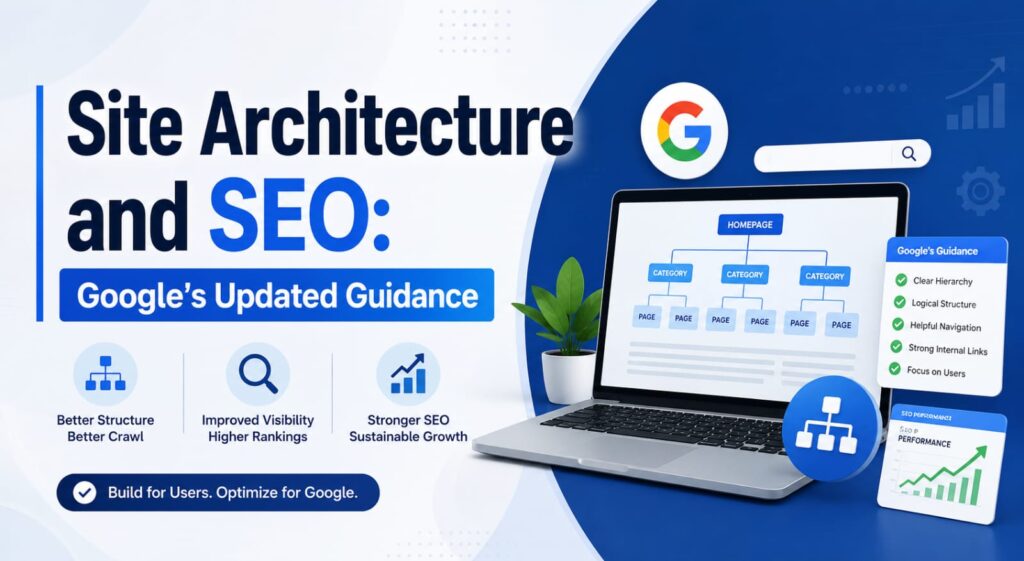
In 2026, SEO has changed dramatically. It is no longer just about publishing optimized content or building backlinks. The real competitive advantage now lies in how a website is structured at its core.
Search systems from Google have become far more advanced in understanding:
- Content relationships
- Website hierarchy
- Page importance
- Topic depth
- User navigation behavior
This means one thing clearly:
Your rankings depend not only on what you publish, but how your website is architected.
A poorly structured website behaves like a confusing library with no catalog. Even valuable content gets ignored. On the other hand, a well-structured site acts like a well-organized knowledge system that search engines can easily understand and reward.
What Is Site Architecture in SEO?
Site architecture refers to how pages are organized, grouped, and linked within a website.
It includes:
- Navigation structure
- URL hierarchy
- Internal linking
- Content categorization
- Page depth levels
Think of it as the blueprint of your website.
Simple analogy:
- Homepage = main city center
- Categories = districts
- Subcategories = neighborhoods
- Pages = individual buildings
If roads are broken or missing, neither users nor search engines can move efficiently.
Why Google Now Prioritizes Site Structure (2026 Update)
Modern search systems from Google evaluate websites using AI-based understanding models. These systems don’t just read pages—they map entire site ecosystems.
Key reasons architecture matters more today:
1. AI-based crawling prioritization
Google decides which pages matter most based on structure.
2. Topical authority modeling
Websites are grouped into subject clusters.
3. Engagement-based evaluation
User navigation behavior affects ranking signals.
4. Content relationship mapping
Pages that support each other rank better together.
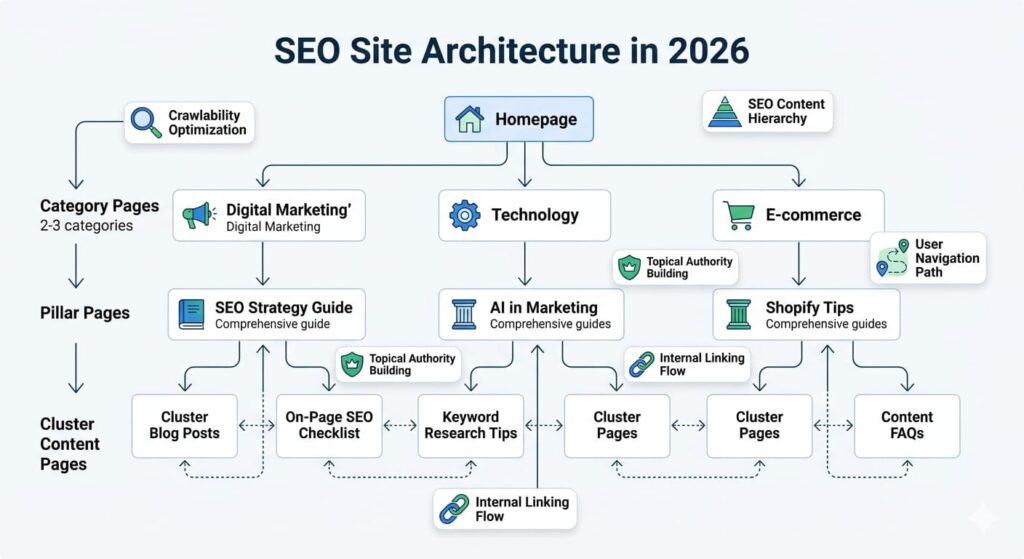
Core Principles of Modern SEO Site Architecture
1. Flat Site Architecture (Faster Crawling + Better Indexing)
A flat structure ensures that important pages are not buried deep.
Ideal structure:
Home → Category → Page
Problem structure:
Home → Blog → Year → Month → Category → Subcategory → Page → Page → Page
Why flat structure works:
- Reduces crawl depth
- Improves indexing speed
- Distributes authority evenly
- Enhances user navigation
SEO insight:
Pages beyond 4 clicks from homepage often lose ranking potential.
2. Topic Clusters: The Foundation of Modern SEO
Topic clusters are now one of the strongest ranking frameworks.
Instead of creating isolated blog posts, websites now build interconnected content systems.
Structure:
Pillar Page (Main Topic)
A long, authoritative page covering a broad topic.
Cluster Pages (Supporting Content)
Detailed subtopics that connect back to the pillar.
Internal Links
Bi-directional linking between pillar and clusters.
Example: SEO Topic Cluster
Pillar Page:
Complete Guide to SEO
Cluster Pages:
- Technical SEO Guide
- On-Page SEO Optimization
- Internal Linking Strategy
- Keyword Research Methods
- Site Architecture Guide
All pages reinforce one another, building topical authority.
Why this works:
- Search engines understand topic depth
- Authority is distributed across related pages
- Improves ranking for competitive keywords
- Strengthens semantic relevance
3. Internal Linking: The Power Distribution System
Internal linking is no longer optional—it is a ranking infrastructure.
What internal links do:
- Pass authority between pages
- Define content hierarchy
- Help crawlers discover pages
- Strengthen topical relationships
Best Internal Linking Strategy:
Rule 1: Every page must link to related pages
No isolated content.
Rule 2: Use descriptive anchor text
Avoid:
- “Click here”
- “Read more”
Use:
- “site architecture SEO strategy”
- “internal linking best practices”
Rule 3: Link toward pillar pages
Clusters should always reinforce main topics.
Internal linking architecture model:
Pillar Page
↔ Cluster Page A
↔ Cluster Page B
↔ Cluster Page C
SEO impact:
Strong internal linking can improve rankings without new backlinks.
4. URL Structure Optimization (Clean + Semantic URLs)
URLs are now considered semantic signals.
Good URL structure:
- /seo/site-architecture-guide
- /blog/internal-linking-strategy
- /seo/topic-cluster-model
Bad URL structure:
- /page?id=8891
- /blog/post-final-v3-new
- /seo/12345
Best practices:
- Keep URLs under 4–6 words
- Include primary keyword
- Avoid unnecessary folders
- Maintain consistency
5. Navigation Architecture & UX Signals
User experience is deeply tied to SEO performance.
Strong navigation should include:
- Simple top menu
- Clear categories
- Breadcrumbs
- Search bar
- Mobile-first design
Breadcrumb example:
Home → SEO → Site Architecture → Guide
Why it matters:
Search engines use navigation patterns to understand:
- Content importance
- Hierarchy
- User intent flow
6. Crawlability & Indexing Optimization
Even the best content is useless if not properly indexed.
Key technical elements:
XML Sitemap
Helps search engines discover all important pages.
Robots.txt
Controls crawler access.
Canonical Tags
Prevents duplicate content confusion.
Noindex Tags
Removes low-value pages from search index.
Critical insight:
Crawl budget is now a competitive SEO resource.
If wasted, important pages may never rank.
7. Content Silos: Building Topical Authority
Content silos group related topics into tightly structured sections.
Example:
SEO Silo:
- Technical SEO
- On-Page SEO
- Off-Page SEO
- Site Architecture
Digital Marketing Silo:
- PPC Advertising
- Social Media Marketing
- Email Marketing
- Conversion Optimization
Benefits:
- Strong thematic relevance
- Better indexing efficiency
- Higher ranking consistency
- Reduced keyword cannibalization
Mini Case Study: Site Architecture Optimization Impact
Scenario:
A content website with:
- 500+ blog posts
- No structured linking
- Weak categorization
- Multiple orphan pages
Problems identified:
- Google crawled irrelevant pages frequently
- Important content buried deep
- No clear topical authority
- High bounce rate due to poor navigation
Fix implemented:
- Created 6 pillar pages
- Built structured topic clusters
- Rebuilt internal linking system
- Simplified navigation menu
- Fixed URL structure
Results after 3 months:
- +72% organic traffic increase
- +55% faster indexing speed
- 3.2x improvement in keyword rankings
- Stronger visibility for competitive keywords
Key insight:
No new content was added—only structure was improved.
Common Site Architecture Mistakes
1. Orphan Pages
Pages with no internal links become invisible.
2. Deep Page Structures
Important content buried too deep loses ranking power.
3. Random Internal Linking
No relevance = weak SEO signals.
4. Duplicate URLs
Confuses search engines and splits authority.
5. Overcrowded Categories
Weakens topical clarity.
How Google’s Updated Guidance Changes SEO Strategy
According to evolving systems from Google:
1. Context matters more than keywords
Search understands meaning, not just terms.
2. Structure defines authority
Well-organized sites are prioritized.
3. Pages work as networks
Not standalone ranking assets.
4. UX affects indexing behavior
Better navigation improves crawl decisions.
Action Plan: Build a High-Performance SEO Architecture
Step 1: Website Audit
- Identify all pages
- Remove unnecessary URLs
- Categorize content properly
Step 2: Build Pillar Pages
- One major page per topic
- Must be comprehensive
Step 3: Create Topic Clusters
- Supporting articles
- Interlinked structure
Step 4: Optimize Internal Linking
- Add contextual links everywhere
- Strengthen pillar authority
Step 5: Improve Navigation
- Simplify menus
- Add breadcrumbs
Step 6: Technical SEO Cleanup
- Fix indexing issues
- Improve sitemap structure
- Resolve crawl errors
Future of Site Architecture (AI Search Era)
SEO is shifting toward AI-driven understanding of entire websites.
Future trends:
- Websites mapped like knowledge graphs
- Topic clusters become primary ranking units
- Internal linking becomes semantic structure
- UX signals influence indexing priority
- Authority flows through content networks
Conclusion
Site architecture is no longer a technical SEO detail—it is the foundation of modern search visibility.
A weak structure leads to:
- Poor indexing
- Lost rankings
- Weak authority flow
A strong structure leads to:
- Faster rankings
- Better crawl efficiency
- Strong topical dominance
Key takeaway:
In 2026 SEO, structure is not support—it is strategy.
If you want a complete SEO site structure, topic cluster system, or high-ranking content architecture built for modern search engines, visit http://Admavrix.com and upgrade your SEO system for 2026.