For over 20 years, the internet has worked on one simple principle: users search for information, platforms display results, and humans complete the work manually. Whether it was booking a flight, comparing products, researching a topic, or writing reports, the responsibility of execution always remained with the user.
That model is now breaking.
We are entering a new phase where artificial intelligence is no longer just a support system — it is becoming an execution layer of the internet.
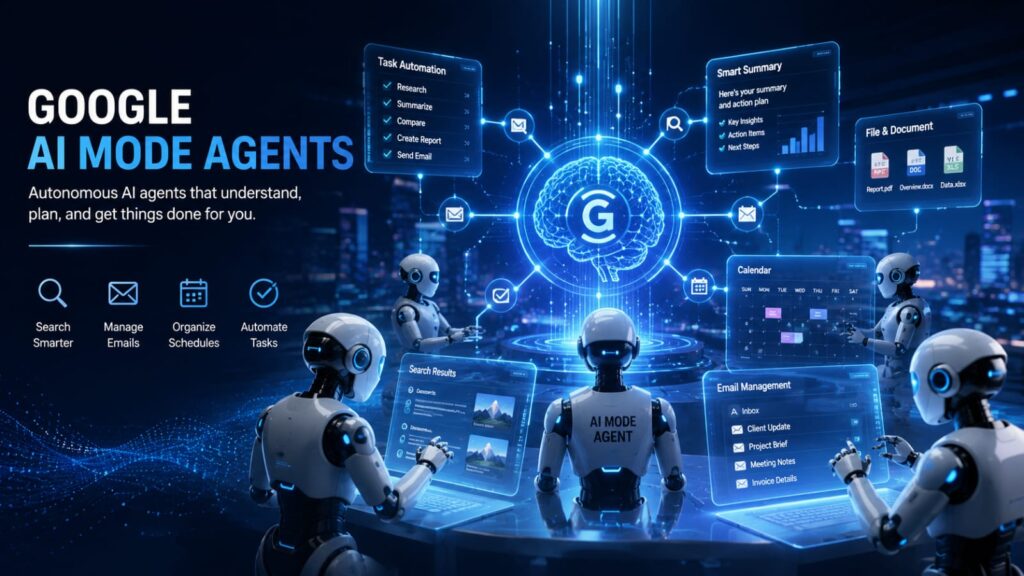
With the introduction of AI Mode Agents for Ultra subscribers, Google is shifting its core identity from a search provider to a task execution ecosystem.
Instead of simply returning links or summaries, the system now aims to understand intent, plan multi-step actions, and complete entire workflows on behalf of users.
This is a fundamental transformation.
Search is no longer the destination — it is becoming the trigger for action.
In this new model, users do not browse the web. They delegate tasks.
And this shift marks the beginning of the Agentic AI era, where artificial intelligence systems act independently until a goal is fully completed.
What Are AI Mode Agents?
AI Mode Agents are advanced AI systems designed to move beyond conversation and into execution.
They do not stop at answering questions. Instead, they continue working until the assigned task is completed.
Core Definition:
AI Mode Agents are autonomous AI systems that transform user intent into completed real-world actions
The Biggest Shift in Internet History
To understand the importance of this change, we must look at how digital systems have evolved.
Evolution of Digital Interaction
| Era | System Type | User Behavior | AI Role |
|---|---|---|---|
| Web 1.0 | Static Web | Read content | None |
| Web 2.0 | Search Engines | Search manually | Show links |
| Web 3.0 | AI Chatbots | Ask questions | Provide answers |
| Web 4.0 | AI Agents | Assign tasks | Execute workflows |
We are now transitioning into the execution-based internet, where AI becomes an active participant in completing tasks.
Why Google Introduced AI Mode Agents
The launch of AI Mode Agents is driven by major global shifts in technology and user behavior.
1. Decline of Traditional Search Behavior
Users no longer want lists of links — they want instant outcomes.
2. Rise of Autonomous AI Systems
AI competition is pushing toward systems that act, not just respond.
3. Productivity Revolution
Users and businesses want automation, not manual effort.
4. Outcome-Based Internet
The focus has shifted from:
“Find information”
to
“Get the result”
Who Can Access AI Mode Agents?
Currently, AI Mode Agents are available only to:
- Ultra subscribers (premium tier users)
- Selected enterprise users
- Early access testers
This limited rollout shows that Google is carefully testing:
- Performance
- Safety
- Reliability
- User behavior
It also signals a future where advanced AI automation becomes a premium digital layer.
Core Features of AI Mode Agents
1. Autonomous Task Execution
AI completes entire workflows without step-by-step instructions.
2. Multi-Step Reasoning
Handles complex processes such as:
- Research
- Filtering
- Comparison
- Decision-making
- Reporting
3. Deep Ecosystem Integration
Works across:
- Search
- Gmail
- Google Docs
- Calendar
- Android ecosystem
4. Context Awareness
Remembers:
- User preferences
- Past interactions
- Ongoing tasks
5. Adaptive Intelligence
Continuously improves outputs using real-time feedback and usage patterns.
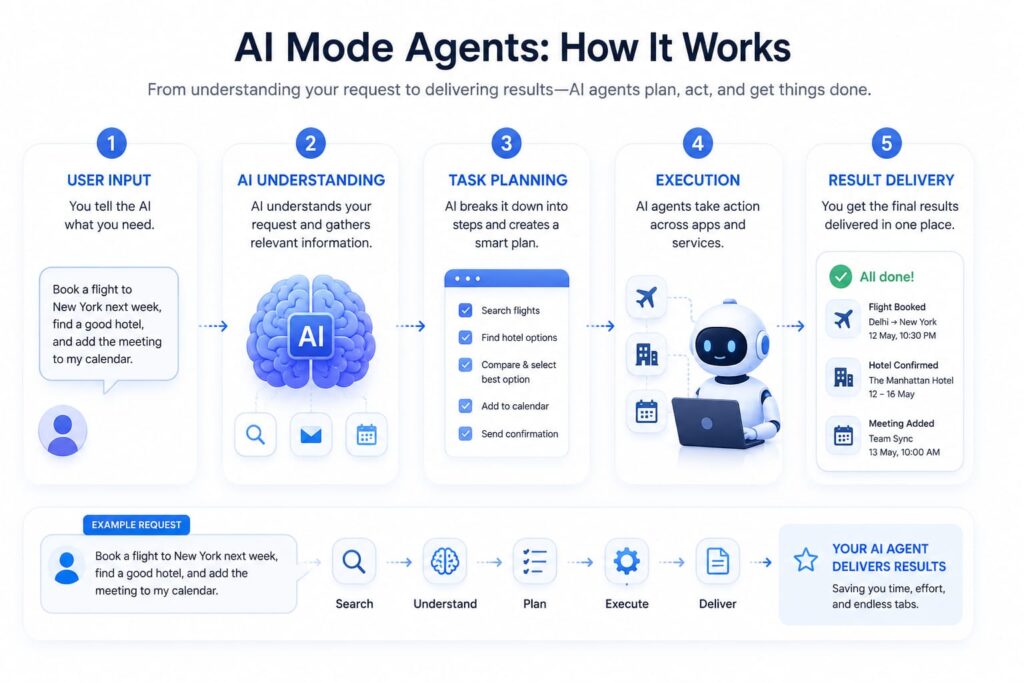
How AI Mode Agents Work (Step-by-Step)
Step 1: Intent Understanding
AI interprets the real goal behind the user’s request.
Step 2: Task Breakdown
It divides the goal into smaller actionable steps.
Step 3: Planning Phase
AI creates an execution roadmap.
Step 4: Execution Phase
It performs actions across connected applications.
Step 5: Optimization Phase
AI refines results for accuracy and relevance.
Step 6: Final Output
User receives a complete, structured outcome.
Real-World Use Cases of AI Mode Agents
Business Use Case
Generate competitor analysis for fintech startups in India
AI:
- Identifies competitors
- Collects data
- Compares features
- Builds structured report
Travel Use Case
Plan a 5-day Tokyo trip under ₹1.5 lakh
AI:
- Finds flights
- Selects hotels
- Creates itinerary
- Manages budget
Marketing Use Case
Build SEO strategy for a tech blog
AI:
- Keyword research
- Topic clustering
- Content roadmap
- Strategy execution plan
Productivity Use Case
Organize my weekly schedule
AI:
- Analyzes calendar
- Prioritizes tasks
- Schedules meetings
- Optimizes time blocks
Feature Comparison Table
| Feature | Traditional AI | Copilot AI | AI Mode Agents |
|---|---|---|---|
| Output Type | Answers | Suggestions | Completed tasks |
| Workflow | Single-step | Partial | Multi-step |
| User Role | Active worker | Collaborator | Delegator |
| Intelligence | Static | Assisted | Autonomous |
| App Integration | Limited | Moderate | Deep ecosystem |
| Decision Power | User only | Shared | AI-driven |
| Result Type | Information | Guidance | Execution |
Impact on SEO and Digital Marketing
AI Mode Agents will significantly reshape how search visibility works.
1. Rise of Zero-Click Search
Users may get answers directly without visiting websites.
2. Search Becomes Execution Layer
Search engines evolve into answer + action systems.
3. Content Must Be AI-Optimized
Winning content must be:
- Structured
- Clear
- Semantic
- Fact-driven
4. Authority Becomes Critical
Trust signals outweigh keyword density.
SEO Impact Table
| SEO Factor | Traditional Search | AI Agent Search |
|---|---|---|
| Organic Traffic | High | Reduced |
| CTR Importance | High | Medium |
| Content Style | Keyword-focused | Structured + semantic |
| Ranking Signals | Backlinks + keywords | Authority + clarity |
| User Journey | Search → Click | Search → AI answer |
| Visibility | SERP ranking | AI-generated answers |
Business Impact
1. Automation of Digital Operations
Marketing and reporting tasks become partially automated.
2. Reduced Website Dependency
Users may never visit informational websites.
3. Content Strategy Shift
Content must be designed for AI interpretation.
4. Competitive Pressure
Only high-quality structured content survives visibility changes.
Advantages of AI Mode Agents
- Faster execution
- Reduced manual effort
- Deep personalization
- Cross-platform automation
- Smarter decision-making
Challenges and Risks
1. Privacy Concerns
Requires deep access to user data.
2. Accuracy Risks
Misinterpretation may lead to incorrect outputs.
3. Over-Automation
Users may lose control in decision-making.
4. Limited Access
Currently restricted to premium users only.
Industry Transformation: The Agentic AI Era
We are entering the Agentic AI era, where systems act independently.
AI Evolution Timeline
| Phase | Description |
|---|---|
| Phase 1 | Search AI |
| Phase 2 | Assistant AI |
| Phase 3 | Copilot AI |
| Phase 4 | Agent AI |
We are now fully inside Phase 4: Autonomous Execution Systems.
Future Predictions
In the coming years:
- AI will book complete travel plans automatically
- Businesses will run AI-powered dashboards
- Personal AI agents will manage schedules
- Websites will become secondary interfaces
- AI will become the primary digital layer
The internet will shift from manual browsing to automated execution ecosystems.
Key Takeaways
- Google AI Mode Agents redefine search into execution
- AI now completes tasks instead of only answering
- SEO is shifting toward structured AI-friendly content
- Businesses must adapt to AI-first discovery
- Internet is becoming outcome-driven
FAQ
What are Google AI Mode Agents?
They are autonomous AI systems that execute tasks instead of just answering queries.
Who can access AI Mode Agents?
Currently Ultra subscribers and selected users.
How are they different from chatbots?
They perform real-world tasks across apps instead of just responding.
Will they impact SEO?
Yes, they may reduce clicks and increase zero-click results.
Is this the future of Google Search?
Yes, it represents a shift toward execution-based search.
Conclusion: The Internet Is Becoming Autonomous
Google AI Mode Agents represent a historic turning point in digital evolution.
We are moving from:
“Search for information”
to:
“Assign tasks and receive completed results”
This shift changes everything:
- SEO strategy
- Business models
- Content creation
- User behavior
- Digital workflows
The internet is no longer just a place to find information — it is becoming a system that acts for you.
To stay ahead in AI, SEO, and digital transformation trends, visit http://Admavrix.com for expert insights, future strategies, and high-quality guides designed for the next generation of digital growth.