
Search has always been the foundation of how information is discovered on the internet.
For decades, the system was simple: users typed a query, search engines returned a list of ranked blue links, and websites competed for position. The higher the ranking, the more visibility and traffic a page received.
This model created the entire SEO industry, influencing content creation, advertising, publishing, and even business models across the internet.
But that system is now undergoing a structural transformation.
AI-powered search engines no longer rely solely on ranking pages. Instead, they generate direct answers by analyzing multiple sources, interpreting meaning, and synthesizing responses in real time.
This shift is not an update to SEO — it is a redesign of search itself.
And in this new environment, visibility is no longer defined by ranking position. It is defined by whether your content is selected, trusted, and cited inside AI-generated responses.
This is the beginning of the AI citation economy.
How Zero-Click Search Is Reshaping User Behavior
The foundation of this transformation is changing user behavior.
Earlier, users actively browsed the web. They clicked multiple links, compared sources, and spent time navigating different pages before forming conclusions.
Today, behavior is drastically different.
Users now:
- Expect instant answers without browsing
- Rely heavily on AI-generated summaries
- Avoid opening multiple search results
- Prefer consolidated responses over exploration
This has led to a major rise in zero-click search behavior, where users get answers directly on the search interface without visiting websites.
As a result, even top-ranking pages are experiencing reduced traffic despite maintaining strong positions.
This shift is forcing marketers to rethink what “visibility” actually means.
Why AI Search Is Replacing Traditional Ranking Systems
Traditional search engines were built on indexing and ranking.
AI search systems operate differently. They do not simply list results — they interpret information.
Instead of ranking pages, AI systems:
- Analyze multiple sources simultaneously
- Extract relevant knowledge
- Evaluate consistency across data points
- Identify authoritative signals
- Generate unified responses
This fundamentally changes the role of content on the internet.
Content is no longer just something to be ranked.
It is something to be interpreted.
And only content that is clear, structured, and authoritative is selected for AI-generated responses.
Ranking vs Citation: The New Visibility Economy
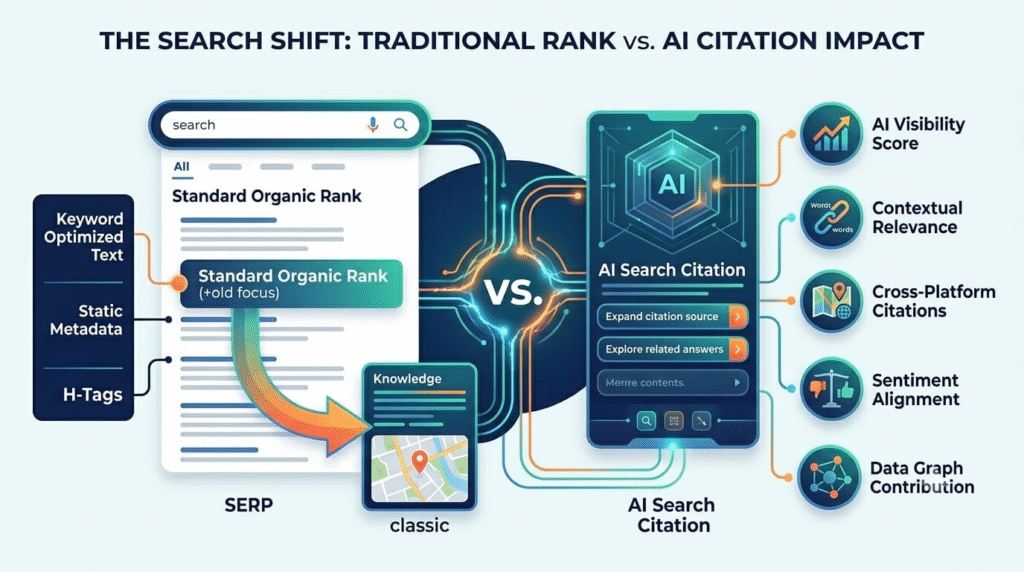
The most important shift in modern SEO is the transition from ranking-based visibility to citation-based visibility.
In traditional SEO:
- Ranking in top positions guaranteed traffic
- Visibility was tied directly to SERP placement
- Click-through rate defined success
In AI-driven search:
- Being cited matters more than ranking
- Visibility happens inside AI-generated answers
- Traffic is no longer guaranteed even with top rankings
📊 Ranking vs Citation Comparison
| Factor | Traditional SEO Ranking | AI Citation System |
|---|---|---|
| Visibility | Search result position | Mention inside AI response |
| Success Metric | Rank #1–#10 | Being cited as a source |
| Traffic Outcome | High click-through potential | Often reduced clicks |
| Optimization Focus | Keywords & backlinks | Authority & clarity |
| Competition | Position-based | Inclusion-based |
The key shift is simple:
👉 Rankings show where you stand
👉 Citations show whether you matter
How AI Systems Decide What Content Gets Cited
AI search engines do not rely on traditional ranking signals alone.
Instead, they evaluate content through a reasoning-based process.
They:
- Break down content into meaningful segments
- Compare information across multiple sources
- Identify consistency and factual alignment
- Assess authority signals across the web
- Extract the most reliable and relevant insights
This means content selection is no longer based on keyword density or backlinks alone.
Instead, AI prioritizes:
- Clarity of explanation
- Structural organization
- Factual accuracy
- Context completeness
- Trustworthiness of source patterns
Poorly structured or ambiguous content is far less likely to be included in AI-generated answers.
Why Click-Based SEO Traffic Is Declining in 2026
One of the most visible effects of AI search adoption is declining organic click-through rates.
Even when websites rank highly, users often do not click because:
- Answers are already provided directly by AI
- Summaries remove the need for exploration
- Users trust synthesized responses more than individual websites
This is a fundamental disruption in the traditional SEO funnel.
Traffic is no longer automatically linked to visibility.
Instead, visibility is now fragmented across:
- Search rankings
- AI-generated answers
- Knowledge panels
- Citation mentions
This reduces dependency on website visits as the primary success metric.
How Brands Are Building AI-First Content Strategies
Businesses are adapting quickly to this new ecosystem by redesigning their content strategies.
1. Authority-First Content Creation
Instead of focusing on keyword targeting, brands are prioritizing:
- Expert-driven insights
- Deep topical coverage
- Fact-based explanations
AI systems reward credibility over repetition.
2. Structured Information Design
Well-structured content is significantly easier for AI systems to process.
High-performing content includes:
- Clear headings
- Logical flow
- Short paragraphs
- Tables and comparisons
- Direct explanations
Structure is now a visibility factor.
3. Topic Ecosystem Development
Instead of publishing isolated blogs, brands are building interconnected topic clusters.
This helps AI systems understand:
- Depth of expertise
- Content consistency
- Domain authority
4. Cross-Platform Authority Signals
AI systems evaluate trust signals beyond a single website.
Mentions across:
- Social platforms
- Industry websites
- News sources
strengthen overall citation probability.
Core Challenges in the AI Citation Ecosystem
While this shift creates opportunity, it also introduces significant challenges.
1. Reduced Organic Traffic Dependence
Websites may lose direct visitors even with strong rankings.
2. Lack of Visibility Transparency
It is difficult to track when or how AI systems cite content.
3. Algorithmic Dependency
AI models determine visibility without clear ranking rules.
4. Increased Competition for Authority
Only high-trust sources consistently appear in citations.
5. Uneven Impact on Smaller Publishers
New or low-authority websites may struggle to gain inclusion.
New Growth Opportunities in AI-Driven Search Visibility
Despite challenges, this shift opens powerful new opportunities.
1. Early AI Adoption Advantage
Early optimized content gains disproportionate visibility.
2. Authority Compounding Effect
Once cited, content is more likely to be reused and referenced.
3. Reduced Keyword Competition Pressure
Visibility is no longer limited to ranking positions.
4. Long-Term Brand Strength Building
AI systems reinforce consistent authoritative sources over time.
The Future of Search: From Ranking Systems to Knowledge Layers
Search is evolving into a multi-layered ecosystem combining:
- Traditional SEO rankings
- AI-generated answers
- Entity-based recognition systems
- Citation-based authority networks
This emerging model is often described as:
👉 AI Visibility Optimization (AIO)
In this system, success depends on:
- Trust signals
- Content clarity
- Information structure
- Domain authority
- Consistency across the web
Search is no longer a list of results.
It is becoming a knowledge interpretation system.
Why AI Visibility Will Define Digital Authority
This transformation is not limited to SEO — it is reshaping digital authority itself.
If AI becomes the primary interface for information discovery, then:
- AI decides which sources are visible
- AI determines what information is trusted
- AI controls how knowledge is summarized
- AI influences traffic distribution patterns
This means visibility is no longer just about search engines.
It is about being part of the knowledge layer itself.
Brands that fail to adapt risk becoming invisible even if they rank.
Conclusion: The Shift From Ranking to Recognition
The search landscape is undergoing its most significant transformation in decades.
We are moving from a system where websites compete for rankings to a system where they compete for inclusion in AI-generated answers.
This is the essence of the AI citation impact shift.
In the future of search, visibility will not be defined by position.
It will be defined by recognition.
The brands that understand this shift early will not just rank higher — they will become part of the AI knowledge ecosystem that defines how information is delivered globally.
FAQ (SEO Optimized)
What is AI citation in SEO?
AI citation is when artificial intelligence systems use your content as a source within generated answers instead of simply listing your page in search results.
How is AI citation different from traditional SEO ranking?
SEO ranking determines position in search results, while AI citation determines whether your content is included inside AI-generated responses.
Can high-ranking pages lose traffic in AI search?
Yes. Even top-ranked pages can lose traffic if AI systems provide direct answers without requiring users to click through.
How can websites improve AI visibility?
By creating structured, authoritative, and clearly written content that AI systems can easily interpret and trust.
Is SEO still relevant in 2026?
Yes. SEO still matters, but it now works alongside AI visibility optimization and citation-based discovery systems.
Stay ahead of the search evolution and AI-driven visibility era.
👉 Visit: https:http://Admavrix.com
👉 Learn advanced AI search, SEO, and digital growth strategies
👉 Adapt early to the future of AI-powered discovery
