Artificial Intelligence has evolved from an emerging technology into one of the most important business tools of the modern era.
In 2026, brands face unprecedented challenges. Customers have more choices, more information, and higher expectations than ever before. A single negative review can spread across social media in minutes. A poor customer experience can result in lost revenue and damaged trust. At the same time, competitors are using advanced technologies to improve marketing performance and gain market share.
This is why AI has become a strategic necessity rather than a luxury.
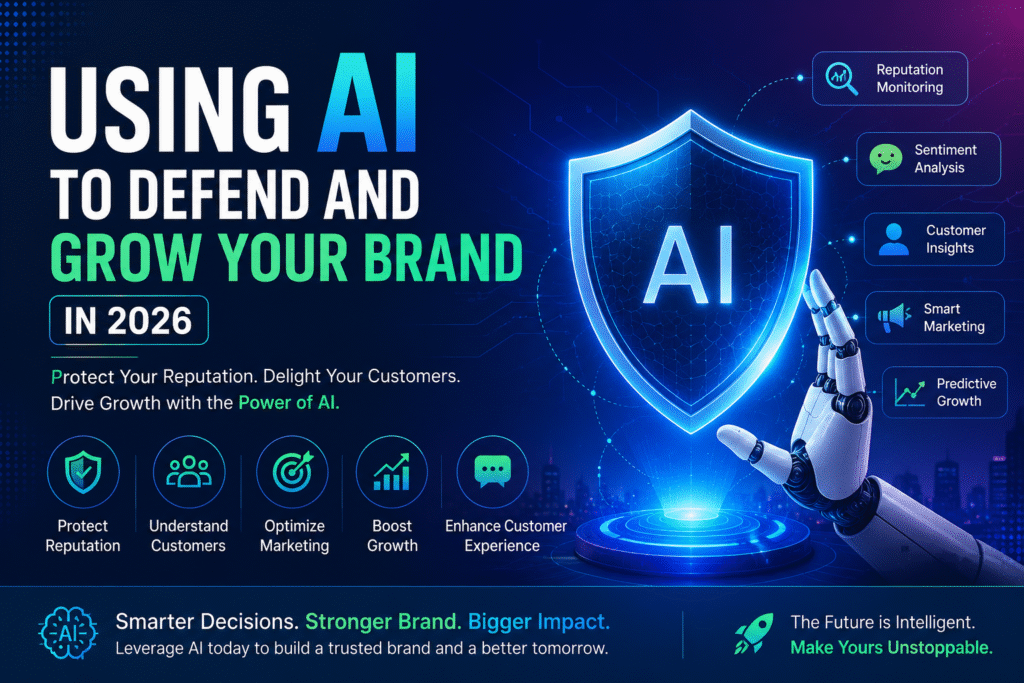
Businesses are increasingly using artificial intelligence to protect their reputation, understand customer behavior, improve marketing campaigns, optimize customer experiences, and identify growth opportunities before competitors do.
The companies that thrive in 2026 will not simply use AI for automation. They will use AI as both a shield and a growth engine.
Why AI Matters for Modern Brands
Consumers interact with brands through multiple channels every day.
These channels include:
- Search engines
- Social media
- Online reviews
- Email marketing
- AI-powered assistants
- E-commerce platforms
- Community forums
Managing all these touchpoints manually is becoming increasingly difficult.
AI helps businesses process massive amounts of information and transform data into actionable insights.
Instead of reacting to problems after they occur, brands can proactively identify risks and opportunities.
The Biggest Brand Challenges in 2026
Modern businesses face numerous threats that can impact reputation and growth.
Common Challenges
| Challenge | Business Impact |
|---|---|
| Fake Reviews | Reduced customer trust |
| Negative Social Media Trends | Reputation damage |
| Rising Advertising Costs | Lower ROI |
| Customer Churn | Revenue loss |
| Brand Impersonation | Trust issues |
| Misinformation | Customer confusion |
| Competitive Pressure | Market share decline |
AI provides solutions to each of these challenges.
AI as a Brand Defense System
One of the most valuable uses of AI is protecting brand reputation.
AI-powered monitoring tools can track conversations across thousands of websites and platforms in real time.
This includes:
- Social media platforms
- Review websites
- News publications
- Industry blogs
- Customer support channels
- Online communities
Instead of manually reviewing content, AI automatically identifies patterns, trends, and risks.
AI-Powered Reputation Monitoring
Traditional reputation management often relies on manual observation.
AI changes this completely.
Traditional Monitoring vs AI Monitoring
| Traditional Method | AI Method |
| Manual searches | Automated monitoring |
| Delayed response | Real-time alerts |
| Limited visibility | Full digital visibility |
| Human-only analysis | Predictive insights |
| Slow crisis detection | Early warning system |
This allows businesses to respond quickly before problems escalate.
Understanding Customer Sentiment
Customer sentiment influences buying decisions, loyalty, and brand perception.
AI-powered sentiment analysis evaluates:
- Customer reviews
- Social media comments
- Survey responses
- Support tickets
- Online discussions
The technology determines whether conversations are positive, neutral, or negative.
This gives businesses a clear understanding of public perception.
For example, if negative sentiment suddenly increases, brands can investigate and address the issue immediately.
Fighting Fake Reviews and Brand Attacks
Fake reviews remain one of the biggest threats to online credibility.
Consumers rely heavily on reviews before making purchasing decisions.
AI helps identify:
- Review spam
- Fake accounts
- Coordinated attacks
- Bot-generated content
- Fraudulent engagement
This helps businesses maintain trust and transparency.
Trust remains one of the most important factors influencing customer decisions.
AI and Crisis Prevention
Brand crises rarely happen without warning signs.
AI can identify:
- Sudden spikes in negative mentions
- Emerging complaints
- Viral discussions
- Reputation risks
- Public sentiment shifts
By detecting warning signals early, businesses can take corrective action before a crisis develops.
How AI Helps Grow Your Brand
While brand protection is essential, growth remains the primary objective for most businesses.
AI supports growth by helping companies:
- Understand customers better
- Improve personalization
- Increase conversions
- Optimize advertising
- Improve customer retention
- Create better content
The strongest brands use AI to balance defense and growth.
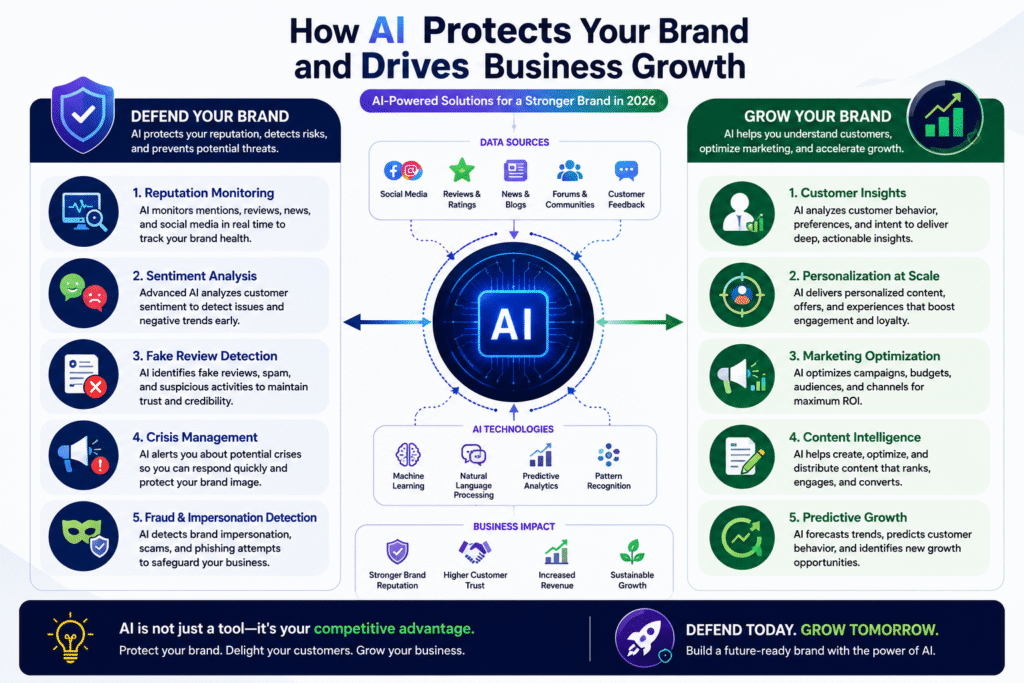
Customer Insights: Understanding Your Audience Better
One of AI’s greatest strengths is data analysis.
Businesses collect enormous amounts of customer information every day.
AI can analyze:
- Purchase history
- Website activity
- Product preferences
- Social media engagement
- Email interactions
This allows businesses to identify patterns that humans might miss.
The result is a deeper understanding of customer needs and behaviors.
AI-Powered Personalization
Consumers increasingly expect personalized experiences.
Generic marketing campaigns are becoming less effective.
AI enables:
- Personalized product recommendations
- Dynamic website content
- Customized email campaigns
- Individualized advertising
- Tailored customer journeys
Benefits of Personalization
| Traditional Marketing | AI Personalization |
| Generic messaging | Personalized messaging |
| Lower engagement | Higher engagement |
| Lower conversions | Better conversions |
| Limited relevance | High relevance |
Personalization creates stronger customer relationships and improves loyalty.
AI and Content Marketing
Content remains a critical component of digital marketing.
AI helps marketers:
- Discover trending topics
- Identify audience interests
- Generate content ideas
- Improve SEO
- Analyze engagement
However, AI works best when combined with human creativity.
The most effective content strategies combine data-driven insights with authentic storytelling.
AI and SEO in 2026
Search is changing rapidly.
Businesses must now optimize for both traditional search engines and AI-powered search experiences.
AI tools can help marketers:
- Identify keyword opportunities
- Analyze competitors
- Improve content structure
- Optimize metadata
- Track search trends
As AI-generated search results become more common, authority and trust will become increasingly important ranking factors.
AI-Powered Advertising
Advertising platforms are becoming increasingly dependent on AI.
AI helps marketers:
- Improve targeting
- Optimize budgets
- Predict conversions
- Analyze audience behavior
- Increase ROI
Traditional Advertising vs AI Advertising
| Traditional Advertising | AI Advertising |
| Manual optimization | Automated optimization |
| Broad targeting | Precision targeting |
| Reactive adjustments | Predictive adjustments |
| Slower decision-making | Real-time optimization |
This improves efficiency and reduces wasted ad spend.
AI and Customer Retention
Acquiring a new customer often costs significantly more than retaining an existing one.
AI helps businesses identify customers who may be at risk of leaving.
Indicators include:
- Reduced engagement
- Lower purchasing frequency
- Support complaints
- Subscription inactivity
By identifying these patterns early, businesses can implement targeted retention strategies.
Predictive Analytics: The Next Competitive Advantage
One of AI’s most powerful capabilities is prediction.
Predictive analytics helps businesses:
- Forecast demand
- Anticipate market changes
- Predict customer behavior
- Improve inventory planning
- Identify revenue opportunities
This allows companies to make proactive decisions rather than reactive ones.
Building an AI-Powered Brand Strategy
Successful businesses use AI across multiple functions.
AI Brand Strategy Framework
| Brand Defense | Brand Growth |
| Reputation Monitoring | Customer Insights |
| Sentiment Analysis | Personalization |
| Fraud Detection | Lead Generation |
| Crisis Prevention | Marketing Optimization |
| Review Management | Revenue Growth |
The best results come from balancing protection and growth initiatives.
Ethical AI and Consumer Trust
As AI adoption increases, businesses must use it responsibly.
Key principles include:
- Transparency
- Data privacy
- Human oversight
- Ethical decision-making
- Fair treatment of customers
Technology should strengthen trust, not undermine it.
Businesses that prioritize responsible AI practices will build stronger customer relationships.
Preparing for the Future of AI
The role of AI in marketing and brand management will continue to expand.
Future developments may include:
- Hyper-personalized customer experiences
- Advanced predictive intelligence
- Automated reputation forecasting
- AI-driven strategic planning
- Enhanced customer engagement systems
Organizations that invest early in AI capabilities will be better positioned for long-term success.
Conclusion
Artificial Intelligence is reshaping how brands operate in 2026.
From protecting reputation and monitoring customer sentiment to improving personalization and driving growth, AI offers opportunities that were unimaginable just a few years ago.
The most successful businesses are not using AI simply to automate tasks. They are using it to strengthen customer relationships, improve decision-making, and create sustainable competitive advantages.
As digital competition continues to increase, brands that embrace AI strategically will be better equipped to defend their reputation, earn customer trust, and accelerate growth.
The future belongs to businesses that combine human creativity with AI-powered intelligence.
Frequently Asked Questions
How can AI protect a brand’s reputation?
AI monitors online conversations, detects negative sentiment, identifies risks, and helps businesses respond before issues become crises.
Can AI improve customer retention?
Yes. AI identifies customers at risk of leaving and helps businesses create personalized retention strategies.
Is AI useful for small businesses?
Absolutely. Many affordable AI tools help small businesses improve marketing performance and customer experiences.
Does AI replace marketers?
No. AI enhances marketing by providing insights and automation, while human creativity and strategy remain essential.
What is the biggest advantage of AI for brands?
The ability to combine brand protection, customer insights, marketing optimization, and growth strategies into a single intelligent system.
Stay Ahead with Admavrix
Want to stay updated on AI, SEO, digital marketing, and business growth trends?
Visit http://Admavrix.com for expert insights, practical strategies, and the latest industry updates designed to help businesses succeed in the AI-driven future.