Search engines are no longer just tools for finding information—they are powerful gatekeepers of visibility, reputation, and revenue.
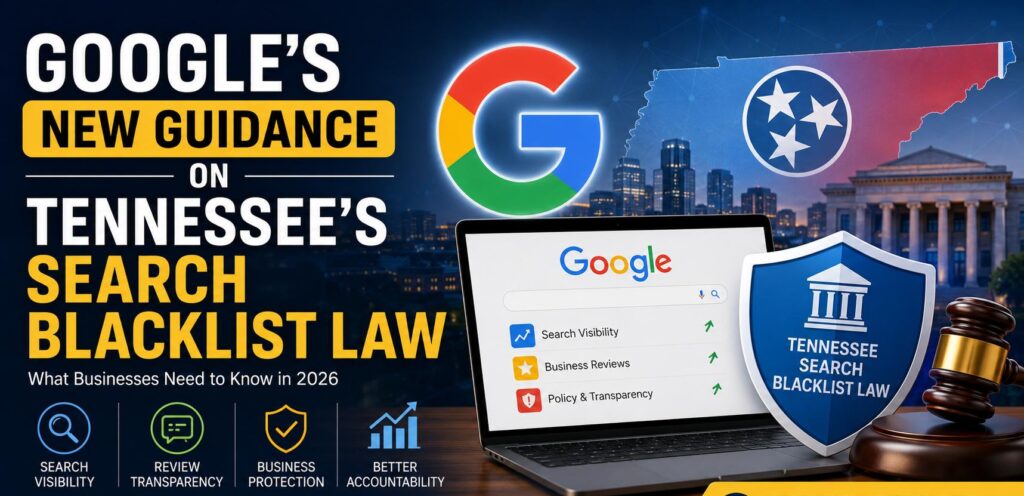
In 2026, this influence is being challenged by new regulations, including Tennessee’s controversial Search Blacklist Law (SB 2262). The law aims to give small businesses more transparency when their visibility, rankings, or reviews change unexpectedly on platforms like Google Search.
In response, Google has issued new guidance explaining how businesses can monitor their search presence, request explanations, and use official tools to track visibility changes.
This development is not just legal news—it is a major shift in how SEO, digital marketing, and online reputation management will work in the future.
What Is Tennessee’s Search Blacklist Law?
Tennessee’s SB 2262 is designed to protect small businesses (generally those with 50 or fewer employees) from unexplained visibility losses in search engines.
The law focuses on three major concerns:
1. Search Visibility Drops
If a business suddenly loses rankings or disappears from search results.
2. Listing Removal
If a website or business page is removed from search indexing.
3. Review Deletions
If 25% or more reviews are removed from a business profile.
These scenarios are collectively referred to as “blacklisting” under the law.
However, it is important to understand:
This is not “blacklisting” in the traditional SEO sense—it refers to algorithmic or policy-based visibility changes.
Why This Law Was Created
Small businesses rely heavily on Google for survival.
A single ranking drop can mean:
- Fewer calls
- Reduced store visits
- Lower website traffic
- Loss of customer trust
- Decreased revenue
Before this law, businesses often had no clear explanation when visibility dropped.
Tennessee lawmakers aimed to create:
- More transparency
- Faster response systems
- Clear appeal processes
- Better accountability from search engines
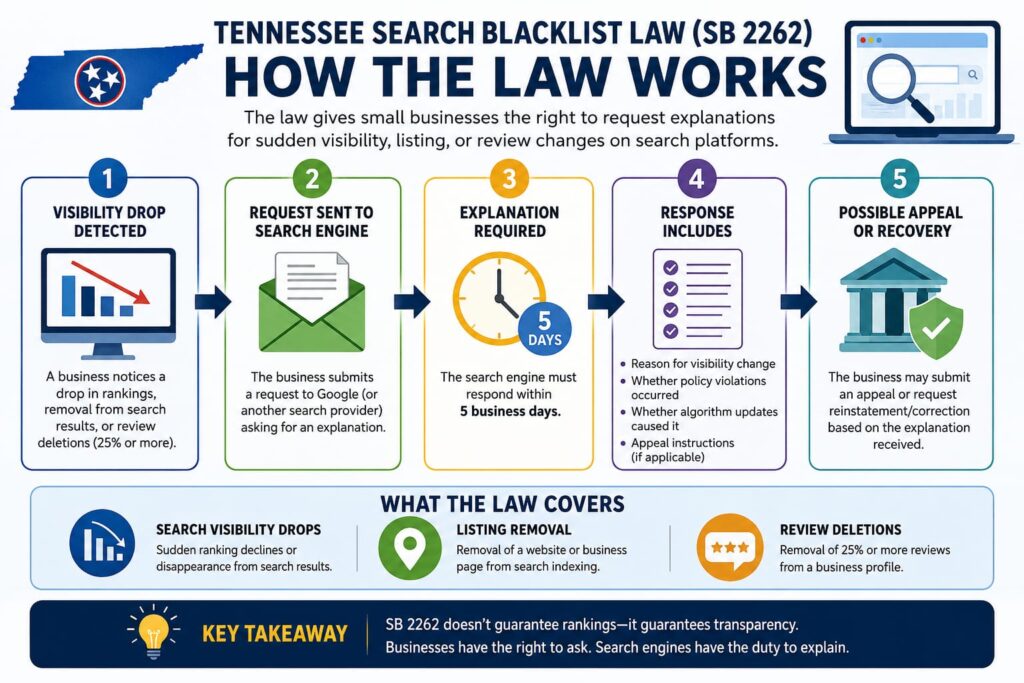
How the Law Works (Step-by-Step)
The final version of SB 2262 does NOT force automatic notifications.
Instead, it gives businesses the right to request explanations.
Step 1: Visibility Drop Detected
A business notices ranking or traffic decline.
Step 2: Request Sent to Search Engine
The business contacts Google or another search provider.
Step 3: Explanation Required
Search engines must respond within 5 business days.
Step 4: Response Includes:
- Reason for visibility change
- Whether policy violations occurred
- Whether algorithm updates caused it
- Appeal instructions (if applicable)
Step 5: Possible Appeal or Recovery
Businesses may request reinstatement or correction.
Google’s Official Guidance Response
Google responded quickly with updated guidance to help businesses comply with and understand the system better.
The company emphasized three key platforms:
1. Google Search Console
Search Console is the primary control center for website visibility.
It provides:
- Indexing status
- Manual penalty alerts
- Security warnings
- Search performance tracking
- Removal notifications
👉 Businesses must verify their website here to receive critical updates.
2. Google Business Profile
For local businesses, this is essential.
It manages:
- Google Maps visibility
- Customer reviews
- Business information
- Local ranking signals
Since the law includes review removal concerns, this tool becomes extremely important.
3. Google Merchant Center
For e-commerce businesses:
- Product listing control
- Shopping visibility
- Policy alerts
- Feed performance tracking
Does Google Really “Blacklist” Websites?
The term “blacklist” is misleading.
Google does NOT manually blacklist businesses randomly.
Instead, ranking changes occur due to:
Algorithm Updates
Google constantly updates its ranking systems.
Content Quality Issues
Low-value or spam-like content may lose rankings.
Technical SEO Problems
Such as:
- Broken pages
- Slow loading speed
- Crawl errors
Policy Violations
- Spam links
- Manipulative SEO
- Hidden content
Security Issues
- Malware
- Hacked websites
So what businesses call “blacklisting” is usually a technical or algorithmic change, not intentional suppression.
Why Review Removal Is a Big Deal
One of the most controversial parts of the law is review deletion.
Reviews influence:
- Customer trust
- Click-through rates
- Conversion rates
- Local rankings
- Brand reputation
Example Impact:
If a business loses 25%+ reviews:
- Trust score drops
- Fewer customers click listing
- Ranking signals weaken
- Competitors gain advantage
This is why Tennessee included review transparency in the law.
SEO Industry Impact
This law is a warning signal for SEO professionals.
Agencies must now focus on:
1. Transparent Reporting
Clients will demand clearer explanations for ranking changes.
2. Stronger Monitoring Systems
Tracking:
- Traffic drops
- Ranking volatility
- Review changes
3. Compliance-Based SEO
Avoid risky tactics that could trigger penalties.
4. Better Documentation
Keeping records of SEO actions becomes essential.
What This Means for Businesses in 2026
This law does NOT guarantee rankings or protection.
Instead, it ensures:
- Better communication
- Faster explanations
- Increased accountability
Businesses still face:
- Algorithm updates
- Competition
- Content quality filters
- Technical issues
But now they have a clearer path to understand what happened.
Common Reasons for Ranking Drops
Many businesses misunderstand ranking losses.
Here are the real causes:
| Cause | Explanation |
|---|---|
| Algorithm updates | Google changes ranking systems |
| Weak content | Low-quality or outdated pages |
| SEO mistakes | Keyword stuffing, bad backlinks |
| Technical errors | Indexing or speed issues |
| Competition | Other websites outperforming |
How Businesses Should Respond
To stay protected, businesses should follow these steps:
Step 1: Use Google Search Console
Monitor visibility and alerts.
Step 2: Manage Reviews Actively
Respond and track review changes.
Step 3: Improve Content Quality
Focus on helpful, original content.
Step 4: Fix Technical SEO
Improve speed, structure, and indexing.
Step 5: Stay Policy Compliant
Avoid spam tactics.
Future of Search Transparency
Tennessee’s law may inspire similar regulations globally.
We may soon see:
- Mandatory visibility reports
- Standardized ranking explanations
- More legal oversight on search engines
- Increased transparency in AI search results
Search is evolving from a “black box” system into a regulated transparency ecosystem.
Why This Matters for Marketers
Digital marketers must adapt quickly.
SEO is no longer just about rankings—it is about:
- Trust
- Compliance
- Data transparency
- Platform accountability
Those who adapt will gain a major competitive advantage.
Final Takeaway
Google’s new guidance on Tennessee’s Search Blacklist Law highlights a major shift in how search visibility is managed and understood.
While it does not change how rankings are calculated, it introduces:
- Better communication systems
- Structured explanation requests
- Improved transparency between businesses and search engines
For businesses, the message is clear:
SEO success in 2026 depends on compliance, quality, and visibility management—not shortcuts.
If you want to improve your Google rankings, SEO performance, or digital visibility strategy, our team at:
http://Admavrix.com
can help you with:
- Advanced SEO optimization
- Google Business Profile growth
- Reputation management
- Content marketing strategy
- Technical SEO audits
Take control of your visibility before algorithm changes take control of you.
Visit: https://Admavrix.com