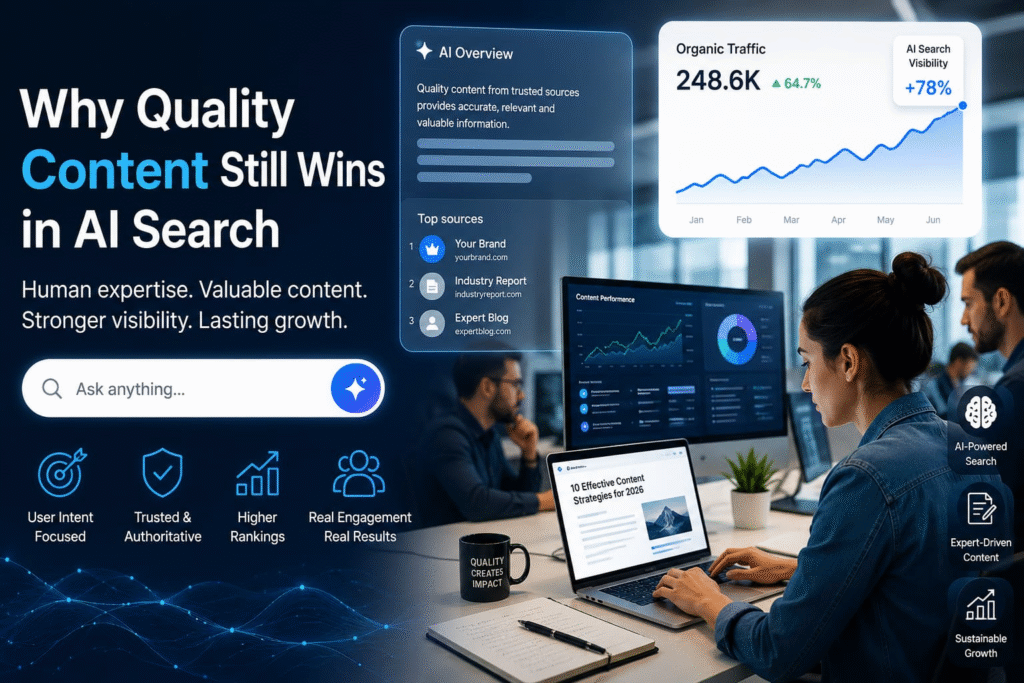
AI search is rapidly changing how users discover content online. From Google AI Overviews to conversational search assistants, businesses are entering a new era where algorithms can summarize, recommend, and rank information faster than ever before.
But despite the rise of automation, one reality remains unchanged: quality content still wins in AI search.
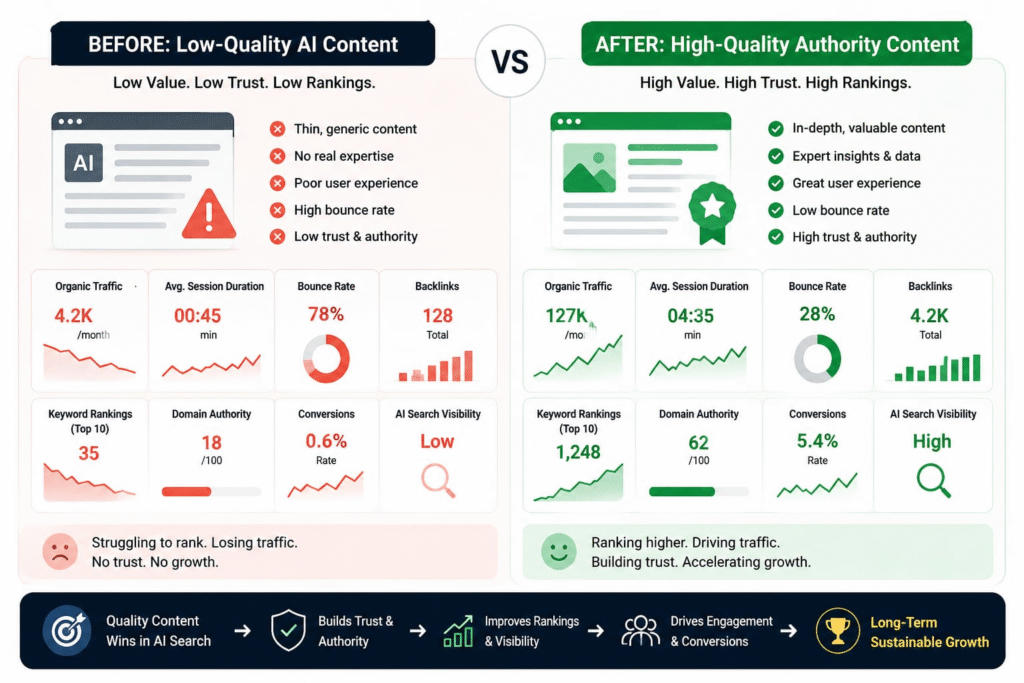
Many marketers believed AI-generated content would dominate rankings simply because it could be produced at scale. Instead, search engines are rewarding brands that provide expertise, trustworthiness, relevance, and genuine value to users.
Today’s AI-powered search systems are smarter. They evaluate content quality, authority, engagement, and usefulness — not just keywords. Businesses publishing low-value, repetitive content are seeing declining visibility, while companies investing in expert-led, high-quality content continue gaining organic traffic and customer trust.
For business owners, CMOs, and marketing leaders, this shift creates both a challenge and an opportunity. Brands that prioritize content quality now will build stronger visibility, higher conversions, and long-term authority in 2026 and beyond.
Table 1: Content Strategies in AI Search
| Content Type | Best For | Cost | Key Benefit | Difficulty |
| Expert Long-Form Blogs | SEO authority | Medium | Higher rankings and trust | Medium |
| AI-Generated Generic Articles | Fast publishing | Low | Quick content production | Low |
| Research-Based Reports | Thought leadership | High | Strong backlinks and authority | High |
| Video + Written Hybrid Content | Engagement | Medium | Better retention and user experience | Medium |
| Case Studies & Industry Guides | Lead generation | Medium | Higher conversion rates | Medium |
Why Why Quality Content Still Wins in AI Search Matters for Business Growth in 2026
AI Search Engines Prioritize Authority and Trust
Modern AI search engines are no longer relying solely on keyword density or backlinks. Instead, they are designed to identify trustworthy, authoritative, and highly relevant information.
Google’s AI-driven search ecosystem increasingly evaluates:
- Expertise
- Content depth
- Accuracy
- User engagement
- Source credibility
- Freshness of information
This means businesses producing shallow or mass-generated AI content often struggle to maintain rankings over time.
For example, a healthcare company publishing medically reviewed educational articles is far more likely to gain visibility than websites generating generic AI summaries without expertise or credibility.
Businesses that consistently publish reliable information are becoming preferred sources for AI-generated search responses.
Search Intent Has Become the Core Ranking Factor
In 2026, search intent matters more than ever.
AI-powered search systems aim to provide complete and accurate answers to user queries. Brands that deeply understand customer pain points and provide actionable solutions are outperforming competitors using outdated SEO tactics.
Successful content today focuses on:
- Solving real problems
- Providing actionable insights
- Answering questions clearly
- Using examples and data
- Improving readability and engagement
For example, a SaaS company writing about “AI marketing automation” will rank better if the article explains implementation strategies, ROI expectations, workflows, and practical use cases instead of publishing a basic keyword-focused overview.
The brands winning in AI search are those creating genuinely helpful experiences.
High-Quality Content Builds Long-Term Brand Equity
Content is no longer just an SEO tool — it is a trust-building asset.
Businesses that consistently publish authoritative content gain:
- Higher organic traffic
- Better conversion rates
- Increased backlinks
- Stronger brand recognition
- Improved customer trust
AI search engines frequently surface trusted brands repeatedly. Once a company establishes authority within a niche, it becomes easier to dominate future search visibility.
This is especially important for B2B companies where purchase decisions involve trust, expertise, and long-term relationships.
A strong content strategy compounds over time, creating sustainable growth instead of short-term traffic spikes.
Why Quality Content Still Wins in AI Search vs AI Content Farms vs Keyword Stuffing
| Strategy | Cost | Results | Time Required | Best Use Case |
| Quality Content Strategy | Medium | Sustainable long-term growth | Medium to Long | Brand authority and conversions |
| AI Content Farms | Low | Short-term traffic spikes | Short | Mass publishing |
| Keyword Stuffing SEO | Low | Poor long-term performance | Short | Outdated SEO methods |
| Expert-Led Thought Leadership | High | Strong authority and trust | Long | Enterprise positioning |
3 Real-World Examples of Why Quality Content Still Wins in AI Search Driving Results
HubSpot: Building an Inbound Marketing Empire
became one of the strongest examples of content-driven business growth through educational marketing.
Strategy
The company focused heavily on SEO blogs, downloadable resources, templates, research reports, and educational content targeting marketers and sales professionals.
Result
HubSpot generated millions of monthly organic visits and established itself as an industry authority in inbound marketing and CRM solutions.
Its content ecosystem continues to outperform low-quality AI-generated competitors because it prioritizes user value and expertise.
Shopify: Winning Through Search Intent Optimization
invested in comprehensive educational content designed specifically for entrepreneurs and online store owners.
Strategy
Instead of creating generic SEO pages, Shopify produced detailed tutorials, e-commerce growth strategies, and conversion-focused business guides.
Result
The company became a dominant organic search presence across e-commerce and entrepreneurship-related keywords, contributing significantly to customer acquisition growth.
Semrush: Leveraging Proprietary Data for Authority
used data-driven content to establish itself as a trusted authority in digital marketing.
Strategy
The brand regularly publishes original research studies, SEO benchmark reports, and search trend analysis backed by proprietary platform data.
Result
Their research-based articles attract thousands of backlinks, improve domain authority, and generate significant organic visibility across competitive keywords.
This demonstrates how original insights continue to outperform generic content in AI-driven search ecosystems.
Case Study: How Adobe Used Quality Content to Grow Organic Visibility by 78%
faced growing competition from websites producing large volumes of AI-generated creative tutorials and design-related content.
Problem
Adobe needed to strengthen its organic visibility while maintaining authority in highly competitive creative software categories.
The company noticed that generic tutorial content was becoming increasingly saturated across search results.
Strategy
Adobe shifted toward a quality-first content model focused on:
- Expert-led educational content
- Visual storytelling
- Interactive tutorials
- Creator case studies
- SEO-focused topic clusters
The goal was to create resources that offered deeper value than automated competitors.
Execution
Adobe collaborated with creative professionals, designers, and industry experts to produce high-quality educational content optimized for user intent.
The company also improved content freshness by updating existing articles regularly and integrating multimedia experiences into its content strategy.
Result
Within 12 months, Adobe reportedly achieved:
- 78% increase in organic visibility
- Higher engagement rates
- Increased branded search traffic
- More authority backlinks
- Improved product trial conversions
The case highlights how businesses investing in quality content continue outperforming low-value automation strategies in AI search.
How to Implement Why Quality Content Still Wins in AI Search: 5-Step Framework
Step 1: Understand User Intent Deeply
Before creating content, businesses must understand what users actually want.
Research:
- Search behavior
- Customer pain points
- Frequently asked questions
- Buyer journey stages
- Competitor content gaps
Content aligned with user intent consistently performs better in AI-driven search environments.
Step 2: Build Topic Clusters Instead of Random Articles
Search engines reward topical authority.
Instead of publishing disconnected blogs, businesses should build structured content ecosystems around core topics.
For example, a digital marketing company could create clusters around:
- AI marketing
- SEO automation
- Paid advertising
- Customer acquisition
- Content strategy
This strengthens authority signals and improves ranking potential.
Step 3: Combine Human Expertise With AI Tools
AI can accelerate content production, but human expertise remains essential for credibility and differentiation.
The best-performing content combines:
- Human insights
- Industry expertise
- AI-assisted research
- Original examples
- Data-backed recommendations
Businesses using AI only for scale often struggle to stand out in competitive industries.
Step 4: Prioritize Content Freshness
AI search systems prefer updated information.
Brands should refresh existing content regularly by:
- Updating statistics
- Improving readability
- Adding new examples
- Expanding sections
- Optimizing for evolving search intent
Fresh content improves rankings, trust, and engagement simultaneously.
Step 5: Measure Engagement and Performance
Quality content is reflected in user behavior.
Track metrics such as:
- Bounce rate
- Average session duration
- Scroll depth
- Returning visitors
- Conversion rates
- Organic keyword growth
Analyzing these metrics helps businesses identify which content genuinely delivers value.
Continuous optimization is critical for long-term AI search success.
Key Takeaways
- Quality content still wins in AI search because trust and expertise matter more than content volume.
- AI-powered search engines prioritize authority, relevance, and user experience.
- Human expertise combined with AI efficiency creates the strongest content strategy.
- Research-driven and actionable content generates better engagement and backlinks.
- Businesses focusing on user intent outperform competitors using outdated SEO tactics.
- Quality content still wins in AI search by building long-term visibility, trust, and conversions.
Final Thoughts
AI search is transforming digital marketing, but it is not eliminating the importance of valuable content. Instead, it is rewarding businesses that provide deeper expertise, stronger authority, and genuinely useful information.
Brands that invest in quality-first content strategies today will gain a major competitive advantage in 2026 and beyond.
The future of search belongs to businesses that combine AI efficiency with human creativity, trust, and strategic insight.
Ready to Use Why Quality Content Still Wins in AI Search for Your Business?
AI-powered search is evolving fast, but brands that invest in authoritative, high-quality content continue to lead in visibility, trust, and conversions. Build a smarter content strategy that helps your business stand out, rank higher, and grow sustainably in 2026 and beyond.