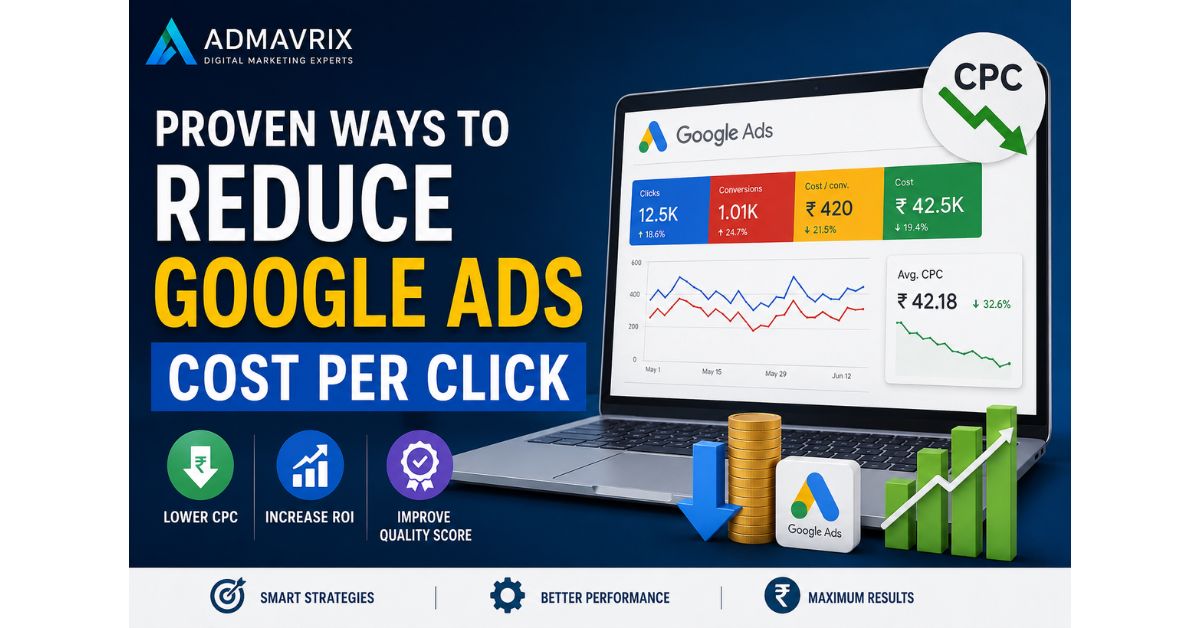
Paying too much for every click on Google Ads? Imagine reducing your Cost Per Click by 20–50% without sacrificing traffic or conversions. The good news is that it’s possible—and it starts with optimizing your campaigns the right way.
Introduction
Google Ads remains one of the most powerful digital advertising platforms. However, many businesses struggle with high advertising costs because they fail to optimize their campaigns effectively.
Lowering your Google Ads Cost Per Click (CPC) isn’t about simply reducing bids. It’s about improving your Quality Score, targeting the right audience, writing compelling ads, and creating better landing page experiences.
In this guide, Admavrix explains proven techniques that help businesses reduce CPC while increasing conversions and maximizing return on investment (ROI).
What Does Google Ads Cost Per Click Mean?
Cost Per Click (CPC) is the amount you pay each time someone clicks on your Google advertisement.
Google determines CPC based on several factors, including:
- Keyword competition
- Quality Score
- Ad relevance
- Landing page experience
- Bid strategy
- Expected Click-Through Rate (CTR)
A lower CPC means you receive more website visitors for the same advertising budget.
Key Points
- Improve Quality Score
- Target long-tail keywords
- Increase Click-Through Rate
- Optimize landing pages
- Remove poor-performing keywords
- Use negative keywords
- Test multiple ad copies
- Improve conversion rates
- Optimize bidding strategy
- Monitor campaigns regularly
Visual Introduction
Think of Google Ads like an auction.
Higher Quality Score + Better Ads + Better Landing Page = Lower CPC
Poor Quality Score + Generic Ads + Weak Landing Page = Higher CPC
The better experience you provide users, the less Google charges for each click.
Features of an Optimized Google Ads Campaign
- Highly relevant keywords
- Strong ad copy
- High Quality Score
- Fast-loading landing pages
- Mobile optimization
- Smart bidding
- Continuous optimization
- Audience targeting
- Conversion tracking
- Negative keyword management
Benefits of Reducing Google Ads CPC
- Lower advertising costs
- Higher ROI
- More clicks within the same budget
- Better conversion rates
- Improved Quality Score
- Increased campaign profitability
- Greater competitive advantage
- Better customer acquisition
Quick Insights Table
| Factor | Impact on CPC |
|---|---|
| Quality Score | Very High |
| Ad Relevance | High |
| Landing Page Experience | High |
| CTR | High |
| Keyword Competition | Medium |
| Bid Strategy | Medium |
| Negative Keywords | High |
| Conversion Rate | High |
Step-by-Step Guide to Reduce Google Ads Cost Per Click
1. Improve Your Quality Score
Quality Score is Google’s rating of your ads.
A higher Quality Score often results in lower CPC.
Focus on:
- Relevant keywords
- Better headlines
- Useful landing pages
- Faster website speed
2. Target Long-Tail Keywords
Instead of targeting:
“Digital Marketing”
Use:
“Affordable Digital Marketing Agency in Bangalore”
Long-tail keywords usually have:
- Less competition
- Lower CPC
- Better conversions
3. Use Negative Keywords
Negative keywords stop irrelevant clicks.
Example:
If you sell premium software, add:
- Free
- Jobs
- Internship
- Tutorial
This prevents wasted budget.
4. Write Better Ad Copy
Great ads improve CTR.
Higher CTR tells Google your ads are relevant.
Include:
- Focus keyword
- Benefits
- CTA
- Numbers
- Emotional triggers
Example:
Reduce Google Ads Costs by 40% | Free PPC Audit
5. Improve Landing Pages
Google rewards good user experiences.
Your landing page should have:
- Fast loading speed
- Mobile-friendly design
- Clear CTA
- Relevant content
- Trust signals
- Testimonials
6. Optimize Location Targeting
Don’t advertise everywhere.
Focus only on cities or countries where your customers actually live.
This reduces unnecessary clicks.
7. Schedule Ads Smartly
Review campaign reports.
Pause ads during low-converting hours.
Increase bids during peak conversion times.
8. Monitor Search Terms
Search Term Reports reveal what users actually searched.
Remove irrelevant keywords immediately.
Add new profitable keywords regularly.
9. Test Multiple Ads
Never rely on one advertisement.
Create at least:
- 3 Headlines
- 2 Descriptions
Google automatically identifies better-performing ads.
10. Increase Conversion Rate
A campaign with higher conversions can afford better optimization.
Improve:
- Forms
- CTA buttons
- Landing page copy
- Trust badges
- Testimonials
Small Case Study
A local eCommerce store partnered with Admavrix after struggling with expensive Google Ads campaigns.
Results after three months:
- CPC reduced by 38%
- CTR increased by 42%
- Quality Score improved from 5 to 8
- Conversion rate increased by 31%
- Cost per lead decreased significantly
The biggest improvements came from keyword optimization, better ad copy, and landing page enhancements.
Deep Explanation
Many advertisers assume that increasing bids guarantees better results.
In reality, Google values user experience more than bid amount.
A business with a Quality Score of 9 can often outrank a competitor with a higher bid but a Quality Score of 5.
This means investing in ad quality, keyword relevance, and landing page optimization can lower costs while improving ad positions.
Real Example
Suppose two companies bid on the same keyword.
Company A
Quality Score: 9
Bid: ₹40
Company B
Quality Score: 5
Bid: ₹55
Despite bidding less, Company A may still secure a higher ad position because Google rewards relevance and quality.
This results in lower CPC and better ROI.
Google Ads Trends for 2026
Several emerging trends are shaping Google Ads performance:
- AI-powered Smart Bidding
- Predictive audience targeting
- Performance Max campaigns
- First-party data strategies
- Privacy-first advertising
- Automated asset optimization
- Enhanced conversion tracking
Businesses adopting these trends early gain a competitive advantage while keeping CPC under control.
Common Mistakes
Avoid these costly errors:
- Ignoring Quality Score
- Targeting broad keywords only
- Skipping negative keywords
- Sending traffic to the homepage
- Not tracking conversions
- Writing weak ad copy
- Never testing ads
- Ignoring mobile optimization
- Running campaigns without optimization
Pro Tips
- Improve Quality Score before increasing bids.
- Use Responsive Search Ads.
- Monitor campaigns weekly.
- Pause underperforming keywords.
- Focus on high-converting audiences.
- Refresh ad creatives regularly.
- Optimize landing pages every month.
- Track every conversion accurately.
Expert Quote
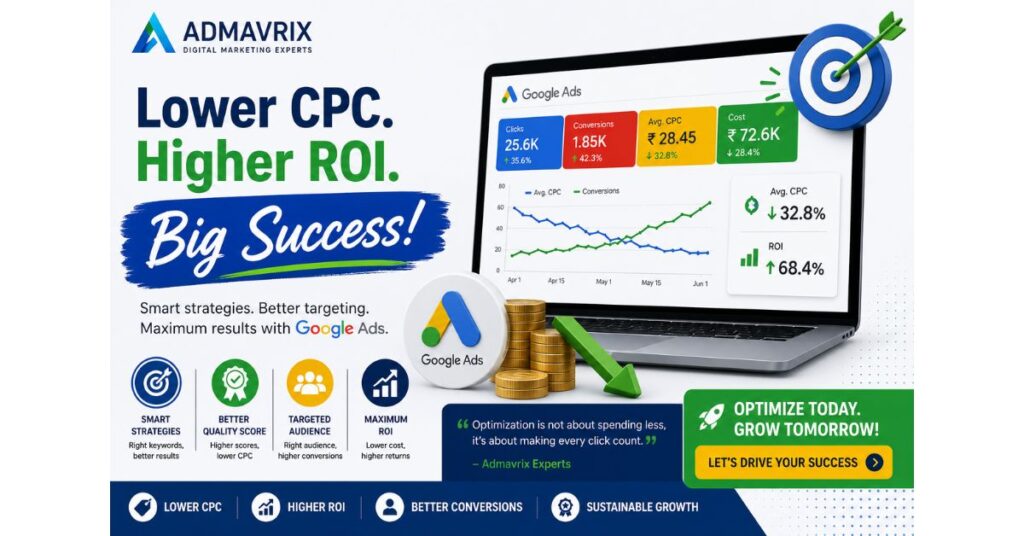
“The lowest Cost Per Click doesn’t always generate the highest ROI. Focus on relevance, Quality Score, and conversion optimization instead of simply chasing cheaper clicks.” — Admavrix PPC Team
Future Outlook
As Google’s AI continues to evolve, advertisers who combine automation with human strategy will achieve the best results.
Future campaigns will rely more on audience signals, machine learning, first-party data, and personalized experiences rather than manual bid adjustments.
Businesses that continuously optimize their campaigns will consistently enjoy lower CPC and stronger returns.
Conclusion
Reducing Google Ads Cost Per Click requires more than lowering bids. Success comes from improving Quality Score, choosing the right keywords, writing compelling ad copy, optimizing landing pages, and continuously testing campaign performance.
By following these proven strategies, businesses can reduce advertising costs, attract more qualified visitors, and generate higher conversions while maximizing every marketing dollar.
Why Choose Admavrix?
At Admavrix, we help businesses create data-driven Google Ads campaigns that deliver measurable results. Our PPC specialists focus on lowering CPC, improving Quality Score, increasing conversions, and maximizing ROI through continuous optimization and strategic campaign management.
Ready to reduce your Google Ads costs and grow your business? Contact Admavrix today for a customized PPC strategy and performance audit.
FAQ
1. What is a good Google Ads CPC?
It depends on your industry, but lower CPC combined with high conversion rates is generally ideal.
2. Does Quality Score affect CPC?
Yes. A higher Quality Score often leads to lower Cost Per Click.
3. Can negative keywords reduce CPC?
Yes. They prevent irrelevant clicks and improve campaign efficiency.
4. How often should I optimize Google Ads?
Review campaigns weekly and make optimization changes regularly.
5. Are long-tail keywords better?
Yes. They typically have lower competition, lower CPC, and higher conversion rates.
6. Should I use automated bidding?
Smart Bidding can be highly effective when supported by accurate conversion tracking and sufficient campaign data.